
AI Gaming Market Trends, Growth Opportunities and Competitive Outlook 2026–2034
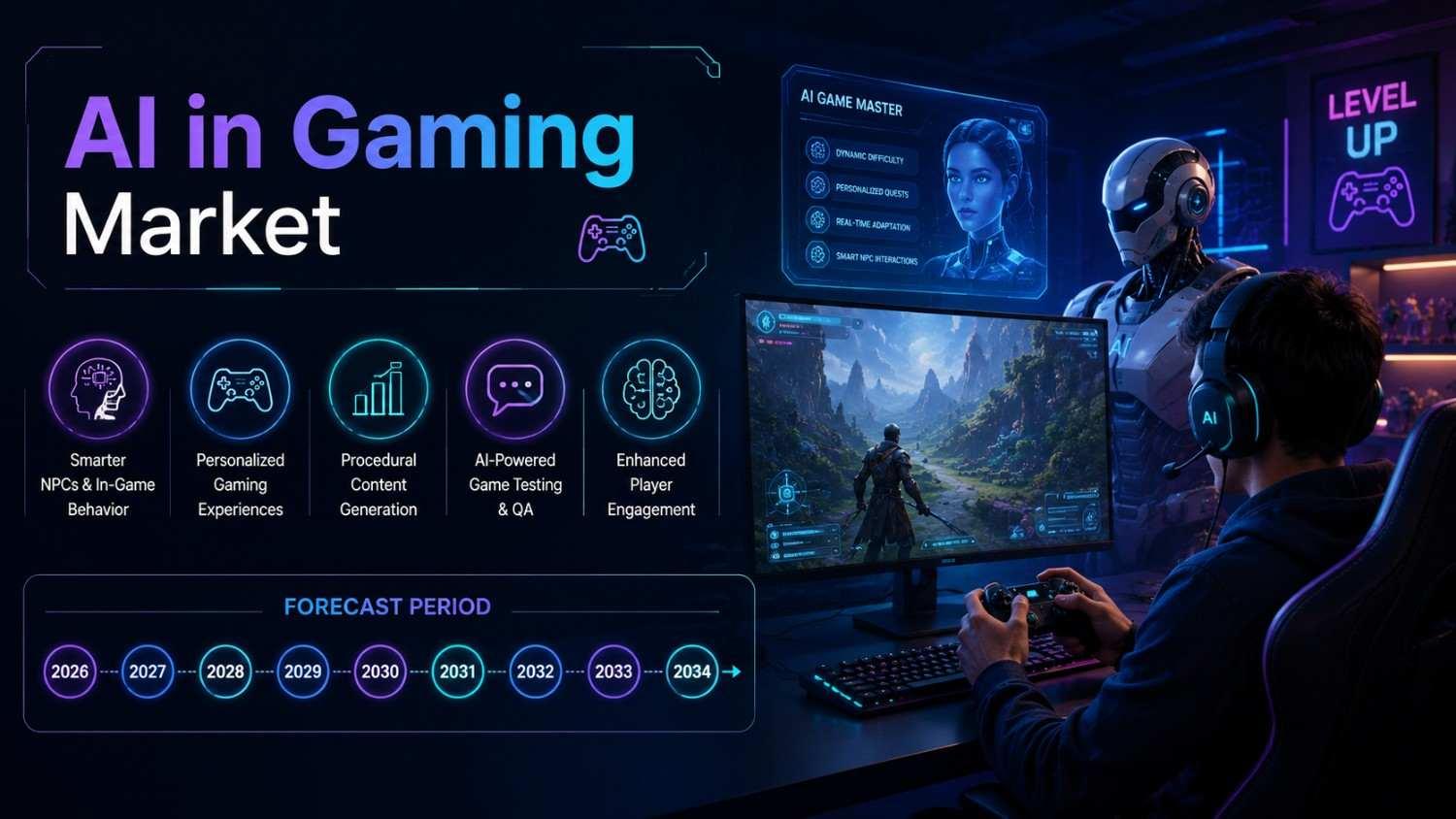
Artificial intelligence in interactive entertainment has evolved from basic scripted state machines to sophisticated deep learning models, generative AI platforms, and real-time behavioral analytics. As game publishers and studios demand faster production pipelines and richer player engagement, AI integration has become a strategic priority rather than an experimental feature.
The AI in gaming market size stood at US$ 6.22 Billion in 2025 and is predicted to grow to a value of US$ 70.66 Billion by 2034, registering a CAGR of 31.00% between 2026–2034.
Key Market Drivers
- Demand for Immersive and Adaptive Experiences: Modern gamers demand dynamic, unpredictable environments. Intelligent systems analyze continuous player interactions to adapt difficulty, dynamically balance gameplay, and tailor narratives in real time.
- Graphics Optimization and Rendering Efficiency: Deep Learning Super Sampling (DLSS), neural super-resolution, and AI frame-generation technologies allow high-end graphics to run on lower-cost devices, lowering barriers to entry for players.
- Efficiency in Production Pipelines: Procedural Content Generation (PCG) tools automatically construct sprawling terrains, complex environments, and dynamic assets. This drastically reduces studio art debt and compresses multi-year production schedules.
- Mobile and Cloud Gaming Proliferation: Expanding mobile access and cloud platform infrastructures create massive touchpoints for cloud-hosted AI engines to deliver personalized features across low-latency networks.
Market Opportunities
- Generative Non-Player Character (NPC) Interaction: Generative AI allows NPCs to understand natural language speech, display persistent emotional memory, and respond dynamically rather than relying on strict dialogue trees.
- Automated Quality Assurance and Testing: Machine learning agents can simulate thousands of simultaneous play sessions, uncovering obscure bugs, maps boundaries, and balancing weapon or character stats long before public releases.
- Real-time Anti-Cheat and Fraud Prevention: AI algorithms evaluate behavioral patterns across massive multiplayer environments to instantly flag unauthorized third-party software, boosting player trust in competitive games.
Market Segmentation
By Component
- Software: Includes core neural net engines, procedural generation tools, voice recognition systems, and analytical platforms.
- Hardware: High-performance GPUs, specialized AI accelerators, and data center servers powering local and cloud-side model inferences.
- Services: Professional consulting, system integration, custom AI model training, and managed cloud infrastructure.
By Technology
- Machine Learning & Deep Learning: Underpins dynamic AI models, predictive analytics, and image rendering algorithms.
- Generative AI: Focuses on autonomous text, asset, audio, 3D model, and environment generation.
- Natural Language Processing (NLP): Enables real-time voice command execution, dynamic dialogue systems, and multilingual translation.
By Application
- Non-Player Character (NPC) Behavior Modeling
- Game Development & Design Automation
- Quality Assurance & Game Testing
- Gameplay Optimization & Personalization
- Fraud Prevention & Anti-Cheat Analytics
By Platform
- Mobile: Dominates market share due to global smartphone adoption and cloud-driven AI personalization.
- PC & Console: Leads high-end graphics processing, complex localized AI behaviors, and physics simulations.
Market News and Recent Developments
- Generative Engine Frameworks: Leading engine providers have introduced native Generative AI suites directly into game creation tools, letting designers build 3D environments using simple text and voice prompts.
- Local Neural Inference Capabilities: Graphics processing unit vendors continue releasing architectures optimized for on-device AI workloads, reducing reliance on external servers while cutting network latency.
- Voice-Driven Gameplay Solutions: Studio integrations of natural language voice systems are letting players talk directly with in-game companions and non-playable allies, fundamentally altering game narrative structures.
Competitive Landscape Analysis
The global competitive landscape consists of hardware manufacturers, engine builders, cloud infrastructure providers, and specialized AI platforms. Ecosystem leaders focus heavily on strategic partnerships, proprietary hardware architectures, and developer toolkits to entrench their technologies across major gaming studios.
Top Industry Players
- NVIDIA Corporation
- Microsoft Corporation
- Epic Games, Inc.
- Unity Software Inc.
- Electronic Arts Inc.
- Tencent Holdings Ltd.
- Ubisoft Entertainment
- Inworld AI
Technological differentiation centers on lowering processing overhead, providing high-speed SDKs for developer environments, and maintaining real-time latency across multiplayer frameworks.
Regional Breakdown
|
Region |
Regional Characteristics |
|
North America |
Dominates overall revenue share, driven by strong tech infrastructure, early studio adoption, and leading AI research centers. |
|
Asia-Pacific |
Fastest-growing regional market, propelled by massive mobile gaming adoption, large player bases, and cloud infrastructure investments. |
|
Europe |
Displays steady growth, backed by strict regulatory compliance frameworks and strong emphasis on ethically integrated AI design tools. |
|
Rest of World |
Rapid digital infrastructure upgrades across Latin America and the Middle East continue creating fresh commercial channels. |
Future Outlook
Through 2034, artificial intelligence will fundamentally rewrite how games are created, distributed, and played. Development workflows will shift from manual content building to creative orchestration, where AI tools draft foundation assets while human designers focus on artistic direction and dynamic storytelling.
As edge-computing hardware advances, future game engines will process fully conversational characters, procedurally generated worlds, and dynamic balance adjustments entirely in real time. Studios that adopt scalable AI tools across their production pipelines will enjoy shorter release cycles, reduced overhead, and significantly higher player retention over the next decade.
The Insight Partners provides comprehensive syndicated and tailored market research services in the healthcare, technology, and industrial domains. Renowned for delivering strategic intelligence and practical insights, the firm empowers businesses to remain competitive in ever-evolving global markets.
• Email: sales@theinsightpartners.com
• Website: theinsightpartners.com
• Phone: +1-646-491-9876

 Arabic
 French
 Spanish
 Portuguese
 Deutsch
 Turkish
 Dutch
Dutch
 Italiano
 Russian
 Romaian
 Portuguese (Brazil)
 Greek
Greek
