
AI-Based Image Analysis Industry Market Size and Future Growth Prospects 2034
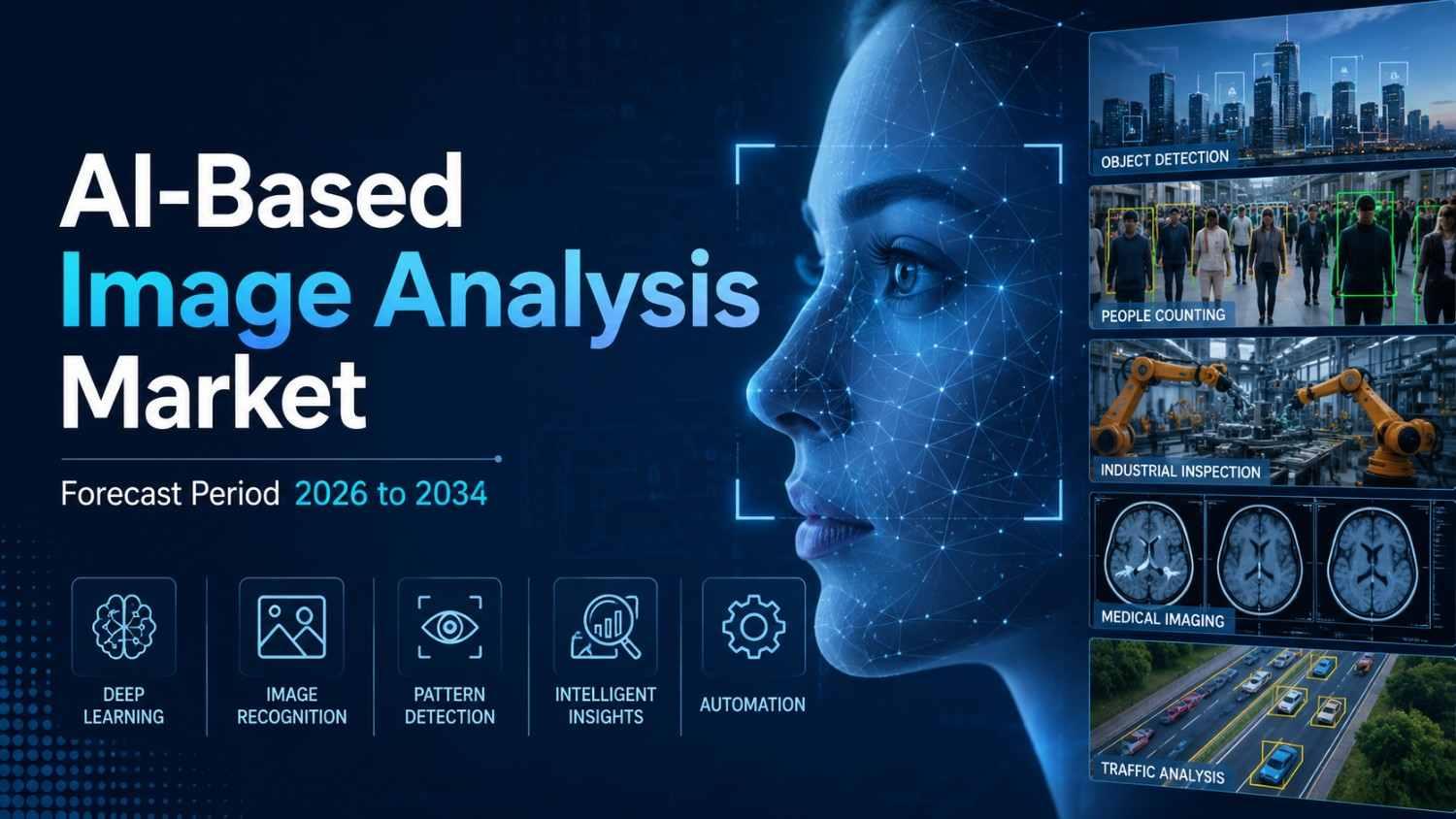
The AI-based image analysis market is experiencing rapid expansion, driven by the integration of artificial intelligence, deep learning, and advanced computer vision technologies across diverse industrial verticals. AI-based image analysis systems automate visual processing, enabling automated identification, feature extraction, object detection, and precise classification without requiring manual intervention.
The AI-based image analysis market was valued at US$ 13.27 Billion in 2025 and is projected to reach US$ 68.52 Billion by 2034, expanding at a CAGR of 22.78% during 2026–2034.
Key Market Drivers
- Rising Demand for Automation in Manufacturing: Industrial enterprises are increasingly embedding AI vision software into production lines for automated surface defect detection, precise assembly line inspection, and operational quality control.
- Healthcare Digitalization and Medical Imaging: The medical sector is heavily deploying deep learning algorithms to evaluate complex radiological scans, such as MRIs, X-rays, and CT scans. These solutions assist radiologists by detecting early-stage anomalies, accelerating clinical workflows, and minimizing diagnostic error rates.
- Shift Toward Edge Computing Infrastructure: The rapid rise of edge AI allows visual processing to occur locally on devices, drones, industrial robots, and smart cameras. Processing data at the edge minimizes network latency, reduces cloud bandwidth expenditures, and fulfills strict real-time response requirements for time-critical systems.
- Expansion of Smart Cities and Automated Surveillance: Governments and urban infrastructure developers are deploying AI-driven video analytics to bolster public safety, automate traffic monitoring, and optimize crowd management.
Strategic Growth Opportunities
- Autonomous Vehicles and Advanced Driver Assistance: The growth of self-driving and semi-autonomous vehicles opens large revenue avenues. Computer vision algorithms process visual sensor feeds in real time, executing lane detection, pedestrian classification, sign recognition, and collision avoidance.
- Retail Visual Search and Automated Inventory Analytics: E-commerce operators and brick-and-mortar retailers are deploying visual AI algorithms to power visual search tools, track shelf stock levels dynamically, and evaluate customer foot-traffic patterns.
- Explainable AI (XAI) for Regulated Sectors: High-stakes industries like healthcare, finance, and defense require algorithmic transparency. Developing interpretable AI models that explain image categorization pathways provides commercial advantages for enterprise solution providers.
Market Segmentation
By Deployment Type
- Cloud-based Deployment: Represents the largest overall revenue share due to high scalability, cost-effective maintenance, and access to high-performance cloud processing nodes.
- On-Premises Deployment: Preferred by highly regulated financial institutions, defense agencies, and healthcare facilities that demand strict data governance and localized storage control.
- Hybrid / Edge Deployment: Experiencing swift adoption across automotive and manufacturing environments due to zero-latency processing demands.
By Algorithm
- Deep Learning: Dominates total revenue share, using convolutional neural networks (CNNs) and transformer frameworks to extract granular features from unstructured image datasets.
- Machine Learning & Pattern Recognition: Widely used for lighter computational tasks, structured image sorting, and classical visual classification routines.
By Application
- Medical Imaging & Diagnostics: Forms the largest single application segment, powered by high clinical adoption rates.
- Industrial Defect Inspection: Demonstrates sustained growth across electronics, automotive, and semiconductor production lines.
- Security, Surveillance & Object Tracking: Focuses on real-time event alerts, perimeter defense, and public safety infrastructure.
- Autonomous Navigation: Projected to generate accelerated long-term growth as autonomous mobilities scale commercial deployment.
Market Analysis Competitive Landscape
The competitive environment is characterized by intense consolidation, joint ventures, technological partnerships, and heavy investment in software research and development. Established cloud providers, specialized computer vision vendors, and industrial automation providers dominate market shares.
Key strategy trends include launching lightweight microservices for edge devices, acquiring specialized AI startups, and securing regulatory approvals for diagnostic tools.
Top Key Players
- NVIDIA Corporation: Industry leader providing high-performance GPU hardware acceleration, software development kits, and enterprise platforms.
- Microsoft Corporation: Offers enterprise-grade cloud vision APIs, customizable machine learning models, and hybrid AI computing solutions.
- Alphabet Inc. (Google): Delivers scalable cloud vision frameworks, AutoML capabilities, and advanced neural architecture toolkits.
- Amazon Web Services (AWS): Provides robust image and video analytics microservices tailored for enterprise workflows.
- IBM Corporation: Develops enterprise computer vision systems for industrial inspection, visual intelligence, and asset management.
- Siemens Healthineers / Siemens AG: Focuses on AI-integrated industrial vision platforms alongside medical diagnostic imaging systems.
- Intel Corporation: Provides dedicated vision processing units, open-source computer vision software libraries, and edge computing chips.
- SenseTime Group: Specializes in deep learning algorithms, facial recognition systems, and large-scale urban visual analytics platforms.
Market News and Recent Developments
- Edge AI Chips and Acceleration Modules: Leading hardware manufacturers continue launching energy-efficient neural processing units (NPUs) optimized to execute complex vision models directly inside compact IoT devices.
- Expansion of Healthcare Clearances: Global regulatory bodies are expediting approval processes for medical-grade AI diagnostics, accelerating software commercialization across public and private hospital systems.
- Strategic Mergers and Tech Acquisitions: Cloud software providers are actively acquiring niche computer vision startups to integrate specialized vision capabilities into broad enterprise platforms.
- Integration of Generative AI and Vision Language Models: Developers are combining generative algorithms with classic computer vision systems, enabling multi-modal models that synthesize visual data and answer natural language queries about image contents.
Future Outlook
Looking toward 2034, the market will move toward fully autonomous, real-time visual reasoning systems. Key developments will center around context-aware visual models, zero-shot learning frameworks, and localized processing that operates independently of cloud connections. As deep learning architectures become more energy-efficient, AI-based image analysis will become a standard, ubiquitous component of industrial machinery, medical equipment, consumer devices, and public infrastructure worldwide.
The Insight Partners provides comprehensive syndicated and tailored market research services in the healthcare, technology, and industrial domains. Renowned for delivering strategic intelligence and practical insights, the firm empowers businesses to remain competitive in ever-evolving global markets.
• Email: sales@theinsightpartners.com
• Website: theinsightpartners.com
• Phone: +1-646-491-9876

 English
 Arabic
 Spanish
 Portuguese
 Deutsch
 Turkish
 Dutch
Dutch
 Italiano
 Russian
 Romaian
 Portuguese (Brazil)
 Greek
Greek
