
The Fascinating Role of Reptiles in M.C. Escher's Art
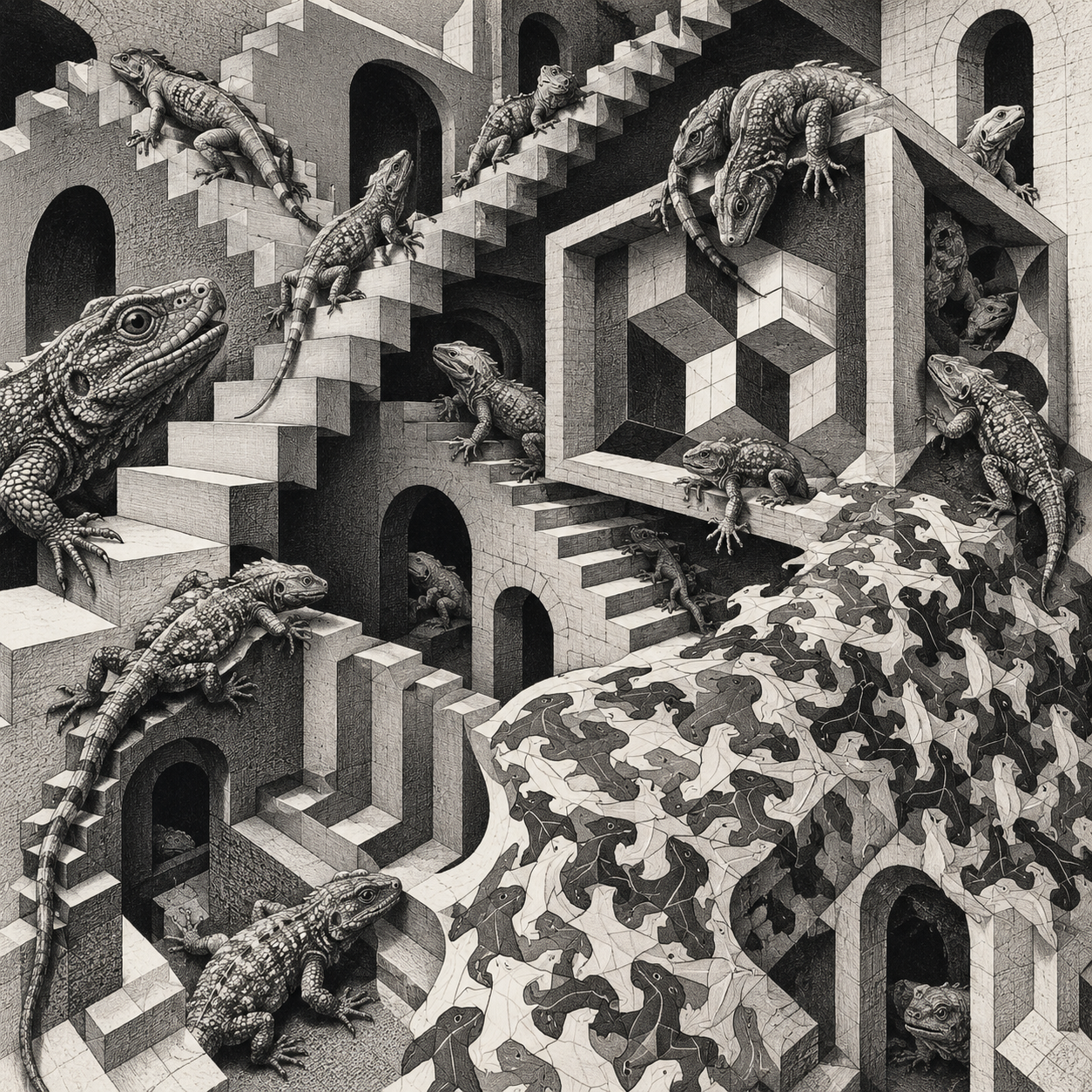
M.C. Escher is known for transforming ordinary subjects into extraordinary visual experiences. Across his career, he explored mathematical patterns, symmetry, reflections, impossible architecture, and the relationship between recognizable forms. Animals were also an important part of his artistic vocabulary, particularly when they could be incorporated into repeating patterns or transformations.
Among the creatures that appear in his work, the lizard holds a special place. Through carefully arranged forms and imaginative compositions, Escher demonstrated how a familiar animal could become part of a much larger exploration of geometry and perception. Examining the M.C. Escher lizard imagery provides a fascinating way to understand the artist's approach to transformation and tessellation.
Escher's Interest in Animals and Nature
Nature provided Escher with an important source of inspiration. He studied landscapes, plants, animals, and architectural details with extraordinary attention, often using drawings to explore their shapes and structures.
Animals were particularly useful for his experiments with tessellation because their recognizable forms could be repeated, transformed, and arranged in complex patterns. Instead of treating a creature as an isolated subject, Escher could use its silhouette as a building block for an entire composition.
The lizard became especially effective for this purpose because its elongated body, legs, and distinctive shape could be incorporated into geometric arrangements while remaining recognizable.
Understanding the M.C. Escher Lizard
The M.C. Escher lizard is strongly associated with one of his most memorable explorations of tessellation and transformation. In compositions featuring lizards, Escher arranged repeated figures so that they fitted together in an intricate visual pattern.
What makes these images particularly engaging is the tension between individuality and repetition. Each lizard remains recognizable, yet it also becomes one element within a larger structure. The repeated figures demonstrate how a single natural form can become part of a carefully organized geometric system.
This approach reflects Escher's broader fascination with the relationship between order and imagination. A natural creature becomes a mathematical component without losing its visual character.
Tessellation as a Creative Tool
Tessellation was more than a mathematical concept for Escher. It became a creative language through which he could explore transformation, symmetry, and continuity.
A successful tessellation requires shapes to fit together precisely. Escher pushed this concept further by using recognizable subjects instead of abstract geometric forms. His figures could gradually change, overlap, or interact in ways that made the overall composition feel dynamic.
The lizard was well suited to this process. Its shape provided enough flexibility to create repeated patterns while allowing Escher to experiment with orientation, scale, and transformation.
For viewers, the result is an image that can be appreciated from two perspectives. From a distance, the overall pattern creates a strong visual impression. Up close, individual figures reveal the craftsmanship and planning behind the composition.
From Lizard to Other Forms
One of Escher's most fascinating artistic techniques was transformation. Rather than simply repeating a figure, he sometimes explored how one form could gradually become another.
This idea appears throughout his body of work. Birds can become fish, geometric shapes can develop into animals, and recognizable figures can transition into abstract patterns.
The lizard imagery fits naturally into this broader artistic philosophy. It demonstrates Escher's ability to take something familiar and place it within a visual system that challenges ordinary expectations.
This transformative quality is one reason M.C. Escher works continue to attract both art enthusiasts and collectors. His compositions are not merely decorative patterns; they are carefully constructed visual ideas.
Why Escher's Animal Imagery Remains Popular
Animal-themed Escher works have a distinctive appeal because they combine recognizable subjects with complex visual structures. A viewer can immediately identify the animal while simultaneously appreciating the mathematical organization surrounding it.
This accessibility makes Escher's work appealing to audiences with different interests. Someone interested in wildlife may be drawn to the animals, while someone fascinated by mathematics may focus on tessellation and symmetry.
Collectors can also appreciate the technical precision required to create these compositions. Fine lines, carefully calculated forms, and intricate repetition demonstrate the discipline behind Escher's seemingly effortless illusions.
Discovering M.C. Escher Works at Walker Fine Art
For collectors interested in exploring Escher's artistic legacy, Walker Fine Art offers a specialized collection of M.C. Escher works. Examining original pieces provides an opportunity to appreciate the details, craftsmanship, and techniques that can be difficult to fully understand through reproductions alone.
Exploring different mc escher works can also reveal how his ideas developed across different subjects. His fascination with animals, geometry, reflection, perspective, and infinity appears in numerous forms throughout his career.
For those particularly interested in the mc escher lizard, studying the work within the larger context of his artistic practice can make its significance even more apparent.
A Lasting Lesson in Creativity
M.C. Escher demonstrated that even the most familiar subjects can become extraordinary when viewed from a different perspective. His lizard imagery transforms a recognizable creature into part of a sophisticated exploration of repetition, geometry, and visual perception.
That ability to combine nature with mathematical structure remains one of the defining qualities of his art. Through M.C. Escher works, viewers can discover how careful observation and imaginative thinking can produce images that continue to surprise generations later.

 English
 Arabic
 French
 Spanish
 Portuguese
 Deutsch
 Turkish
 Dutch
Dutch
 Italiano
 Russian
 Romaian
 Portuguese (Brazil)
