
Artificial Sweetener Market to Reach USD 15.6 Billion by 2036
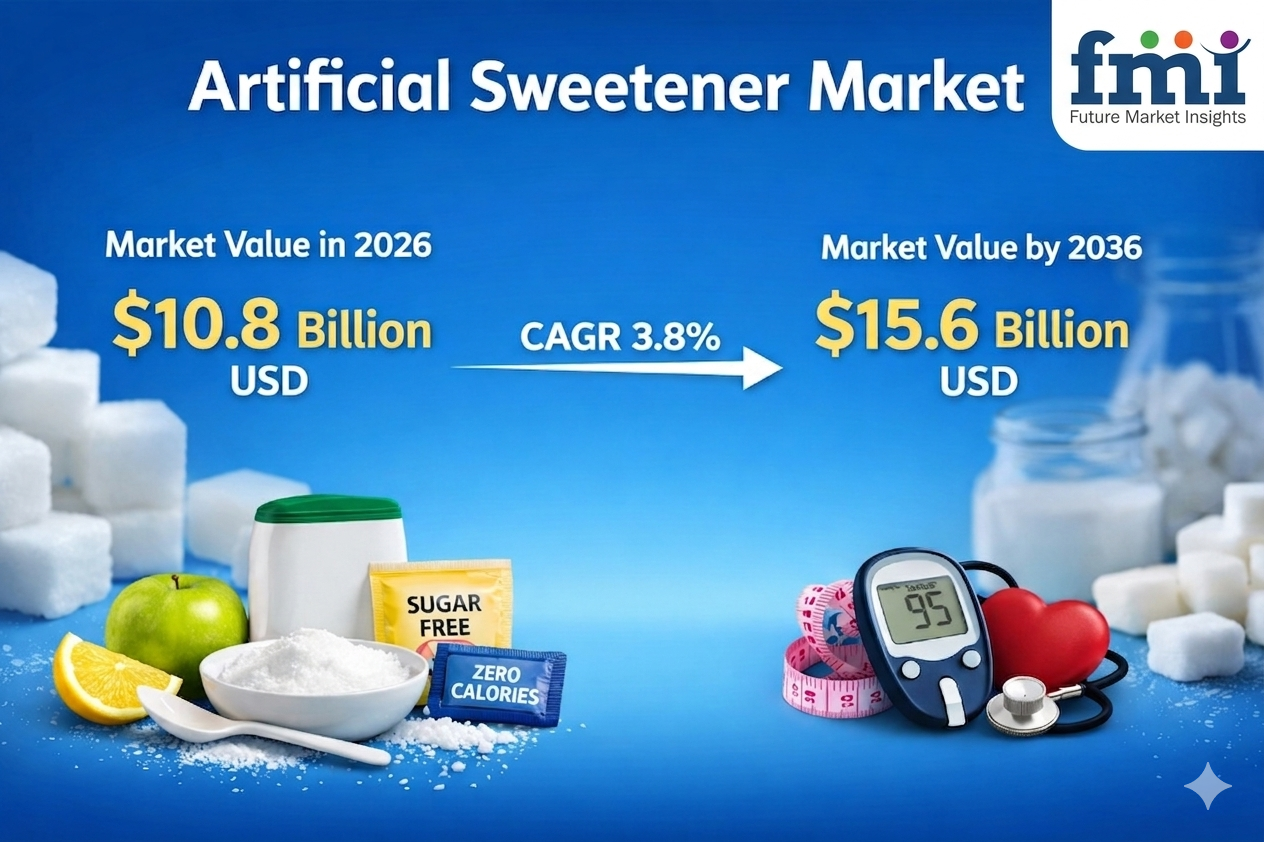
The Artificial Sweetener Market is entering a steady growth phase as rising health awareness, increasing diabetes prevalence, and demand for low-calorie food alternatives reshape global consumption patterns. Valued at approximately USD 10.8 billion in 2026, the market is projected to expand to USD 15.6 billion by 2036, reflecting a CAGR of 3.8% over the forecast period.
According to industry insights, growth is no longer driven solely by sugar substitution but by a broader shift toward healthier lifestyles, weight management, and functional food consumption. Consumers are actively seeking alternatives that provide sweetness without the caloric impact of traditional sugar.
Request Sample Report - https://www.futuremarketinsights.com/reports/sample/rep-gb-95
The Health Shift: From Sugar Reduction to Smart Sweetening
For decades, artificial sweeteners were primarily used as sugar substitutes in diet beverages. However, the market has evolved significantly. Consumers are now adopting these ingredients as part of long-term health strategies aimed at reducing calorie intake and managing blood glucose levels.
Low-calorie and zero-calorie sweeteners such as aspartame, sucralose, and stevia-based blends are gaining widespread acceptance. These ingredients are increasingly used across beverages, bakery products, dairy, and packaged foods to meet changing dietary preferences.
Technology Intensification: Advancing Taste and Stability
One of the key growth drivers in the artificial sweetener market is continuous innovation in formulation technologies. Manufacturers are focusing on improving taste profiles, reducing aftertaste, and enhancing stability under various processing conditions.
Advancements include:
- High-intensity sweeteners with improved flavor masking
- Heat-stable formulations for baking and processed foods
- Blended sweetener systems for better taste balance
- Clean-label and plant-based sweetener alternatives
These innovations are enabling manufacturers to expand applications while maintaining product quality and consumer acceptance.
Recurring Demand Backbone: Processed and Packaged Foods
The increasing consumption of processed and packaged foods continues to drive consistent demand for artificial sweeteners. Food and beverage manufacturers rely on these ingredients to maintain sweetness while reducing overall calorie content.
Applications span across soft drinks, flavored dairy products, confectionery, and ready-to-eat meals. As urbanization and busy lifestyles fuel demand for convenience foods, artificial sweeteners remain a critical component in product formulation.
Regional Dynamics: North America Leads, Asia-Pacific Accelerates
North America remains a dominant market due to high consumer awareness, strong presence of health-conscious populations, and widespread availability of low-calorie food products. Regulatory approvals and established product portfolios further support market stability.
Asia-Pacific is emerging as a high-growth region, driven by rising diabetes rates, increasing disposable incomes, and expanding food processing industries. Countries such as China and India are witnessing growing adoption of sugar alternatives in both urban and semi-urban markets.
Navigating Constraints: Regulatory and Perception Challenges
Despite steady growth, the market faces challenges related to regulatory scrutiny and consumer perception. Artificial sweeteners must comply with strict safety standards, and approval processes can vary across regions.
Additionally, some consumers remain skeptical about synthetic ingredients, prompting manufacturers to invest in transparency, labeling, and natural-origin alternatives to build trust and acceptance.
Competitive Landscape: Innovation and Clean-Label Focus
Competition in the artificial sweetener market is centered around innovation, product diversification, and clean-label positioning. Companies are focusing on developing advanced formulations that deliver improved taste while aligning with health and wellness trends.
Key strategies include expanding plant-based sweetener portfolios, enhancing research and development capabilities, and introducing blended solutions that replicate sugar-like taste more effectively.
The Outlook: Health-Driven Consumption to Shape Future Growth
The future of the artificial sweetener market is closely linked to evolving dietary habits and increasing focus on preventive healthcare. As consumers continue to prioritize low-calorie and functional foods, demand for advanced sweetening solutions is expected to rise steadily.
By 2036, artificial sweeteners will play a vital role in supporting healthier food systems, enabling manufacturers to balance taste, nutrition, and functionality across a wide range of applications.
For an in-depth analysis of evolving formulation trends and to access the complete strategic outlook for the Artificial Sweetener Market through 2036, Full Report Request -
https://www.futuremarketinsights.com/reports/global-artificial-sweeteners-market

 Arabic
 French
 Spanish
 Portuguese
 Deutsch
 Turkish
 Dutch
Dutch
 Italiano
 Russian
 Romaian
 Portuguese (Brazil)
 Greek
Greek