
AI-Based Climate Modelling Market Size and Growth Analysis by Technology, Deployment, and Application
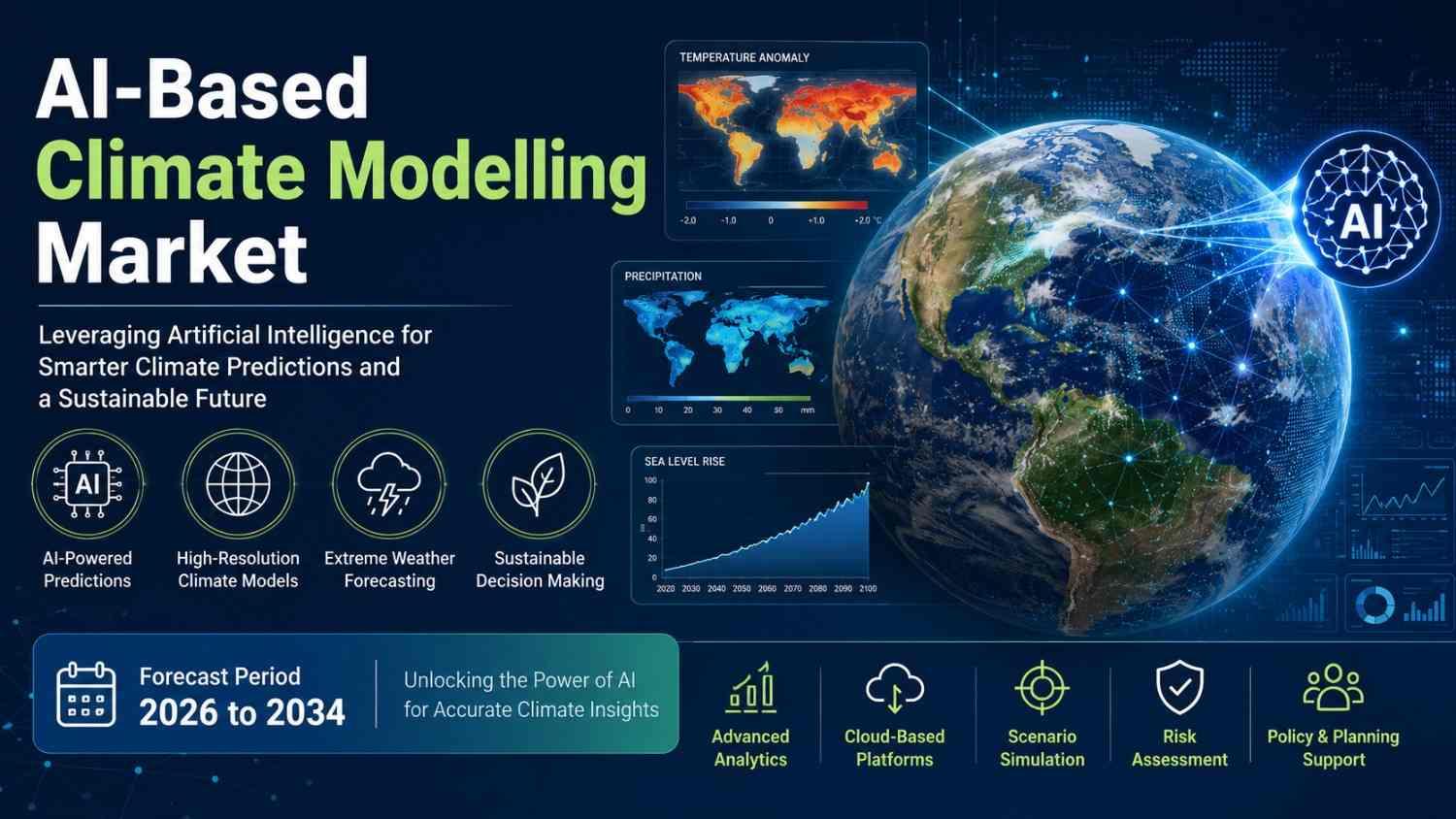
The global AI-based climate modelling market is experiencing rapid expansion, driven by the urgent need for high-resolution environmental predictions, improved disaster preparedness, and precise ESG analytics. Traditional numerical weather prediction and physical climate models, while foundational, often require massive supercomputing power and lengthy compute times. AI-based climate modelling integrates deep learning, generative neural networks, and machine learning algorithms with multi-petabyte datasets gathered from satellites, remote sensing devices, and IoT sensors.
The AI-based climate modelling market was valued at US$ 388 Million in 2025 and is projected to reach US$ 2,045 Million by 2034, advancing at a CAGR of 19.4% during 2026–2034
Market Drivers
- Increasing Frequency of Extreme Weather Events: Rising global temperatures have multiplied the severity and frequency of severe heatwaves, catastrophic flooding, wildland fires, and severe tropical cyclones. Governments and private entities rely heavily on AI to improve early warning systems and minimize economic losses.
- Demand for Corporate Climate Risk Disclosure & ESG Compliance: Regulatory mandates across the North American and European markets require financial institutions and multinational corporations to disclose physical climate risks to assets and supply chains. AI climate models deliver downscaled, location-specific impact scenarios that help fulfill reporting obligations.
- Advancements in Deep Neural Networks and Physics-Informed Machine Learning (PIML): The emergence of physics-informed AI frameworks ensures that machine learning algorithms obey fundamental laws of thermodynamics and fluid dynamics. This significantly boosts user confidence in long-term probabilistic climate projections.
Strategic Opportunities
- Hyper-Local Forecasting for Agriculture and Logistics: Standard global models offer low spatial resolution, often spanning grids of tens of kilometers. AI platforms create scalable opportunities for hyper-local climate and micro-weather models, helping agricultural producers optimize irrigation, crop rotation, and harvest scheduling.
- Renewable Energy Grid Integration: Intermittent solar and wind power generation requires precise short-term forecasting of cloud coverage, wind patterns, and surface solar irradiance. AI-driven climate software offers utility providers predictive intelligence to optimize energy storage and grid balancing.
- Public-Private Partnerships and Cloud Infrastructure Collaboration: Strategic alliances between cloud software providers, academic institutions, and space agencies present untapped expansion opportunities. Integrating AI weather modeling models into cloud platforms lowers adoption barriers for regional enterprise users.
Market Segmentation Analysis
By Component
- Software: Software applications dominate the market share. Software tools digest structured climate archives, atmospheric datasets, and satellite feeds to execute spatial risk simulations and micro-climate mapping.
- Hardware: Comprises specialized AI processing hardware, custom accelerators, and cloud edge infrastructure required to train compute-heavy deep learning networks.
- Services: Encompasses consulting, platform deployment, model calibration, and managed risk assessment services catered to enterprise environments.
By Technology
- Machine Learning: Represents a primary technology segment due to widespread adoption in predictive weather analysis and dataset pattern recognition.
- Deep Learning & Neural Networks: Experiencing fast adoption due to superior performance in processing unstructured spatial-temporal imagery, satellite photographs, and complex oceanographic data.
- Natural Language Processing & Computer Vision: Utilized for automated risk monitoring, satellite image interpretation, and policy document extraction.
By Deployment
- Cloud-Based: Cloud deployments account for the dominant revenue share due to their scalable compute power, elasticity, and seamless cross-border data integration.
- On-Premise: Adopted by highly secure government research labs, defense agencies, and specialized meteorological bureaus needing localized control over confidential environmental datasets.
By Application
- Weather Forecasting: Dominates the application landscape as meteorologists shift toward AI emulators to accelerate weather prediction cycles.
- Disaster Risk Reduction & Early Warning Systems: Deployed for flood mapping, wildfire propagation modeling, and hurricane track estimation.
- Environmental Monitoring & Ecosystem Protection: Used to monitor deforestation, track carbon sequestration, and assess ocean acidification dynamics.
- Climate Risk Assessment & Supply Chain Resilience: Employed by asset managers, real estate developers, and insurers to map physical infrastructure risks.
By End User
- Government & Public Sector Agencies: National meteorological offices, defense bodies, and urban planning agencies.
- Research & Academic Institutions: Environmental science departments and supercomputing research consortiums.
- Enterprise Sector: Insurance companies, agricultural firms, energy & utility providers, and logistics entities.
Market News and Recent Developments
- High-Resolution AI Emulator Deployments: Leading technology enterprises have introduced transformer-based global weather emulators capable of generating medium-range planetary forecasts in seconds, outperforming traditional physical supercomputer forecasts in speed and energy efficiency.
- Federal Environmental AI Initiatives: Organizations such as the National Oceanic and Atmospheric Administration (NOAA) and the European Centre for Medium-Range Weather Forecasts (ECMWF) continue to expand strategic pilot projects integrating commercial AI platforms into official forecasting operational pipelines.
- Capital Inflows into Climate-Tech Startups: Specialized climate risk startups focusing on physics-informed neural networks and sub-seasonal AI prediction models continue to attract substantial venture capital funding to accelerate commercial enterprise offerings.
Competitive Landscape and Top Market Players
The market exhibits an evolving competitive structure characterized by technology hyperscalers, global IT providers, and niche climate analytics specialists. Established technology leaders provide foundational supercomputing infrastructure, cloud frameworks, and AI foundation models. Simultaneously, domain-specific climate startups develop targeted applications for enterprise risk management, hyper-local forecasting, and crop yield optimization.
Strategic partnerships between platform creators, academic bodies, and global re-insurance providers remain a vital strategy to secure market share and enhance model accuracy.
Top Key Players:
- IBM Corporation
- Microsoft Corporation
- Alphabet Inc. (Google DeepMind)
- NVIDIA Corporation
- ClimateAi
- Jupiter Intelligence
- AccuWeather, Inc.
- Atmo Inc.
- Open Climate Fix
Future Outlook
Looking ahead to 2034, the AI-based climate modelling industry will transition from standalone experimental frameworks to essential core infrastructure powering global decision making. As physics-informed deep learning models improve, global climate prediction will shift from macro-level projections toward highly accurate sub-kilometer hyper-local forecasting. Furthermore, the convergence of quantum computing with AI neural networks promises to unlock unprecedented simulation speeds for complex ocean and atmosphere dynamics. Enterprise adoption will become ubiquitous as climate risk intelligence integrates directly into corporate ERP systems, supply chain management tools, and financial underwriting platforms.
The Insight Partners provides comprehensive syndicated and tailored market research services in the healthcare, technology, and industrial domains. Renowned for delivering strategic intelligence and practical insights, the firm empowers businesses to remain competitive in ever-evolving global markets.
• Email: sales@theinsightpartners.com
• Website: theinsightpartners.com
• Phone: +1-646-491-9876

 English
 Arabic
 French
 Spanish
 Portuguese
 Turkish
 Dutch
Dutch
 Italiano
 Russian
 Romaian
 Portuguese (Brazil)
 Greek
Greek
