
SUV Leadership Strengthens Global Cars Market Growth Outlook
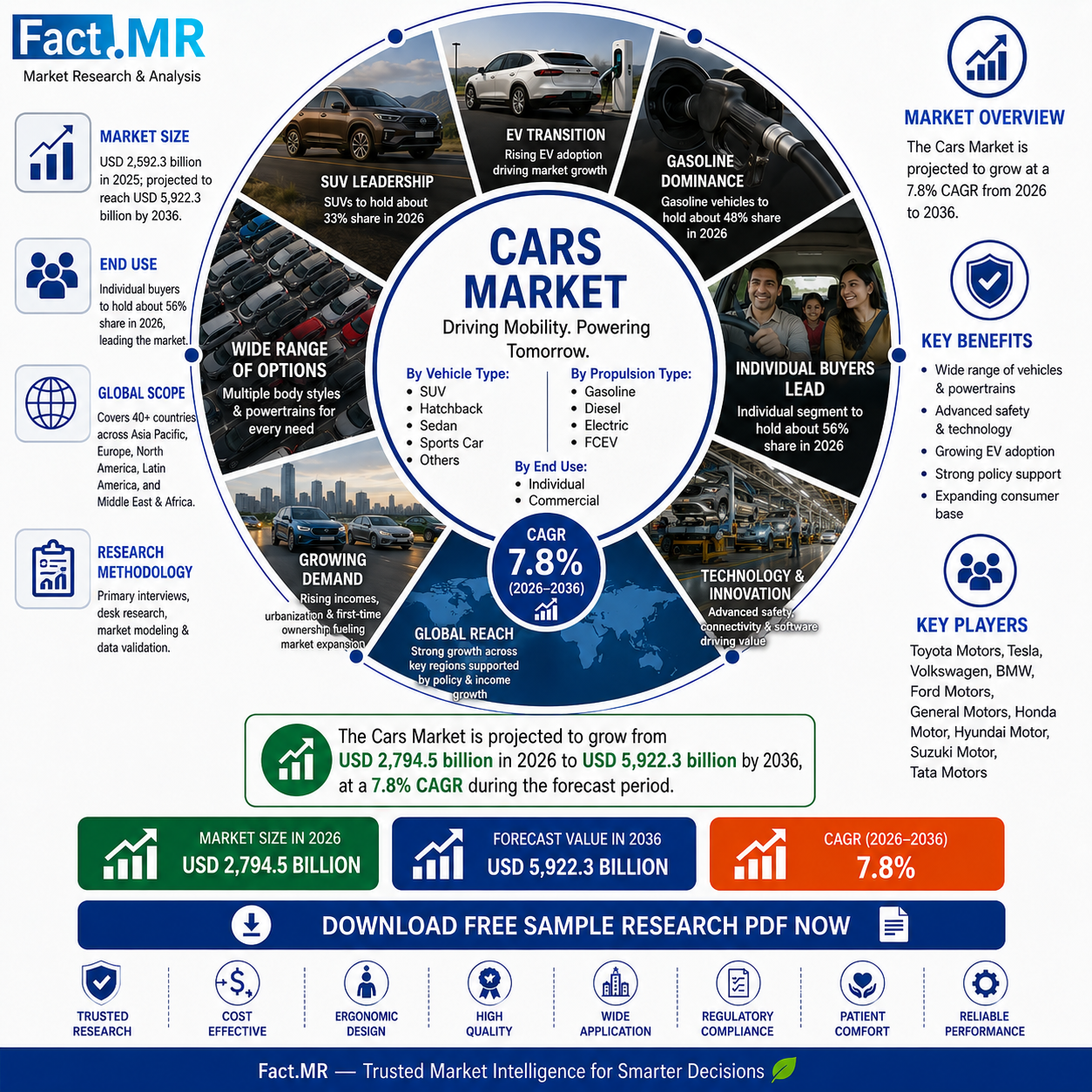
Subhead: USD 2,794.5 billion in 2026 | USD 5,922.3 billion by 2036 | 7.8% CAGR
[August 19, 2026] — The global cars market is estimated at USD 2,794.5 billion in 2026 and is projected to reach USD 5,922.3 billion by 2036, expanding at a 7.8% CAGR from 2026 to 2036, according to Fact.MR analysis. The market was valued at USD 2,592.3 billion in 2025. The forecast represents an absolute dollar opportunity of USD 3,127.8 billion between 2026 and 2036.
Why the Cars Market Is Growing
Market expansion is supported by rising personal vehicle ownership in emerging economies, higher vehicle prices linked to advanced technology, and the shift toward electric vehicles. Rising middle-class income in China, India, and Southeast Asia is supporting first-time car purchases, especially SUVs and hatchbacks. EV incentives in the United States and India are also supporting electric car sales. At the same time, EU carbon rules and 2035 zero-emission targets are pushing automakers toward electric drivetrains.
Growth may face limits from battery raw material supply constraints, affordability issues in developing markets, and changing geopolitical trade barriers. Fact.MR also identifies income growth, urban mobility expansion, EV adoption, and premium vehicle technology as major forces shaping demand.
Get detailed market forecasts, competitive benchmarking, and pricing trends: https://www.factmr.com/connectus/sample?flag=S&rep_id=14522
Third-Party Market Evidence
Several dated statistics cited on the Fact.MR page support the market shift. OICA, January 2025, reported that global SUV and crossover production reached 48% of passenger car output in 2024, highlighting strong demand for these vehicle types. China's Ministry of Industry and Information Technology, January 2025, reported that China's NEV market reached 12.9 million units in 2024. ACEA, January 2025, reported that diesel passenger-car share in the European Union declined to 13.4% in 2024 as gasoline hybrids and electric vehicles gained ground.
Key Numbers
|
Metric |
Value |
|
Market value, 2025 |
USD 2,592.3 billion |
|
Estimated value, 2026 |
USD 2,794.5 billion |
|
Forecast value, 2036 |
USD 5,922.3 billion |
|
CAGR, 2026–2036 |
7.8% |
|
Absolute dollar opportunity |
USD 3,127.8 billion |
|
SUV share, 2026 |
Approximately 33% |
|
Gasoline share, 2026 |
Approximately 48% |
|
Individual end-use share, 2026 |
Approximately 56% |
Source: Fact.MR analysis. Third-party statistics are attributed to the named sources above.
Segment Breakdown
Vehicle Type: SUVs are expected to hold approximately 33% share in 2026. Fact.MR links this position to utility, elevated seating, safety features, spacious interiors, and premium technology content.
Propulsion Type: Gasoline vehicles are projected to account for approximately 48% share in 2026. Established refuelling networks, lower upfront costs, and driving range continue to support gasoline demand.
End Use: Individual buyers hold approximately 56% share in 2026. Personal vehicle ownership remains a major source of global passenger-car demand.
Country Growth Outlook
|
Country |
CAGR, 2026–2036 |
|
China |
10.3% |
|
India |
9.9% |
|
Germany |
8.4% |
|
Brazil |
7.0% |
|
United States |
6.8% |
|
United Kingdom |
6.0% |
|
Japan |
5.5% |
China leads major markets with a 10.3% CAGR, supported by NEV competition and premium SUV demand. India follows at 9.9%, driven by first-time ownership, income growth, urbanisation, and EV incentives. Germany is forecast at 8.4%, while Brazil is expected to grow at 7.0%. The United States is projected at 6.8%, the United Kingdom at 6.0%, and Japan at 5.5%.
Competitive Landscape
The market is moderately concentrated in premium segments and highly competitive in mass-market segments. Fact.MR identifies Toyota, Volkswagen Group, Hyundai-Kia, Stellantis, and General Motors as groups with the largest combined passenger-vehicle production volumes globally, with each selling more than 3 million cars annually.
The source does not publish individual company market-share percentages, so no company share figures are added here. Competition is increasingly focused on EV range, charging speed, software-defined features, battery integration, and total cost of ownership. Tesla and Chinese OEMs such as BYD are highlighted for software integration, battery vertical integration, and EV pricing strategies. Key profiled companies include Toyota Motors, Tesla, Volkswagen, BMW, Ford Motors, General Motors, Honda Motor, Hyundai Motor, Suzuki Motor, and Tata Motors.
Analyst Perspective
Shambhu Nath Jha, Principal Consultant at Future Market Insights, wrote that “CXOs will find the market’s 7.8% CAGR through 2036 driven by a dual growth engine of Asia Pacific first-time ownership expansion.” The published commentary also identifies developed-market EV technology premiumisation and sustained SUV leadership as important growth factors.
Frequently Asked Questions
How large is the cars market in 2025?
The cars market was valued at USD 2,592.3 billion in 2025, according to Fact.MR.
What will the cars market be worth in 2036?
The market is projected to reach USD 5,922.3 billion by 2036.
What is the cars market CAGR?
Fact.MR projects a 7.8% CAGR from 2026 to 2036.
Which vehicle type leads the market?
SUVs lead with approximately 33% share in 2026.
Which country has the fastest projected growth?
China has the highest listed country CAGR at 10.3% from 2026 to 2036.
About the Report
The Fact.MR cars market study covers passenger cars by vehicle type, propulsion type, end use, region, and country. The forecast period runs from 2026 to 2036. The research uses a hybrid top-down and bottom-up model based on vehicle registration volumes, average selling prices, income growth projections, EV adoption forecasts, OEM data, and primary interviews.

 English
 Arabic
 French
 Spanish
 Portuguese
 Deutsch
 Turkish
 Dutch
Dutch
 Italiano
 Russian
 Romaian
 Portuguese (Brazil)
