
Managed SIEM Service in India: A Safer Security Model for Healthcare
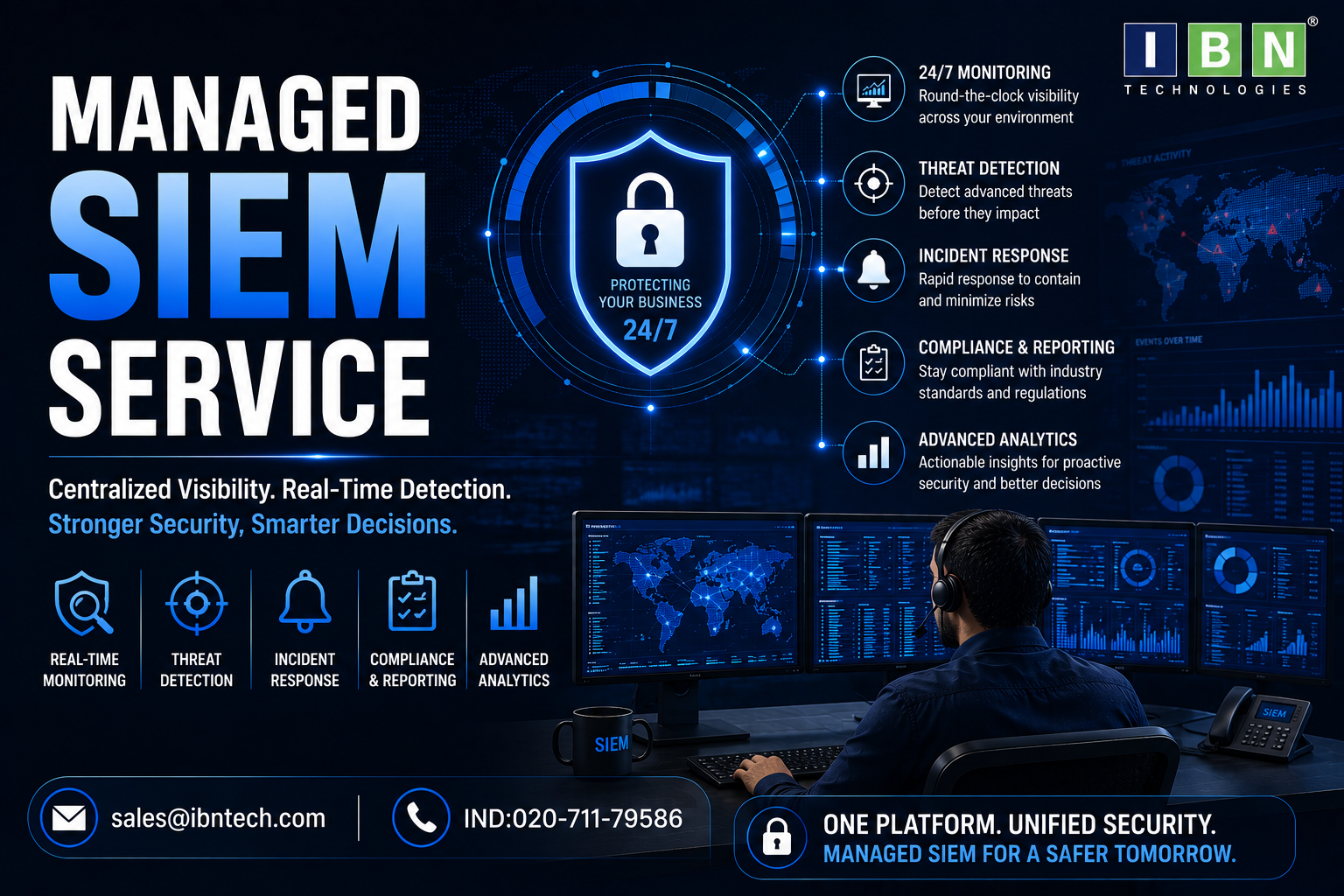
Building Stronger Healthcare Security With Managed SIEM
Healthcare organizations increasingly rely on digital infrastructure to deliver services and manage sensitive information. Electronic systems, cloud applications, endpoints, networks, administrative platforms, and third-party services all contribute to a complex technology environment.
When security information comes from so many sources, healthcare teams need a reliable way to understand what is happening across their environment.
A managed siem service can provide centralized security-event monitoring and analysis while reducing the operational responsibility placed on internal IT and security teams.
For healthcare organizations, the purpose goes beyond detecting suspicious activity. The security operation must also support patient-data protection, business continuity, incident investigation, regulatory responsibilities, and the availability of important systems.
What Is a Managed SIEM Service for Healthcare?
A managed SIEM service combines Security Information and Event Management technology with ongoing monitoring and specialist security operations.
Relevant security events are collected from connected systems and analyzed to identify unusual or potentially malicious activity.
In practical terms, healthcare SIEM monitoring helps an organization bring security information together so analysts can investigate events in context rather than examining every system separately.
A managed approach can be particularly useful when a healthcare IT team does not have the resources or specialist personnel required to operate SIEM continuously.
The provider supports monitoring and analysis, while the healthcare organization retains responsibility for governance, risk decisions, operational priorities, and compliance.
Why Healthcare Organizations Need Centralized Security Visibility
Healthcare environments can be difficult to monitor because they often contain different generations of technology.
A provider may use cloud platforms alongside traditional applications, employee endpoints, network infrastructure, connected devices, third-party services, and systems supporting multiple locations.
Each system can generate security information.
An authentication platform may record unusual access.
An endpoint may identify suspicious behavior.
A network device may record unexpected communication.
An application may show unusual access patterns.
The challenge is understanding whether these events are connected.
Centralized SIEM can help analysts examine security information across different parts of the environment.
That broader view can make it easier to identify patterns that would otherwise remain fragmented.
The Healthcare Business Driver
Cybersecurity in healthcare is closely connected to trust and continuity.
A security incident can potentially expose sensitive information, interrupt business processes, create recovery costs, or affect an organization's ability to provide services efficiently.
Healthcare leaders therefore need security operations that recognize the difference between a technical event and a business-critical incident.
For example, isolating an endpoint may be appropriate in one situation but could create operational difficulties in another.
The security team needs evidence before recommending action.
This is why centralized monitoring and investigation are valuable.
SIEM helps bring together the information needed to understand what may be happening before an organization decides how to respond.
Why Internal SIEM Operations Can Become Challenging
Operating SIEM internally requires ongoing attention.
Teams need to connect data sources, maintain integrations, configure detection rules, tune alerts, review security events, investigate suspicious behavior, maintain dashboards, and produce useful reports.
Healthcare IT teams may already be managing demanding operational responsibilities.
Security monitoring can compete with application support, infrastructure maintenance, cloud administration, user access management, and technology projects.
Staffing can create another challenge.
A SIEM platform may collect information continuously, but security professionals still need to review important events.
Without appropriate coverage, the organization can have extensive security data but limited ability to act on it.
Managed SIEM can address part of this operational gap by providing specialist monitoring and analysis.
IBN Technologies and Managed SIEM for Healthcare
IBN Technologies' healthcare cybersecurity offering identifies 24/7 SOC and SIEM monitoring as part of its security services.
Its wider cybersecurity portfolio includes VAPT, Managed Detection and Response, vCISO Services, Microsoft Security, Cyber Security Maturity Risk Assessment, and Compliance Management and Audit Services.
Its published SOC and SIEM capabilities include continuous monitoring, threat intelligence, incident response, and audit-ready reporting.
For healthcare organizations, these services can be considered as part of a broader security strategy rather than as isolated technologies.
The appropriate scope should depend on the organization's systems, risk profile, security maturity, and compliance requirements.
How Healthcare Organizations Should Evaluate a Managed SIEM Service
A healthcare organization should assess both technology and operational capability before selecting a provider.
|
Evaluation area |
Healthcare leadership should consider |
|
Critical systems |
Are important healthcare and business systems covered? |
|
Data sources |
Can relevant security information be collected? |
|
Monitoring |
Is security activity continuously reviewed? |
|
Detection |
How are suspicious events identified? |
|
Correlation |
Can events across different systems be connected? |
|
Investigation |
Who analyzes high-risk activity? |
|
Escalation |
How are incidents communicated to internal teams? |
|
Response |
What support is available after detection? |
|
Threat intelligence |
Can external threat context support investigations? |
|
Reporting |
Are reports useful for security and management? |
|
Compliance |
Can monitoring support security and audit requirements? |
|
Scalability |
Can the service accommodate new systems and locations? |
The provider should also clearly define the boundary between monitoring and response.
Healthcare leaders need to know whether the provider only identifies and escalates incidents or can also perform approved response activities.
SIEM Helps Connect Disconnected Security Signals
Consider a healthcare employee account.
The account normally accesses a limited group of systems during predictable hours.
One evening, it produces an unusual authentication event.
Around the same time, the employee's endpoint reports suspicious activity.
A separate network device records unexpected outbound communication.
Individually, these events may not establish that an attack is underway.
Together, they may justify a deeper investigation.
A SIEM platform can help bring these events into a common security view.
Security analysts can then examine the context and determine whether the activity appears legitimate, suspicious, or potentially malicious.
This is one of the central benefits of SIEM: helping security teams move from isolated events toward connected security analysis.
The Role of Threat Intelligence
Security monitoring becomes more useful when analysts have context.
Threat intelligence can provide information that helps security teams understand suspicious indicators and emerging risks.
For example, an unusual destination observed in network activity may require additional attention when other evidence suggests potential malicious behavior.
Threat intelligence does not replace investigation.
It adds context that analysts can use alongside internal security information.
For healthcare organizations, this can support more informed prioritization of security events.
SIEM and Incident Response
Detection is only one stage of the security process.
When a potentially serious event is identified, healthcare organizations need to know what happens next.
The security team may need to investigate the affected account.
IT may need to review the endpoint.
Management may need to assess operational implications.
Compliance personnel may need to determine whether additional review is required.
The SOC or managed SIEM team can support the investigation and escalation process.
This is why incident-response procedures should be agreed before a serious security event occurs.
A SIEM system can provide valuable information, but people and processes determine how that information becomes an effective response.
Healthcare Use Case: A Regional Hospital Network
Consider a healthcare organization operating several facilities in India.
Its technology environment includes centralized applications, employee devices, network infrastructure, cloud services, and systems managed by different teams.
The organization has security controls in place but lacks a dedicated team to continuously analyze security information.
A suspicious authentication event occurs on an account with elevated access.
Later, the same account generates activity on an endpoint that does not match its normal pattern.
The SIEM brings the relevant events together.
Security analysts investigate the activity and determine whether the pattern requires escalation.
If the event is considered a genuine security concern, the managed security team follows the agreed incident-response process.
Internal healthcare leaders can then make decisions based on both security evidence and operational considerations.
This approach helps separate security analysis from business decision-making while keeping the two functions connected.
Benefits of Managed SIEM for Healthcare Organizations
A properly managed SIEM operation can provide several advantages.
Centralized visibility helps teams understand security activity across different systems.
Continuous monitoring supports security oversight beyond normal working hours.
Contextual investigation allows analysts to examine related events together.
Specialist expertise can complement internal healthcare IT teams.
Improved prioritization can help security professionals focus on events that warrant investigation.
Incident-response support creates a clearer path from detection to escalation.
Reporting can give leadership greater insight into security activity.
Scalability allows monitoring to evolve as healthcare organizations add systems, locations, applications, and users.
These benefits depend on the quality of monitoring and the organization's internal ability to act on security findings.
Healthcare SIEM Implementation Checklist
Before implementing a managed SIEM service, healthcare leaders should establish:
- Which systems contain sensitive or business-critical information.
- Which security data sources should be connected.
- Which assets require continuous monitoring.
- Which events require immediate investigation.
- Which events require management escalation.
- Who owns incident-response decisions.
- Who can authorize containment.
- Which internal teams must be notified.
- How false positives will be reviewed.
- How threat intelligence will support investigations.
- How vulnerabilities will be handled.
- What reports will be delivered.
- How security information will support audits.
- How new technology will be added to monitoring.
- How provider performance will be reviewed.
A documented operating model can make SIEM more effective than simply connecting more systems to a platform.
Compliance and Security Monitoring
Healthcare organizations operate within a sensitive compliance environment.
The applicable requirements can vary depending on the organization's services, data, geography, contracts, and regulatory responsibilities.
IBN Technologies' healthcare information references ISO 27001:2022, SOC 2 Type II, and HIPAA, while its healthcare cybersecurity offering includes HIPAA-focused VAPT and 24/7 SOC and SIEM monitoring.
Its broader compliance services can also support organizations addressing applicable security and audit requirements.
However, managed SIEM should not be presented as a guarantee of compliance.
Instead, it can support a compliance program by creating structured security monitoring, incident information, reports, and evidence that may be relevant during internal reviews or audits.
Healthcare organizations remain responsible for determining their applicable requirements and maintaining appropriate governance.
Protecting Patient Information Requires More Than Data Security
Patient information protection is important, but healthcare cybersecurity cannot stop at databases.
A compromised employee endpoint can become a security concern.
A stolen credential can provide unauthorized access.
An exposed application can create a pathway into sensitive systems.
A vulnerable legacy environment can increase organizational risk.
This is why security monitoring needs visibility across the wider technology environment.
SIEM can help healthcare security teams identify relationships between different security events and investigate potential attack paths.
Combining SIEM With the Wider Security Program
Managed SIEM works best as part of a broader cybersecurity strategy.
VAPT can help identify vulnerabilities.
MDR can strengthen threat detection and response.
vCISO services can provide strategic cybersecurity leadership.
Cyber Security Maturity Risk Assessment can help organizations understand security gaps and priorities.
Compliance Management and Audit Services can support governance and audit preparation.
IBN Technologies offers these services alongside SOC and SIEM capabilities.
Healthcare organizations can therefore evaluate SIEM in the context of their broader security objectives rather than treating it as a standalone technology purchase.
What Healthcare Leaders Should Expect From a Managed SIEM Provider
The right provider should be able to explain its operating model clearly.
Healthcare leaders should understand how security information is collected, how alerts are prioritized, who investigates suspicious events, how incidents are escalated, and what information reaches management.
The provider should also be able to adapt monitoring when the healthcare environment changes.
New applications, facilities, cloud workloads, users, and third-party connections can all change the organization's security requirements.
A static SIEM configuration may therefore become less effective over time.
Regular reviews are essential.
Creating a Stronger Security Foundation for Healthcare
Healthcare organizations need security operations that combine technology, people, processes, and governance.
SIEM can provide the visibility needed to understand security activity, but its value increases significantly when supported by skilled analysts, clear escalation procedures, threat intelligence, incident response, and ongoing monitoring improvements.
For Indian healthcare organizations, the right managed siem service can reduce the operational burden of SIEM management while improving security visibility across complex technology environments.
When integrated with broader cybersecurity capabilities and aligned with healthcare-specific operational priorities, managed SIEM can help organizations detect suspicious activity earlier, investigate security events with greater context, strengthen incident readiness, and support a more resilient approach to protecting sensitive information and essential digital healthcare operations.
Contact Us:
IND- 02067680404
IBN Technologies Ltd.
E-mail: - sales@ibntech.com

 English
 Arabic
 French
 Spanish
 Portuguese
 Deutsch
 Turkish
 Dutch
Dutch
 Italiano
 Russian
 Romaian
 Greek
Greek
