
Managed SOC Service Provider in India: A Safer Path for Healthcare
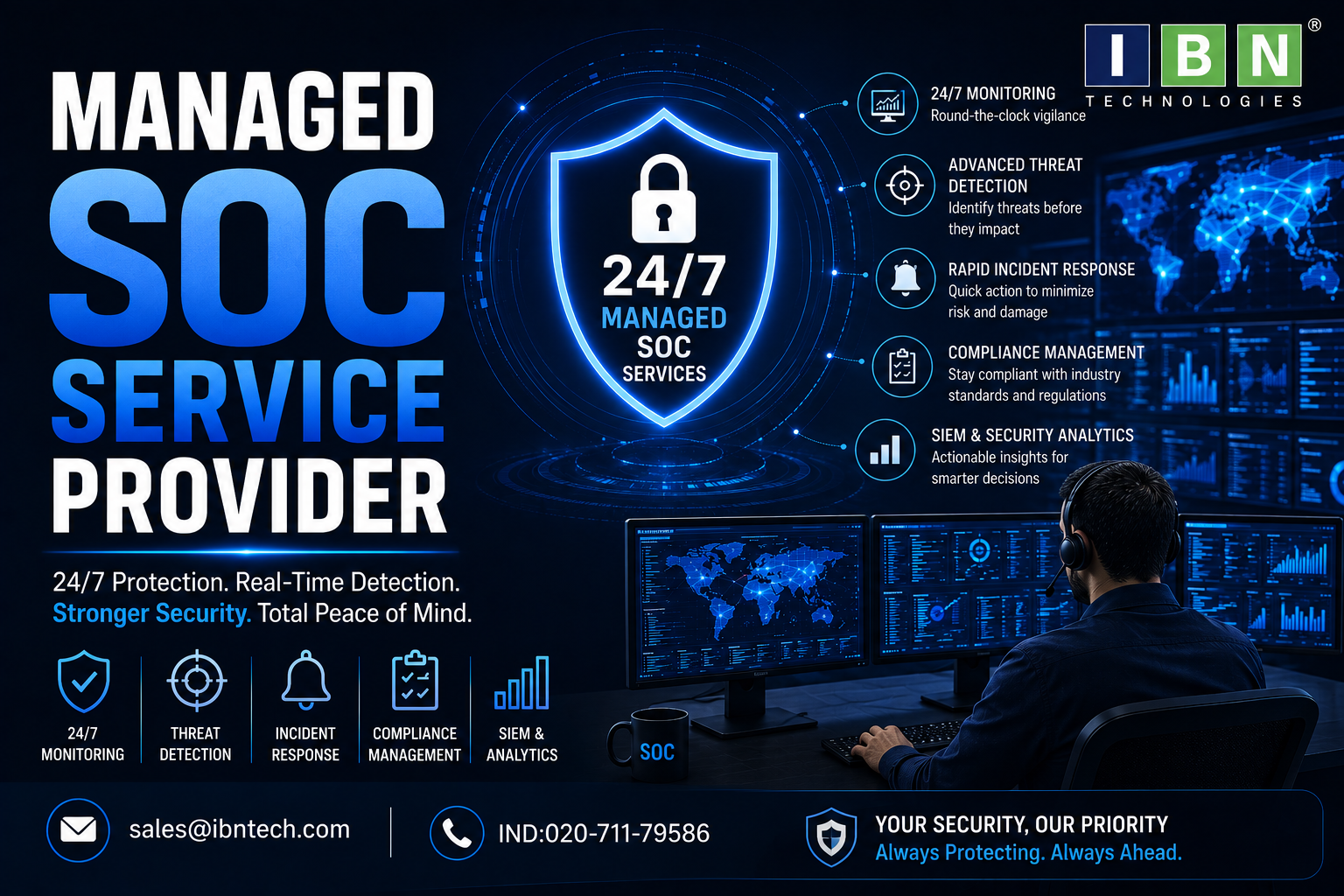
Building Stronger Healthcare Security With a Managed SOC Service Provider
A healthcare organization cannot treat cybersecurity as an isolated IT function. Patient services, clinical workflows, administrative systems, digital records, connected devices, applications, and communication platforms all depend on technology being available and trustworthy.
For hospitals, clinics, diagnostic providers, health-tech organizations, and pharmaceutical businesses, managed soc service provider services can provide an additional layer of continuous security monitoring and specialist incident-response capability.
The objective is not simply to identify cyber threats. Healthcare security operations must also help organizations protect sensitive information, maintain operational continuity, investigate suspicious activity, and support compliance responsibilities.
What Does a Managed SOC Service Provider Do for Healthcare?
A managed SOC service provider operates security monitoring and response functions on behalf of an organization.
Security events from relevant systems are collected and analyzed. Suspicious activity can be investigated, prioritized, and escalated according to predefined procedures.
For healthcare organizations, the approach can be particularly useful when internal teams must focus on keeping critical technology available while security operations require continuous attention.
Healthcare cybersecurity services can therefore complement existing IT teams by providing specialist monitoring, detection, threat analysis, and response support.
The SOC does not replace the healthcare organization's leadership. It strengthens the operational layer that helps security leaders understand what is happening across their environment.
Why Healthcare Organizations Need a Different Security Approach
Healthcare environments have a distinctive combination of data sensitivity and operational dependency.
Patient information must be protected. At the same time, healthcare professionals need timely access to systems that support their responsibilities.
A security incident can therefore have consequences beyond data exposure.
It may affect scheduling, communication, administration, customer services, business operations, or other technology-dependent workflows.
Healthcare organizations also operate complex technology environments.
A single organization may have multiple locations, cloud services, endpoints, legacy applications, third-party platforms, remote users, and interconnected systems.
Security teams need visibility across these environments.
The Threat Is Not Always Obvious
A cyberattack does not necessarily begin with an obvious security alert.
An employee account may show unusual authentication behavior.
An endpoint may connect to an unfamiliar destination.
A privileged user may suddenly access systems outside their normal pattern.
A network device may report unusual activity.
Individually, these events may not prove that an attack is taking place.
The challenge is identifying relationships between them.
Security operations need context, correlation, investigation, and prioritization.
This is difficult when the same IT team responsible for keeping healthcare systems running must also investigate every suspicious event.
A managed SOC can provide a dedicated security function focused on these activities.
Where Traditional or DIY Security Can Fall Short
Many healthcare organizations already have defensive technologies.
They may use endpoint security, firewalls, identity controls, email protection, vulnerability-management tools, and cloud security capabilities.
But security products do not automatically create an effective security operations program.
Someone still needs to monitor events, investigate alerts, identify patterns, determine severity, document incidents, and coordinate escalation.
An internal team may be able to perform these activities during normal working hours but struggle to maintain consistent coverage around the clock.
Staffing is another consideration.
Building a mature SOC requires security analysts, leadership, processes, technology, training, and ongoing optimization.
For a healthcare organization with competing technology priorities, outsourcing selected SOC responsibilities may provide a more practical way to strengthen monitoring.
How IBN Technologies Approaches Healthcare Security
IBN Technologies' healthcare offering identifies cybersecurity and compliance as important challenges for healthcare organizations and highlights services including 24/7 SOC and SIEM monitoring and VAPT.
Its wider cybersecurity portfolio includes Managed Detection and Response, vCISO Services, Microsoft Security, Cyber Security Maturity Risk Assessment, and Compliance Management and Audit Services.
The company's managed SOC and SIEM capabilities include continuous monitoring, threat detection, threat intelligence, incident response, threat hunting, security-device monitoring, user behavior analytics, vulnerability management, and compliance-driven monitoring.
This allows healthcare organizations to consider SOC operations as part of a broader security strategy rather than as an isolated monitoring service.
What Should a Healthcare Managed SOC Service Provider Monitor?
Monitoring should begin with the systems that matter most to the organization's operations and risk profile.
Depending on the environment, this may include endpoints, networks, cloud assets, security devices, applications, and other infrastructure generating relevant security information.
Healthcare organizations should identify their critical systems before defining monitoring requirements.
The provider should then explain what data is collected, how it is analyzed, which events receive priority, and how significant incidents are escalated.
The goal is meaningful visibility, not unlimited data collection.
Protecting Sensitive Healthcare Information
Sensitive healthcare information requires careful protection because unauthorized access can affect patients, organizations, and trust.
Security teams need to understand not only whether an attack has occurred but also whether unusual activity suggests that an account, endpoint, or system may have been compromised.
User behavior analytics can contribute to this process by helping security teams identify activity that differs from expected patterns.
Threat intelligence can add another layer of context by helping analysts understand emerging risks and suspicious indicators.
Threat hunting can also support proactive investigation rather than waiting for a security tool to produce a high-confidence alert.
These capabilities are especially relevant when healthcare environments contain a mixture of modern cloud systems and older technologies.
Healthcare Use Case: A Multi-Location Diagnostic Organization
Consider an Indian diagnostic organization with several facilities.
Each location depends on technology for administrative activities, communication, customer interaction, and internal workflows.
The organization uses centralized applications, cloud services, employee endpoints, and network infrastructure.
Its IT team manages the environment but does not have a dedicated security analyst available to investigate every event continuously.
One day, an account with elevated privileges shows an unusual authentication pattern.
Around the same period, an endpoint associated with the same user produces unexpected network activity.
Neither event automatically proves compromise.
A managed SOC can investigate the activity as a connected security event.
Analysts can examine the authentication behavior, review endpoint information, correlate available security data, and determine whether the activity requires escalation.
If the event is confirmed as a genuine security concern, the SOC can support the organization's established incident-response process.
The internal team can then make decisions about affected systems, operational continuity, and business priorities.
This illustrates an important point: the SOC should support healthcare operations, not operate independently from them.
Evaluating a Provider for Healthcare Operations
Healthcare leaders should evaluate a SOC provider according to both security capability and operational fit.
|
Evaluation area |
Questions healthcare leaders should ask |
|
Critical systems |
Are important applications and infrastructure included? |
|
Monitoring |
What systems and security events are monitored? |
|
Detection |
How are suspicious events prioritized? |
|
Investigation |
Who investigates high-risk alerts? |
|
Response |
What happens when an incident is confirmed? |
|
Escalation |
Who is contacted and how quickly? |
|
Threat hunting |
Can the provider proactively investigate hidden threats? |
|
User activity |
Can unusual account behavior be identified? |
|
Vulnerability management |
How are security weaknesses addressed? |
|
Reporting |
Are reports useful for security, management, and compliance teams? |
|
Scalability |
Can monitoring change as the healthcare environment grows? |
The organization should also determine which response actions the provider can perform independently and which require authorization.
This distinction becomes particularly important when an affected system supports an important healthcare workflow.
The Operational Benefits of Managed SOC Services
A properly structured SOC relationship can provide several benefits.
Continuous monitoring gives healthcare organizations greater visibility outside standard working hours.
Specialist expertise supplements internal IT resources.
Threat investigation helps security teams understand suspicious activity rather than simply recording alerts.
Threat hunting supports proactive security operations.
Incident-response support provides a defined path from detection to escalation and remediation.
Security reporting helps management understand security trends and operational concerns.
Scalability allows monitoring capabilities to evolve with new facilities, applications, users, and cloud services.
The value depends on how well the service is aligned with the organization's actual environment.
Healthcare Security Checklist
Before engaging a managed SOC provider, healthcare leaders should clarify:
- Which systems contain sensitive or business-critical information.
- Which assets require continuous monitoring.
- Which events require immediate escalation.
- Who owns incident-response decisions.
- Who can authorize containment actions.
- Which teams need to be contacted during an incident.
- How suspicious user activity will be investigated.
- How threat hunting is performed.
- How vulnerability findings are incorporated into security operations.
- Which reports will be provided to leadership.
- How security evidence is documented.
- How incident procedures will be tested.
- How monitoring changes will be approved.
- How new applications and infrastructure will be added to the SOC.
These decisions should be documented before the organization experiences a major security event.
Compliance Is Part of the Security Operating Model
Healthcare organizations may face multiple compliance and security obligations depending on their location, services, contracts, data, and operating model.
IBN Technologies' healthcare cybersecurity information references HIPAA alongside ISO 27001 and SOC 2, while its broader SOC and SIEM services reference compliance requirements and frameworks such as GDPR, HIPAA, PCI-DSS, ISO 27001, CERT-In, RBI, and SEBI.
The relevant requirements for each organization should be assessed individually.
A managed SOC should not be presented as an automatic compliance solution.
Instead, it can support compliance programs through continuous monitoring, reporting, incident records, security evidence, and structured operational processes.
Healthcare leadership remains responsible for governance and compliance decisions.
Why Incident Response Must Be Defined in Advance
A security alert has limited value if nobody knows what to do next.
Healthcare organizations should establish an incident-response structure before an incident occurs.
Security teams should know who evaluates severity.
IT leaders should know who is responsible for technical remediation.
Business leaders should understand who makes operational decisions.
Compliance teams should know when an event needs additional review.
The SOC should have clear escalation paths.
This preparation reduces confusion during a high-pressure event and allows security analysts to concentrate on investigation rather than determining basic responsibilities.
Connecting SOC Operations With Broader Cybersecurity
A mature healthcare security strategy should not depend on one security control.
SOC and SIEM operations can work alongside vulnerability assessment, managed detection and response, security leadership, Microsoft security capabilities, and compliance management.
IBN Technologies offers these capabilities within its broader cybersecurity portfolio, allowing organizations to address operational monitoring alongside other security requirements.
For healthcare organizations, this broader approach can be useful because cybersecurity risk rarely exists in one isolated system.
A vulnerability can contribute to an incident.
A compromised identity can lead to unauthorized access.
A security alert may require vulnerability investigation.
A compliance review may reveal gaps in monitoring.
Connecting these activities can provide stronger security visibility.
Building a More Resilient Healthcare Security Program
Healthcare cybersecurity needs to balance protection with availability.
Organizations cannot simply add more security tools and assume the problem is solved. They need people, processes, technology, monitoring, investigation, response, governance, and continuous improvement working together.
For Indian healthcare organizations, the right managed soc service provider should provide more than round-the-clock alert monitoring. It should strengthen visibility, support threat detection and investigation, enable structured incident escalation, contribute to proactive threat hunting, and align security operations with compliance and healthcare business requirements.
The strongest provider relationship is one that complements internal IT and security leadership while helping the organization protect sensitive information and maintain resilient digital healthcare operations.
Contact Us:
IND- 02067680404
IBN Technologies Ltd.
E-mail: - sales@ibntech.com

 English
 Arabic
 French
 Portuguese
 Deutsch
 Turkish
 Dutch
Dutch
 Italiano
 Russian
 Romaian
 Portuguese (Brazil)
 Greek
Greek
