
How Masonry Estimating Helps Predict the True Cost of Brick and Block Work
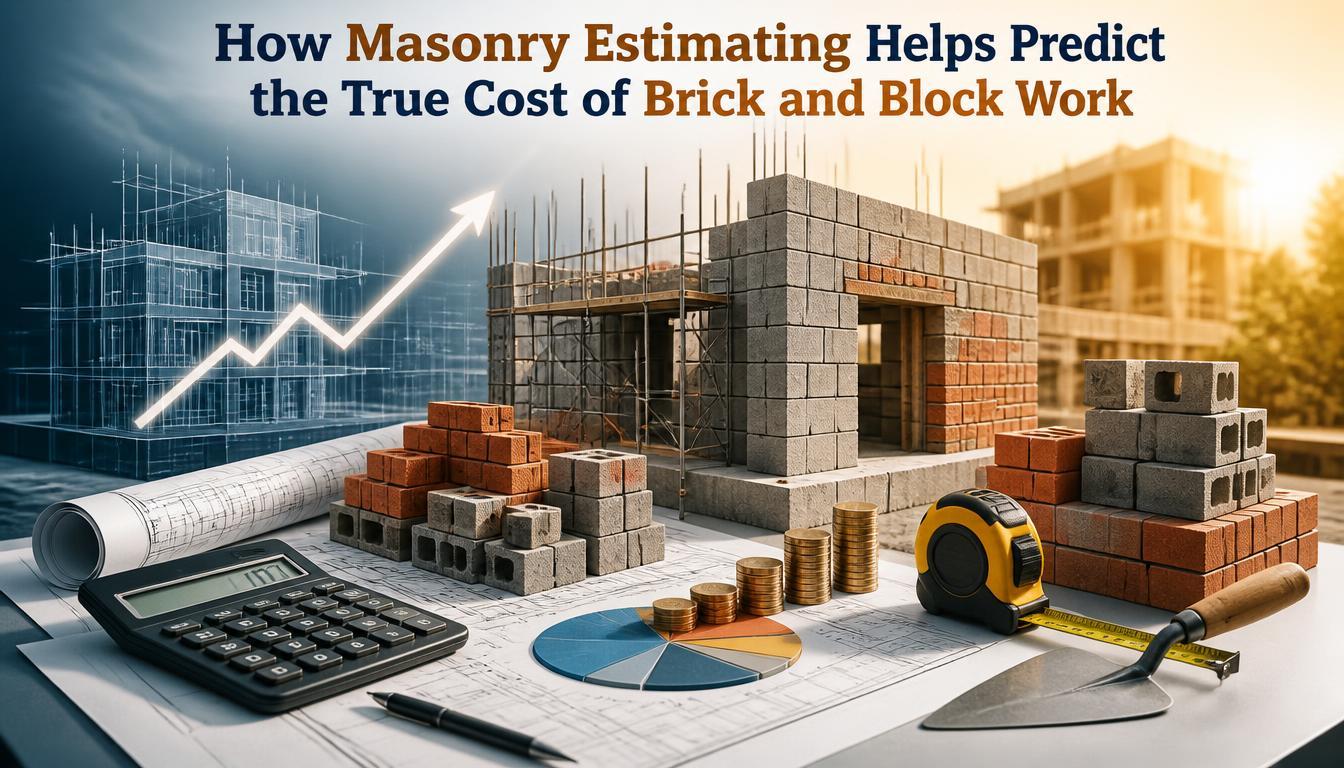
Brick and block work can seem simple on paper. Masonry estimating can be much more than just unit and mortar calculations. It will bring the drawings to life for subcontractors in a cost accounting format they can bid with confidence.
That is the value masonry estimating services add to the project, long before the brick is laid on the job site. Masonry contractors who hire such services can bid with confidence, knowing that the estimate has been tested against the real site conditions.
What Makes Masonry Estimating Different From General Construction Estimating?
Masonry pricing can be influenced by various factors, and the difference in cost can be subtle. The width of the joints, the bond pattern, and the weight of the blocks are all variables that can affect the price. The slightest mistake can make the estimate inaccurate before any work has been done.
A simple square-footage calculation works for many types of jobs, but when it comes to masonry, the estimator has to do more than that. A running bond wall and a Flemish bond wall that have the same size can use a different number of bricks and take longer to build.
How Much Does Labor Really Add To A Masonry Estimate?
Labor is the most underpaid component of any masonry project. According to the Bureau of Labor Statistics, a masonry worker’s median annual income is $56,600 in May 2024. Besides being underpaid, this profession has a limited labor supply. Indeed, BLS forecasts only a 2% annual employment growth from 2024 to 2034. Nevertheless, there are expected to be about 20,700 job openings each year. These numbers suggest that a lower labor supply will drive wages up since most masons will retire or quit the profession, while the need for their services will remain the same.
A poor understanding of the local labor market can cause an inaccurate cost estimate. The initial value may turn out to be significantly lower than the actual cost due to these circumstances.
Why Do Material Prices Keep Moving The Numbers?
Brick and block estimating is tricky as prices can fluctuate quickly. Basing a bid on outdated information can leave you with a devalued estimate. The Bureau of Labor Statistics’ Producer Price Index for concrete block and brick climbed from 395.9 in December 2025 to 401.4 in February 2026.
That is a tiny increase. But on a large commercial job, that added expense can add up quickly. Any estimator working with outdated information on brick and block can be left with a deflated bottom line.
How Much Waste Should A Cost Analysis Actually Include?
Waste is not a deduction from a later item in the estimate; it has already been incorporated into the original masonry cost estimation. The Brick Industry Association Technical Note 10 recommends allowing 15% to 25% on top of the net quantity of mortar. This includes wastage due to cutting, headers, and breakages.
|
Item |
Typical Allowance |
|
Mortar waste |
15–25% |
|
Brick breakage/cuts |
Job-specific, added before waste |
Skipping the allowance can result in shortages of the materials needed to complete the construction. On the other hand, ordering too much material can lead to unnecessary expenses associated with returns and restocking fees. Masonry cost analysis is all about balancing the right amount of materials to finish the job, but not wasting any money on extras.
What Should A Masonry Estimating Partner Actually Deliver?
-
Labor pricing that reflects current wage data, not last year's crew rates.
-
Material pricing pulled from current indices, not a static catalog.
-
Waste and correction factors built in per bond pattern, not a flat percentage.
-
A breakdown by wall, elevation, or phase, not one lump number.
Universe Estimating’s masonry estimating team follows this detailed process for every takeoff, assuring contractors of accurate bids that won’t change once construction begins.
Conclusion
Masonry Estimating is more than just bricks and blocks. It is about people, materials, and a variety of other elements that make up the final cost of completed work. By neglecting even one component, a simple home improvement project can become a budget overrun. When these elements are estimated correctly, the job of laying brick or blocks is much more predictable. The final cost is much more likely to match up with the initial budget and project expectations.

 English
 Arabic
 French
 Spanish
 Deutsch
 Turkish
 Dutch
Dutch
 Italiano
 Russian
 Romaian
 Portuguese (Brazil)
 Greek
Greek
