
Progressive Cavity Pumps Market to Record USD 4.3 Billion Revenue by 2036 at 5.1% CAGR
Market Outlook
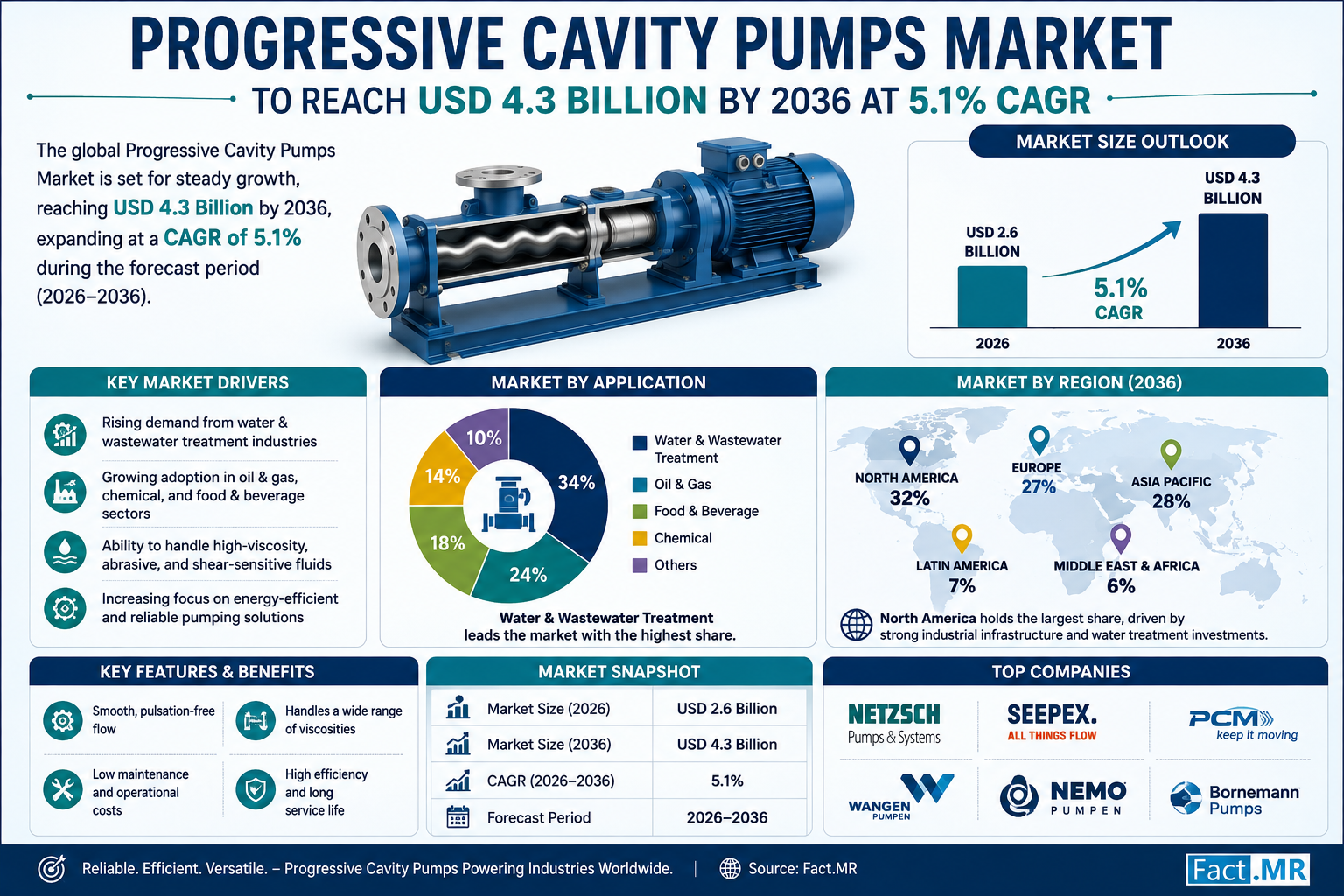
The global progressive cavity pumps market is estimated at USD 2.6 billion in 2026 and is projected to reach USD 4.3 billion by 2036, expanding at a 5.1% CAGR during the forecast period, according to Fact.MR analysis. The market was valued at approximately USD 2.5 billion in 2025, creating an absolute dollar opportunity of about USD 1.7 billion between 2026 and 2036.
Progressive cavity pumps are positive displacement systems that use a helical rotor inside a double-helical stator to move fluids through sealed cavities. Their ability to deliver continuous, non-pulsating flow makes them useful for difficult fluids that can be viscous, abrasive, shear-sensitive, or contain solids.
Demand is being supported by expanding municipal wastewater treatment infrastructure, rising artificial lift requirements in mature oil and gas fields, growing food and beverage processing capacity, and industrial applications that require controlled transfer of challenging fluids. Mining slurry handling and chemical processing are also supporting equipment procurement.
Get detailed market forecasts, competitive benchmarking, and pricing trends: https://www.factmr.com/connectus/sample?flag=S&rep_id=11598
Key Market Drivers
Water and wastewater treatment remains a major demand center. Expanding treatment infrastructure in India, China, and Southeast Asia is creating procurement opportunities for sludge transfer and chemical dosing applications.
Oil and gas operators are another important source of demand. Rising artificial lift requirements in mature fields are sustaining the need for downhole progressive cavity pump systems.
Food and beverage processing is also contributing to market growth. Sanitary progressive cavity pumps can handle viscous and shear-sensitive products, supporting their use in food processing, beverage manufacturing, flavor and syrup handling, and related applications.
Chemical and industrial processes require reliable metered transfer of viscous, abrasive, or corrosive fluids. Mining operations similarly require heavy-duty pump configurations for slurry and tailings management.
Segment Analysis
Power Rating: The 51 to 150 HP category accounts for 44% of power-rating share in 2026, supported by demand across primary applications. The segment benefits from an established installed base and continued replacement and capacity expansion requirements.
Pumping Capacity: The 501 to 1,000 GPM category represents 42% of pumping-capacity share in 2026. Its position is supported by established application requirements across wastewater, industrial slurry handling, chemical transfer, and process industries.
End Use: Water and wastewater accounts for 34% of end-use share in 2026, making it the leading application segment. Sludge transfer, dosing, industrial water treatment, effluent handling, and chemical injection are key uses.
Operation Type: Single-stage progressive cavity pumps maintain a dominant position because of their simple mechanical design, broad application coverage, and lower maintenance complexity. Multi-stage systems serve higher-pressure applications, while metering and dosing pumps address precision fluid delivery requirements.
Regional Growth
Asia Pacific is a key growth region for progressive cavity pumps. India is projected to expand at a 6.4% CAGR through 2036, followed by China at 6.1%. South Korea is projected to grow at 5.1%, while Japan is expected to record a 4.3% CAGR.
In North America, the USA is projected to grow at 5.7% through 2036. European markets show steady expansion, with Germany at 4.9% and the UK at 3.8%.
These markets are supported by end-use expansion, infrastructure investment, replacement demand, and growing requirements for higher-specification pumping equipment.
Competitive Landscape
The competitive landscape is moderately fragmented. Leading participants include NETZSCH, Atlas Copco, DOPAG India (Hilger & Kern Group), Roto Pumps Ltd., INOXPA, Risansi Industries Ltd., Hydro Prokav Pumps (Ingersoll Rand), SynoPumps, Sulzer Ltd., and Pumpsquare Systems LLP.
Companies are competing through broader product portfolios, technical capability, distribution networks, application engineering, and aftermarket services. Smart monitoring systems that track rotor-stator wear and predict maintenance intervals are emerging as an opportunity for additional service revenue.
The source material also identifies recent developments including portfolio expansion by NETZSCH in 2025, technology upgrades by Atlas Copco in 2026, and geographic distribution expansion by DOPAG India in 2025.
Market Opportunities and Challenges
Progressive cavity pump manufacturers have opportunities in smart monitoring, biogas and anaerobic digestion facilities, and precision chemical dosing for water treatment. These applications can create recurring demand for equipment, replacement components, and aftermarket services.
However, stator wear in abrasive applications can increase ownership costs. Competition from peristaltic and rotary lobe pumps can limit adoption in selected sludge and food applications. Dry-running sensitivity and solids concentrations beyond design limits also require careful application engineering.
Analyst Perspective
Shambhu Nath Jha, Principal Consultant at Fact.MR, highlights the performance advantage of progressive cavity pumps in applications involving high viscosity, entrained solids, shear sensitivity, and abrasive content. He also identifies water and wastewater as the largest single application and points to oil and gas artificial lift as a high-value application.
FAQs
What is the size of the progressive cavity pumps market in 2026?
The global market is estimated at USD 2.6 billion in 2026.
What will the progressive cavity pumps market be worth by 2036?
The market is projected to reach USD 4.3 billion by 2036.
What is the CAGR of the progressive cavity pumps market?
The market is forecast to expand at a 5.1% CAGR from 2026 to 2036.
Which segment leads the market?
The 51 to 150 HP segment holds 44% of power-rating share, while water and wastewater accounts for 34% of end-use share in 2026.
Which country is growing fastest?
Among the countries covered, India leads with a projected 6.4% CAGR, followed by China at 6.1%.
Top Trending Reports:
https://www.openpr.com/news/4518035/global-low-odor-restroom-cleaning-chemicals-market-set-to-reach
https://www.openpr.com/news/4518063/low-temp-dishwashing-chemicals-market-to-grow-at-6-1-cagr
https://www.openpr.com/news/4518083/high-cation-exchange-capacity-enhancing-fertility-blend
https://www.openpr.com/news/4518119/heavy-duty-floor-degreasers-market-forecasted-to-reach
About Fact.MR
Fact.MR is a market research and consulting firm providing market intelligence, forecasting, and strategic insights across global industries. Its research combines secondary research, primary interviews, demand-side modeling, company benchmarking, pricing analysis, and forecast validation.

 English
 Arabic
 Spanish
 Portuguese
 Deutsch
 Turkish
 Dutch
Dutch
 Italiano
 Russian
 Romaian
 Portuguese (Brazil)
 Greek
Greek
