
Waste Heat to Power Market Growth Driven by Rising Energy Efficiency and Industrial Waste Heat Recovery Demand
Waste Heat to Power Market: Key Segmentations, Growth Drivers and Recent Developments
Waste Heat to Power Market Overview
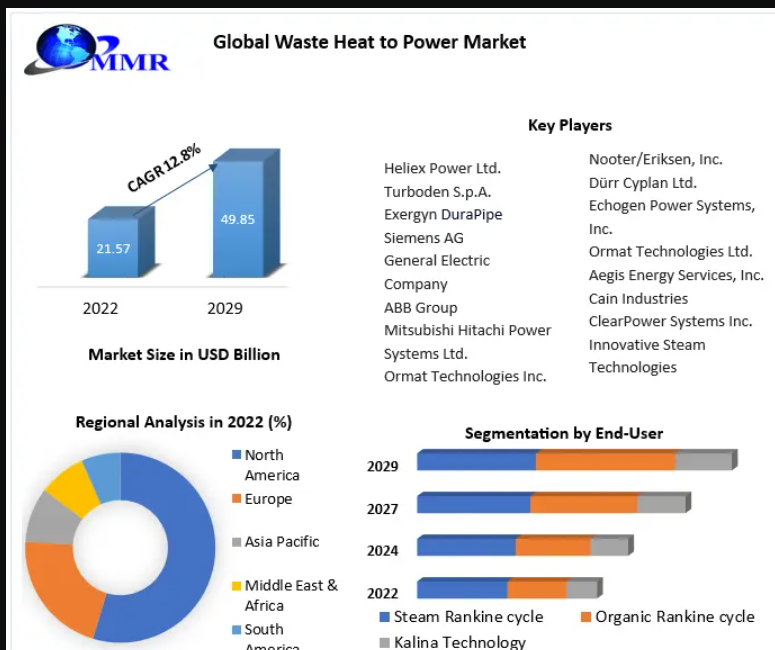
The Waste Heat to Power (WHP) Market is becoming an increasingly important component of the global energy-efficiency and industrial decarbonization landscape as industries seek to convert previously unused thermal energy into electricity or mechanical power. Waste heat is generated by numerous industrial processes, including combustion, refining, chemical reactions, metal production, cement manufacturing, glass production, and pipeline compression. Waste heat-to-power systems capture this thermal energy and convert it into useful electricity, allowing industrial facilities to reduce purchased electricity, improve overall energy efficiency, lower operating costs, and decrease greenhouse-gas emissions. According to Maximize Market Research, the global Waste Heat to Power Market was valued at approximately USD 21.57 billion in 2022 and is projected to reach USD 49.85 billion by 2029, expanding at a CAGR of 12.8% during 2023–2029. The report identifies growing environmental concerns, stricter emissions regulations, increasing energy costs, and demand for sustainable energy solutions as major forces supporting market growth.
The market is particularly attractive because waste heat recovery can generate electricity without requiring a separate primary fuel source. Instead of allowing heat from industrial exhaust gases, engines, furnaces, kilns, and other processes to escape into the environment, WHP systems capture and utilize that energy. This approach can improve the economics of energy-intensive industries while supporting corporate decarbonization strategies. Industries such as oil and gas, chemicals, cement, metals, glass, pulp and paper, and pipeline transportation are increasingly examining waste heat recovery as a practical pathway toward improved energy productivity.
𝐃𝐨𝐰𝐧𝐥𝐨𝐚𝐝 𝐅𝐫𝐞𝐞 𝐏𝐃𝐅 𝐁𝐫𝐨𝐜𝐡𝐮𝐫𝐞 @https://www.maximizemarketresearch.com/request-sample/209373/
Key Market Segmentation
The Waste Heat to Power Market is segmented by technology, end-user industry, and region. By technology, the market includes Steam Rankine Cycle (SRC), Organic Rankine Cycle (ORC), and Kalina technology. Each technology is suited to different temperature ranges and operating conditions. Steam Rankine Cycle systems are well established and remain particularly suitable for high-temperature waste heat sources. They use steam generated from recovered heat to drive a turbine and produce electricity. Because many heavy industrial processes generate high-temperature exhaust gases, SRC continues to have an important position in the market.
The Organic Rankine Cycle segment is expected to experience strong growth because ORC systems can utilize organic working fluids with lower boiling points than water. This makes them suitable for low- and medium-temperature waste heat sources that may not be economically suitable for conventional steam systems. Advances in working fluids, heat exchangers, turbines, system controls, and overall system optimization are improving ORC performance and expanding its application range. Recent market analysis also identifies ORC as a major technology within the broader waste-heat-to-power industry, particularly for industrial decarbonization in sectors such as cement, steel, glass, refining, and chemicals.
Kalina technology represents another segment, using a water-ammonia working-fluid mixture to convert heat into electricity. Its ability to operate across certain variable-temperature heat sources provides opportunities in specialized applications. Although its market penetration is smaller than that of conventional Rankine-based technologies, continued improvements in system design and efficiency could create new opportunities.
By end-user industry, the market includes chemical, oil and gas, heavy metals, pipeline transportation, cement, and other industries. The chemical sector is expected to experience significant growth because chemical manufacturing involves energy-intensive processes and high-temperature reactions. Waste heat recovery enables chemical manufacturers to improve energy utilization while supporting emissions-reduction objectives. The cement industry is also a major application area because cement plants generate substantial quantities of high-temperature waste heat from kilns and other processes. Maximize Market Research identifies cement as the largest application segment over the forecast period, supported by the sector's significant heat-recovery potential and increasing adoption of ORC-based systems.
The oil and gas industry provides another substantial opportunity because refineries, gas-processing facilities, compressor stations, and other operations generate significant quantities of waste heat. Pipeline transportation is also becoming an attractive application because gas turbines used at compressor stations release recoverable thermal energy. Heavy-metal industries, including steel and other metallurgical operations, similarly provide high-temperature waste streams that can be converted into electricity.
Growth Drivers
One of the strongest growth drivers for the Waste Heat to Power Market is the global emphasis on industrial energy efficiency and decarbonization. Governments and industrial companies are under increasing pressure to reduce greenhouse-gas emissions while maintaining productivity. Waste heat recovery provides an opportunity to achieve both objectives by producing additional electricity from energy that has already been consumed. Maximize Market Research identifies stringent environmental regulations and increasing demand for sustainable energy solutions as major drivers of market expansion.
Rising energy costs are another important factor. Energy-intensive industries can face substantial electricity and fuel expenses, making energy-efficiency investments increasingly attractive. Recovering waste heat can reduce dependence on externally purchased electricity and potentially improve the economic performance of industrial facilities. The ability to achieve energy savings while reducing emissions makes WHP particularly appealing for industries with continuous high-temperature processes.
The rapid development of ORC technology is also expanding the addressable market. Conventional steam systems can be less suitable for lower-temperature heat sources, whereas ORC systems can utilize a broader range of thermal energy. A 2026 market assessment estimated the global ORC waste heat-to-power market at USD 4.47 billion in 2024 and projected it to reach approximately USD 12.39 billion by 2032, illustrating the strong investment momentum surrounding this technology.
The expansion of industrial activity in emerging economies is another significant opportunity. Countries across Asia Pacific, particularly China, India, Japan, and other industrializing economies, have large manufacturing and processing sectors that generate substantial waste heat. As industrial production expands and governments introduce stronger energy-efficiency policies, the potential market for waste heat recovery systems is increasing. Maximize Market Research expects Asia Pacific to become a leading regional market because of its large industrial base, rising electricity demand, environmental concerns, and investments in sustainable energy infrastructure.
Another driver is the growing integration of digital technologies and IoT-enabled monitoring. Sensors can monitor temperature, pressure, flow rates, turbine performance, and energy output in real time. Data analytics and predictive maintenance can help operators identify performance changes and schedule maintenance before failures occur. Maximize Market Research identifies digitalization and IoT integration as important developments because they can improve operational efficiency, monitoring, and data-driven decision-making.
𝐃𝐨𝐰𝐧𝐥𝐨𝐚𝐝 𝐅𝐫𝐞𝐞 𝐏𝐃𝐅 𝐁𝐫𝐨𝐜𝐡𝐮𝐫𝐞 @https://www.maximizemarketresearch.com/request-sample/209373/
Recent Developments
Recent developments demonstrate that waste heat recovery is moving toward more efficient, modular, and diversified technologies. In 2026, Turboden commissioned a 1.8 MWe ORC waste-heat-to-power system at an AGC Group flat-glass facility in Thailand, representing its fifth ORC system for the group. The project demonstrates increasing application of ORC technology in energy-intensive glass manufacturing and highlights the potential for converting industrial waste heat into useful electricity.
Turboden and Tallgrass also expanded their collaboration in 2026 through three additional waste-heat-to-power projects in Ohio and Indiana, bringing the planned total capacity associated with their projects to 46.1 MW. The projects demonstrate the increasing deployment of ORC technology for energy recovery from gas-compressor infrastructure and illustrate how waste heat recovery is expanding beyond traditional manufacturing industries.
The maritime sector is another emerging application. In May 2026, Orcan Energy commissioned a 100 kW ORC waste-heat recovery system aboard a Hagland Shipping vessel in Norway. The system captures heat from both engine exhaust gases and high-temperature jacket cooling water and converts it into onboard electricity. The project is the first of four planned installations for the shipping company, illustrating the potential for WHP systems to improve fuel efficiency and reduce emissions in commercial marine operations.
Technological research is also expanding beyond conventional ORC systems. A 2026 study investigated nanogap thermophotovoltaic devices for industrial waste-heat recovery, focusing on optimized designs capable of generating high power densities from medium-temperature heat sources. Such emerging technologies could eventually complement conventional heat engines where traditional systems are difficult to deploy.
Research into thermomagnetic generators is also progressing for low-grade waste heat. A 2026 study developed a validated digital twin to investigate efficiency and transient heat-flow limitations in thermomagnetic energy recovery, highlighting the potential of systems with few moving components for low-temperature heat sources.
Regional Outlook
North America held the leading position in the Waste Heat to Power Market in Maximize Market Research's assessment. The region benefits from a developed industrial base, substantial waste-heat generation, supportive policies, technological capabilities, and the presence of major market participants. Government incentives, grants, and energy-efficiency initiatives can further encourage industrial companies to invest in waste heat recovery systems.
Asia Pacific is expected to become increasingly important as industrialization, urbanization, electricity consumption, and environmental initiatives expand. China, India, Japan, South Korea, and other countries have large energy-intensive manufacturing sectors, creating substantial opportunities for WHP deployment. Maximize Market Research expects Asia Pacific to lead the market in the future because of its large industrial base and increasing investment in sustainable energy infrastructure.
Europe also represents a significant opportunity because of its strong focus on industrial decarbonization, energy efficiency, and emissions reduction. The Middle East and Africa offer opportunities in oil and gas, refining, petrochemicals, and other energy-intensive industries, while South America can benefit from WHP deployment in metals, cement, mining, and processing industries.
Challenges and Restraints
Despite its growth potential, the market faces several challenges. High upfront capital costs remain one of the most important restraints. Installing waste heat recovery equipment requires heat exchangers, turbines, generators, controls, piping, and integration with existing industrial systems. The initial investment can discourage companies with limited capital or uncertain energy-saving returns.
Complexity of retrofitting existing facilities is another challenge. Industrial plants differ significantly in heat-source temperature, flow, operating schedules, contaminants, pressure, and process configuration. WHP systems often need to be customized, requiring detailed engineering and careful integration. Maximize Market Research identifies technological limitations, scalability issues, and integration complexity as important market challenges.
Variable heat availability can also affect system economics. Some industrial facilities have fluctuating production schedules, meaning waste heat output may not remain constant. Advanced controls, thermal storage, flexible operating strategies, and optimized system designs are therefore becoming increasingly important.
Competitive Landscape
The competitive landscape includes major companies such as Siemens AG, General Electric Company, ABB Group, Mitsubishi Hitachi Power Systems, Ormat Technologies, Thermax Limited, Calnetix Technologies, Exergy International, ElectraTherm, Toshiba Corporation, Bharat Heavy Electricals Limited, Turboden, Exergyn, Echogen Power Systems, and other technology providers.
Competition is increasingly focused on efficiency, system reliability, scalability, modularity, working-fluid innovation, heat-exchanger performance, digital monitoring, and integration capabilities. Companies are investing in research and development while forming strategic partnerships to expand geographic reach and develop new industrial applications. Recent projects in glass manufacturing, pipeline infrastructure, and maritime transportation demonstrate that suppliers are seeking opportunities across a widening range of industries.
For full access to the comprehensive strategic report, visit:https://www.maximizemarketresearch.com/market-report/waste-heat-to-power-market/209373/
Future Outlook
The Waste Heat to Power Market is expected to remain an important growth area as industries prioritize energy efficiency, cost reduction, and carbon-emissions management. Maximize Market Research forecasts the market to grow from USD 21.57 billion in 2022 to approximately USD 49.85 billion by 2029, representing a 12.8% CAGR from 2023 to 2029.
The future market will increasingly be shaped by ORC systems, high-efficiency steam cycles, advanced heat exchangers, digital monitoring, AI-enabled predictive maintenance, modular systems, and emerging thermoelectric and thermophotovoltaic technologies. The expansion of WHP into marine transportation, pipeline infrastructure, glass, cement, chemicals, metals, and other energy-intensive sectors will further diversify demand. Continued technological innovation can improve the economic feasibility of recovering lower-temperature heat, while supportive energy and environmental policies can accelerate industrial adoption.
Overall, Waste Heat to Power technology provides industries with an opportunity to transform an unavoidable by-product into a valuable energy resource. As energy costs, emissions-reduction requirements, and sustainability targets become increasingly important, converting waste heat into electricity can improve plant efficiency while supporting decarbonization objectives. Although high capital expenditure and integration complexity remain barriers, ongoing advances in ORC technology, digital controls, heat-recovery equipment, and emerging conversion technologies are expected to create substantial opportunities for market participants through the forecast period.
About Maximize Market Research
Maximize Market Research is a multifaceted market research and consulting company with professionals from several industries. Some of the industries we cover include medical devices, pharmaceutical manufacturers, science and engineering, electronic components, industrial equipment, technology and communication, cars and automobiles, chemical products and substances, general merchandise, beverages, personal care, and automated systems. To mention a few, we provide market-verified industry estimations, technical trend analysis, crucial market research, strategic advice, competition analysis, production and demand analysis, and client impact studies.
Contact Maximize Market Research
3rd Floor, Navale IT Park, Phase 2
Pune Bangalore Highway, Narhe,
Pune, Maharashtra 411041, India
sales@maximizemarketresearch.com
+91 96071 95908, +91 9607365656

 Arabic
 French
 Spanish
 Portuguese
 Deutsch
 Turkish
 Dutch
Dutch
 Italiano
 Russian
 Romaian
 Portuguese (Brazil)
 Greek
Greek
