
Centrifugation Free Sperm Separation System Market Growth, Emerging Technologies and Competitive Landscape to 2032
Centrifugation-Free Sperm Separation System Market: Growth Drivers, Key Segmentation, Trends and Recent Developments
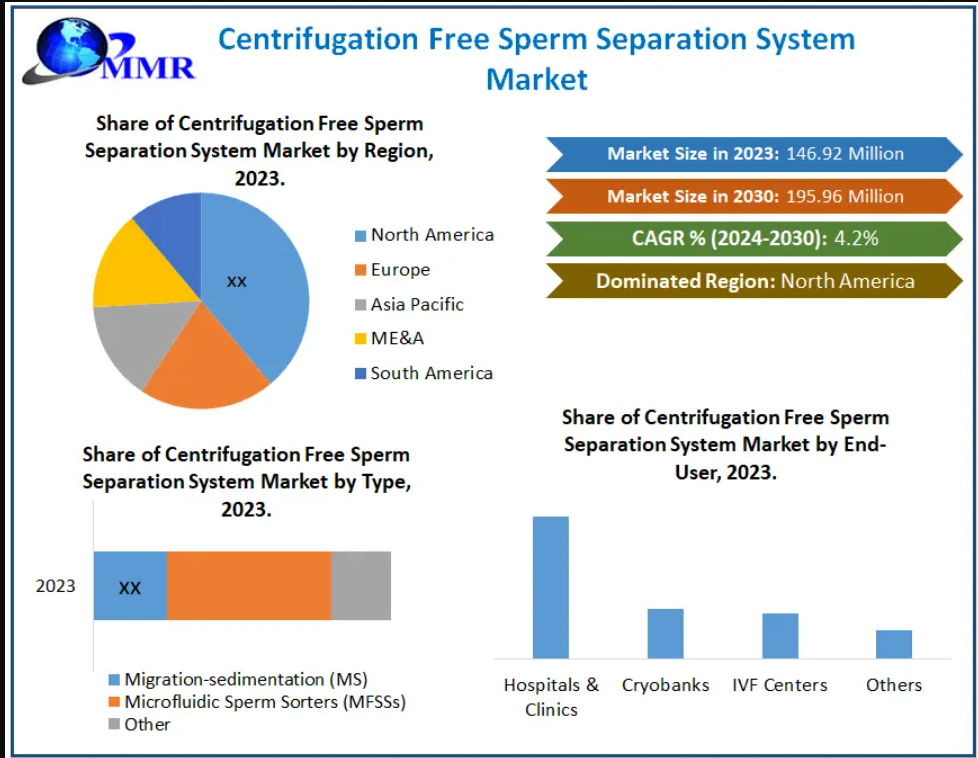
The global Centrifugation-Free Sperm Separation System Market is gaining momentum as fertility clinics, hospitals, IVF centers, and reproductive laboratories increasingly adopt advanced sperm preparation technologies that can reduce the potential damage associated with conventional centrifugation. Centrifugation-free sperm separation systems are designed to isolate and select high-quality sperm from semen without relying on traditional centrifugation procedures. These technologies are increasingly being incorporated into assisted reproductive technologies (ART), including in vitro fertilization (IVF) and intrauterine insemination (IUI), where sperm quality and preparation can influence treatment outcomes. According to Maximize Market Research, the global Centrifugation-Free Sperm Separation System Market was valued at approximately USD 146.92 million in 2023 and is projected to reach nearly USD 195.96 million by 2030, expanding at a CAGR of 4.2% during 2024–2030. The market is being driven by rising infertility rates, increasing utilization of ART procedures, technological advancements in sperm selection, growing awareness of male infertility, and the expansion of fertility treatment infrastructure.
𝐃𝐨𝐰𝐧𝐥𝐨𝐚𝐝 𝐅𝐫𝐞𝐞 𝐏𝐃𝐅 𝐁𝐫𝐨𝐜𝐡𝐮𝐫𝐞 @https://www.maximizemarketresearch.com/request-sample/232720/
Centrifugation-Free Sperm Separation System Market Overview
Traditional sperm preparation techniques frequently use centrifugation to concentrate sperm cells and remove unwanted components from semen. However, excessive or repeated centrifugation may expose sperm cells to mechanical stress and potentially affect sperm quality. Centrifugation-free approaches seek to provide gentler methods for sperm preparation by using mechanisms such as migration-sedimentation, microfluidics, filtration, and other sperm-selection technologies. These systems can help laboratories select motile and potentially higher-quality sperm while reducing dependence on conventional laboratory centrifugation.
The increasing focus on improving laboratory procedures within ART is creating opportunities for centrifugation-free technologies. Fertility specialists are increasingly interested in techniques that provide reproducible sperm preparation while minimizing manipulation of biological samples. At the same time, advances in microfluidics and laboratory automation are opening new possibilities for integrating sperm selection into streamlined fertility workflows. Maximize Market Research highlights microfluidics-based systems, alternatives to density-gradient centrifugation, and automation as major areas of development within this market.
Key Market Segmentation
The Centrifugation-Free Sperm Separation System Market is segmented primarily by type, end user, and region. Based on type, the market includes Migration-Sedimentation (MS), Microfluidic Sperm Sorters (MFSSs), and other technologies. Migration-sedimentation methods use the natural movement and settling characteristics of sperm to separate motile sperm cells from other components. Such approaches can offer a relatively gentle alternative to centrifugation and are relevant for laboratories seeking simpler sperm preparation workflows.
The Microfluidic Sperm Sorters (MFSSs) segment represents an important technology category because microfluidic platforms can manipulate very small volumes of biological samples through precisely controlled channels. These systems can potentially support automated sperm selection according to characteristics such as motility and movement behavior. The growing interest in microfluidics across reproductive medicine is contributing to the development of more advanced sperm selection and preparation platforms. Other technologies also contribute to market growth by providing alternative approaches to conventional centrifugation-based processing.
By end user, the market is divided into hospitals and clinics, cryobanks, IVF centers, and others. IVF centers are particularly important because sperm preparation is a critical laboratory step in assisted reproduction. Hospitals and fertility clinics are also adopting advanced laboratory technologies as demand for fertility services expands. Cryobanks represent another opportunity because efficient sperm processing and preservation workflows are essential for the handling and storage of reproductive samples.
Geographically, the market covers North America, Europe, Asia Pacific, the Middle East & Africa, and South America, with individual countries analyzed within these regions.
Rising Infertility Rates Driving Market Growth
The increasing prevalence of infertility worldwide is one of the most significant growth drivers for the Centrifugation-Free Sperm Separation System Market. Infertility can affect both male and female reproductive health, with male factors accounting for a substantial proportion of infertility cases. As awareness of male reproductive health increases, demand for advanced semen analysis, sperm preparation, and sperm selection technologies is also increasing.
The growing number of couples seeking fertility assistance is expanding the addressable market for ART technologies. IVF and other assisted reproductive procedures require specialized laboratory processes, including sperm preparation before fertilization. As the overall volume of fertility procedures rises, demand for technologies capable of efficiently preparing high-quality sperm samples is expected to increase. Maximize Market Research notes that the increasing use of ART and IVF is a major factor supporting demand for centrifugation-free sperm separation systems.
Increasing Adoption of IVF and Assisted Reproductive Technologies
The expansion of assisted reproductive technologies is creating substantial opportunities for centrifugation-free sperm separation solutions. IVF has become an established treatment option for individuals and couples experiencing infertility, while other procedures such as IUI are also widely used in fertility care. These procedures depend on effective sperm preparation to remove undesirable components and select appropriate sperm populations.
The increasing number of ART cycles worldwide is encouraging fertility laboratories to invest in technologies that can improve workflow efficiency and sample handling. According to the Maximize Market Research report, more than 2.5 million ART cycles are performed annually, demonstrating the scale of the fertility-treatment ecosystem.
𝐃𝐨𝐰𝐧𝐥𝐨𝐚𝐝 𝐅𝐫𝐞𝐞 𝐏𝐃𝐅 𝐁𝐫𝐨𝐜𝐡𝐮𝐫𝐞 @https://www.maximizemarketresearch.com/request-sample/232720/
Technological Advancements in Sperm Selection
Technological innovation is one of the strongest trends shaping the market. Manufacturers and research organizations are developing microfluidic sperm sorters, automated systems, filtration technologies, migration-sedimentation techniques, and other centrifugation-free approaches. These technologies are designed to provide more controlled sperm-selection processes while minimizing unnecessary sample manipulation.
Microfluidic technologies are particularly promising because they can enable precise manipulation of sperm cells within small fluidic environments. Researchers are investigating microfluidic platforms for sperm sorting, guidance, selection, and preparation. Integration with automated laboratory systems could further increase reproducibility and reduce manual intervention.
Automation and robotics are also emerging trends. Automated sperm separation systems can potentially improve laboratory throughput, reduce human error, and provide more standardized processing. As fertility laboratories become increasingly sophisticated, demand for digitally enabled and automated laboratory workflows is expected to support technology adoption.
Growing Awareness of Male Infertility
Increasing awareness of male infertility is another important market driver. Historically, fertility discussions have often focused primarily on female reproductive health, but greater clinical and public awareness of male factors is encouraging more men to undergo fertility assessment. Improvements in semen analysis and sperm-quality testing are helping clinicians identify abnormalities related to sperm count, morphology, motility, and function.
The growing emphasis on sperm quality is directly relevant to sperm separation technologies. Fertility specialists are increasingly seeking techniques that can isolate motile and potentially viable sperm for use in ART procedures. This trend creates opportunities for companies developing technologies that can improve sperm preparation while reducing unnecessary physical stress on cells.
Regional Market Outlook
North America is expected to remain a leading region in the Centrifugation-Free Sperm Separation System Market. The region benefits from advanced healthcare infrastructure, high healthcare expenditure, sophisticated fertility clinics, strong research capabilities, and favorable adoption of reproductive technologies. The presence of established medical-device and laboratory-technology companies also supports innovation and commercialization. Maximize Market Research identifies North America as the region expected to lead market growth.
Europe is another important market, supported by established fertility treatment infrastructure, increasing demand for ART, and research activity in reproductive medicine. Countries such as Germany, the United Kingdom, France, Italy, and Spain provide opportunities for advanced sperm preparation technologies.
Asia Pacific is expected to experience significant growth during the forecast period. China represents a major regional market because of increasing demand for advanced reproductive technologies and expanding healthcare infrastructure. India is also an important market, particularly in metropolitan areas where fertility clinics and access to assisted reproductive services are expanding. Rising awareness, increasing disposable incomes, and improving healthcare infrastructure are expected to support adoption across the region.
The Middle East & Africa and South America also offer long-term opportunities as fertility-care infrastructure expands and awareness of reproductive treatments increases.
Competitive Landscape
The competitive landscape includes established medical-device, laboratory-equipment, fertility-product, and life-science companies, as well as specialized startups. Major companies identified in the Maximize Market Research report include Hamilton Thorne, Irvine Scientific, Thermo Fisher Scientific, Origio a/s (a CooperSurgical company), Cook Medical, EMD Serono, Genea Biomedx, Nidacon International AB, Kitazato Corporation, FUJIFILM Wako Chemicals, Menicon Co. Ltd., and Biotech India, among others.
Companies are competing through technological innovation, product development, laboratory automation, strategic partnerships, research collaborations, and expansion into emerging fertility markets. The competitive environment is increasingly influenced by the demand for systems that can deliver reproducible sperm selection while integrating efficiently into existing IVF laboratory workflows.
For full access to the comprehensive strategic report, visit:https://www.maximizemarketresearch.com/market-report/centrifugation-free-sperm-separation-system-market/232720/
Recent Developments and Emerging Trends
Recent developments in the market have focused heavily on microfluidics, automation, robotics, and alternative sperm-selection methodologies. The development of microfluidic platforms is particularly significant because these systems can support sperm selection and manipulation using controlled fluidic environments. Researchers are also investigating continuous-flow, paper-based, and droplet-based microfluidic technologies for applications throughout the ART workflow.
Another important trend is the increasing adoption of non-invasive and gentle sperm separation techniques. Migration-sedimentation, microfluidic separation, magnetic-activated cell sorting, and swim-up approaches are receiving attention as laboratories seek alternatives to conventional centrifugation. Automation is also being integrated into sperm preparation workflows to increase throughput, improve consistency, and reduce manual errors.
The broader development of organ-on-a-chip and reproductive microfluidic technologies could provide additional opportunities in the longer term. Although many of these technologies remain under development, their potential applications across sperm selection, oocyte selection, embryo culture, monitoring, and cryopreservation demonstrate the expanding technological ecosystem surrounding assisted reproduction.
Future Opportunities
The future of the Centrifugation-Free Sperm Separation System Market is closely linked to the expansion of fertility treatment and continued innovation in reproductive laboratory technologies. Emerging economies offer considerable opportunities because increasing infertility awareness, rising disposable incomes, and improving access to IVF services are encouraging more patients to seek fertility treatment.
Manufacturers that develop cost-effective, compact, automated, and easy-to-integrate systems could gain opportunities in fertility clinics with varying levels of laboratory infrastructure. Continued improvements in microfluidic technology, automation, sperm-selection accuracy, and workflow integration could further increase the attractiveness of centrifugation-free approaches.
Conclusion
The global Centrifugation-Free Sperm Separation System Market is positioned for steady expansion, supported by rising infertility rates, increasing adoption of IVF and ART, growing awareness of male infertility, and continuous technological innovation. The market was valued at USD 146.92 million in 2023 and is expected to reach approximately USD 195.96 million by 2030, representing a CAGR of 4.2% from 2024 to 2030. Migration-sedimentation and microfluidic sperm sorters remain important technology segments, while IVF centers, hospitals and clinics, and cryobanks represent major end users. North America is expected to maintain a leading position, while Asia Pacific offers significant growth potential due to improving healthcare infrastructure and expanding fertility-treatment access.
As fertility laboratories increasingly prioritize gentle sperm handling, automation, reproducibility, and advanced cell-selection technologies, centrifugation-free sperm separation systems are expected to become an increasingly important component of modern assisted reproductive workflows. Continued innovation in microfluidics, robotics, filtration, and automated sperm selection will likely create new opportunities for manufacturers and healthcare providers through 2030.
About Maximize Market Research
Maximize Market Research is a multifaceted market research and consulting company with professionals from several industries. Some of the industries we cover include medical devices, pharmaceutical manufacturers, science and engineering, electronic components, industrial equipment, technology and communication, cars and automobiles, chemical products and substances, general merchandise, beverages, personal care, and automated systems. To mention a few, we provide market-verified industry estimations, technical trend analysis, crucial market research, strategic advice, competition analysis, production and demand analysis, and client impact studies.
Contact Maximize Market Research
3rd Floor, Navale IT Park, Phase 2
Pune Bangalore Highway, Narhe,
Pune, Maharashtra 411041, India
sales@maximizemarketresearch.com
+91 96071 95908, +91 9607365656

 English
 Arabic
 French
 Spanish
 Portuguese
 Deutsch
 Turkish
 Dutch
Dutch
 Russian
 Romaian
 Portuguese (Brazil)
 Greek
Greek
