
Digital Carbon Tracking Emerges as a Business Priority
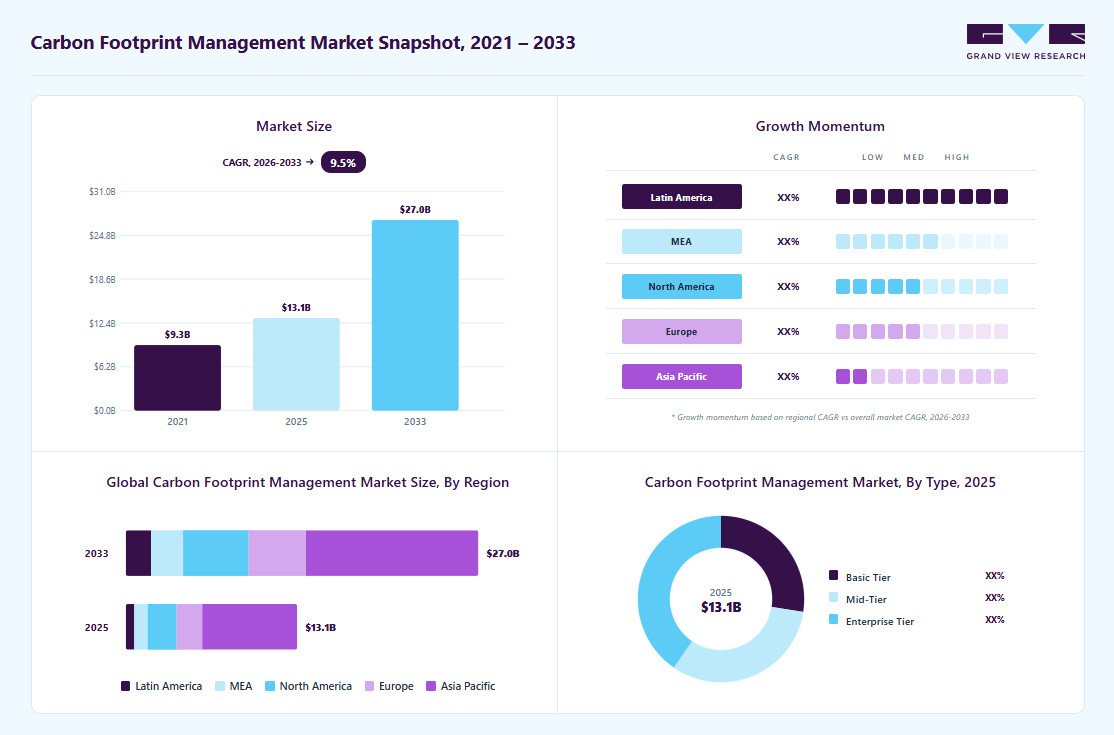
The carbon footprint management market is entering a period of sustained expansion as organizations face growing pressure to measure emissions, improve sustainability reporting, and achieve net-zero targets. The market size was valued at USD 13.1 billion in 2025 and is projected to increase from USD 14.3 billion in 2026 to USD 27.0 billion by 2033, registering a CAGR of 9.5% from 2026 to 2033. Asia Pacific dominated the market with a revenue share of 55.4% in 2025, reflecting strong regulatory activity, industrial development, and increasing corporate focus on emissions management.
Key Market Segmentation
· The market is segmented by deployment, type, end use, and region. By deployment, the cloud segment accounted for the largest share of 59.4% in 2025. Cloud-based platforms provide centralized access to environmental data, support multiple locations, enable scalability, and facilitate emissions monitoring across complex supply chains. The cloud segment is also projected to grow at a CAGR of 12.1% over the forecast period.
· By type, the enterprise tier held the largest revenue share of 40.4% in 2025. Large organizations often operate across numerous facilities and supply chains, increasing the need for comprehensive carbon accounting and reporting capabilities. The enterprise tier is projected to register a CAGR of 10.6%, supported particularly by the increasing complexity of Scope 3 emissions tracking.
· By end use, energy and utilities represented the largest market share at 31.7% in 2025. The sector's high emissions intensity and regulatory requirements are encouraging utilities and power generation companies to adopt solutions for monitoring, reporting, and reducing emissions. Meanwhile, IT and telecommunication is projected to record the fastest CAGR of 14.2%, supported by expanding data centers and rising energy consumption.
Core Market Drivers
Mandatory Climate Disclosures
Increasing ESG disclosure requirements and corporate net-zero commitments are major factors supporting market growth. Governments and regulatory authorities are introducing stricter climate reporting requirements, encouraging organizations to improve greenhouse gas emissions monitoring across operations and supply chains. The European Union’s Corporate Sustainability Reporting Directive, effective from 2024, is expected to impact nearly 50,000 companies through mandatory sustainability disclosures.
Supply Chain Scope 3 Ripple Effect
Scope 3 emissions are becoming a major focus because companies increasingly need visibility beyond their direct operations. Fragmented supplier networks, limited data transparency, and inconsistent reporting practices can make emissions measurement difficult. Enterprise-grade platforms can support automated tracking and integration with supplier systems, helping organizations improve visibility across their value chains.
AI and Digital Technology Integration
Advancements in AI, cloud computing, data analytics, automation, and real-time monitoring are strengthening carbon management platforms. These technologies can improve emissions data management, reporting, sustainability analysis, and decision-making. Companies are increasingly looking for scalable digital tools that can integrate sustainability information across complex operations.
Regional Insights
· Asia Pacific remained the leading regional market with a 55.4% revenue share in 2025. China and Japan are implementing carbon trading systems, emissions reduction targets, and net-zero goals, while the region’s position as a major manufacturing hub creates significant demand for carbon tracking and reporting solutions. China held the largest country market share in 2025.
· Other regions are also showing strong momentum. Latin America is projected to grow at the fastest CAGR of 14.7%, supported by regulatory and market pressures, carbon taxes, voluntary carbon markets, and international ESG reporting requirements. Europe continues to be influenced by stringent climate regulations, while North America benefits from corporate sustainability commitments, investor expectations, and evolving ESG reporting standards.
Data Collection Challenges and AI-Driven Remedies
A key challenge for carbon footprint management is obtaining consistent and accurate emissions data, particularly across complex supply chains. Small and medium-sized suppliers may have limited capabilities for Scope 3 reporting, while differences in ESG regulations, methodologies, and disclosure requirements can complicate implementation. Integration with existing enterprise software and operational databases can also require significant investment and technical expertise.
AI, cloud technology, automation, and data analytics are helping address these challenges by supporting more efficient emissions tracking, reporting, and sustainability analysis. As regulatory expectations and corporate net-zero commitments continue to increase, demand for scalable carbon footprint management platforms is expected to remain strong through 2033.
Key Carbon Footprint Management Companies:
· Dakota Software
· Ecova
· ENGIE
· IBM Corporation
· Ideagen EHS
· IsoMetrix
· Microsoft Corporation
· SAP SE
· Schneider Electric
· Wolters Kluwer
Explore our dedicated business services:
· Brainshare Consulting – End-to-end business consulting services including Opportunity assessment, GTM support, Competitive intelligence, and Consumer Analytics.
· Custom Research – Get a market intelligence report tailored to your specific requirements and aligned with your business goals.
· Consumer Insights – Capture real, evolving consumer sentiment and behavior to help you make data driven strategies.
· Horizon Databooks – Access the world’s largest portal of Market Reports & Statistics
· Investment Insights – Make investment decisions with data driven insights, powered by domain and technology
· Signal (Pricing Intelligence) - Commodity price intelligence to drives strategic advantage.
About us:
Grand View Research, a market research and consulting company, provides syndicated research reports, customized research reports, and consulting services. Grand View Research database is used by the world's renowned academic institutions and Fortune 500 companies to understand the global and regional business environment. Our database features thousands of statistics and in-depth analysis on 46 industries in 25 major countries worldwide.

 English
 Arabic
 French
 Spanish
 Portuguese
 Deutsch
 Turkish
 Dutch
Dutch
 Russian
 Romaian
 Portuguese (Brazil)
 Greek
Greek
