
Germany Healthcare Insurance Market Analysis: Statutory and Private Insurance Trends, Growth Drivers, Challenges and Emerging Opportunities
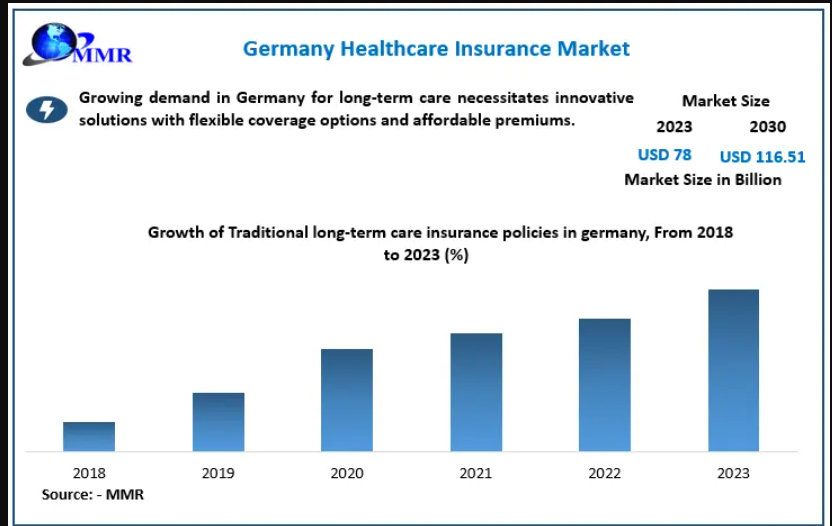
Germany Healthcare Insurance Market: Digital Transformation, Rising Healthcare Costs and Insurance Reforms Shape Market Growth
The Germany Healthcare Insurance Market represents one of the most established and comprehensive healthcare financing systems in Europe, supported by a dual structure comprising statutory health insurance (Gesetzliche Krankenversicherung or GKV) and private health insurance (Private Krankenversicherung or PKV). The market plays a central role in financing medical services, hospital treatment, prescription medicines, preventive care, specialist consultations, and other healthcare services. Germany's healthcare insurance ecosystem is being influenced by demographic changes, increasing healthcare expenditure, technological transformation, rising chronic disease prevalence, and government efforts to maintain the financial sustainability of insurance funds. The statutory system remains the dominant component of healthcare financing, while private insurers provide additional coverage and compete through customized benefits, premium structures, and supplementary healthcare products. According to Germany's Federal Ministry of Health, the country's healthcare economy's core market is largely financed through statutory and private health insurance together with long-term care insurance.
𝐃𝐨𝐰𝐧𝐥𝐨𝐚𝐝 𝐅𝐫𝐞𝐞 𝐏𝐃𝐅 𝐁𝐫𝐨𝐜𝐡𝐮𝐫𝐞 @https://www.maximizemarketresearch.com/request-sample/226433/
Key Market Segmentation
The Germany Healthcare Insurance Market can be segmented by type, insurance model, coverage, service, age group, end user, and distribution channel. By type, the market is broadly divided into statutory health insurance and private health insurance. Statutory health insurance covers a large proportion of the population and operates according to social insurance principles, with contributions generally linked to income and defined benefits. Private health insurance serves eligible individuals, including certain higher-income employees, self-employed individuals, civil servants, and other groups meeting the applicable requirements. By coverage, the market can be divided into individual coverage, family coverage, supplementary coverage, hospital coverage, outpatient coverage, dental coverage, and other specialized benefits. By service, insurers support expenses related to hospital care, physician services, pharmaceuticals, preventive healthcare, rehabilitation, and other medical services.
The market can also be categorized by distribution channel, including direct sales, insurance agents and brokers, online platforms, employer-based channels, and other intermediary channels. Digital channels are becoming increasingly important as consumers expect faster policy comparison, digital claims processing, electronic documentation, and personalized communication. By customer category, insurers increasingly differentiate their offerings according to employees, self-employed professionals, families, senior citizens, students, expatriates, and corporate customers.
Statutory and Private Insurance Structure Drives Market Development
The dual insurance structure is one of the defining characteristics of Germany's healthcare insurance industry. The statutory system is supported by a network of statutory health insurance funds, while private insurers operate alongside it and provide alternative or supplementary coverage. Competition between insurers encourages improvements in customer service, additional benefits, digital tools, preventive healthcare programs, and cost-management strategies.
The financial performance of statutory health insurance funds is becoming an increasingly important market factor. Germany's Federal Ministry of Health reported that GKV expenditures increased by approximately 7.8% in 2025, compared with contribution revenue growth of around 5.3%, placing significant pressure on contribution rates. The 93 statutory health insurance funds recorded a €3.5 billion surplus in 2025, although reserves remained relatively low compared with the legally required minimum. This widening gap between healthcare expenditure and contribution revenue is increasing demand for structural reforms, efficient healthcare delivery, and better cost management.
Rising Healthcare Expenditure Supports Insurance Demand
Increasing healthcare costs are among the primary growth drivers for the Germany Healthcare Insurance Market. Healthcare providers face rising expenses associated with pharmaceuticals, medical technologies, personnel, hospital operations, diagnostic services, and treatment of complex diseases. As healthcare costs increase, comprehensive insurance coverage becomes increasingly important for households and employers.
Germany's aging population is another major factor influencing the market. Older people generally require more frequent medical consultations, prescription medicines, diagnostic procedures, rehabilitation, and hospital services. The increasing prevalence of chronic conditions such as cardiovascular diseases, diabetes, cancer, and musculoskeletal disorders further contributes to healthcare utilization. Insurance providers are consequently investing in preventive care, disease-management programs, telemedicine, and digital health services to improve outcomes while controlling long-term costs.
Digital Transformation and Electronic Health Records
Digitalization is reshaping the German healthcare insurance industry by improving communication between insurers, healthcare providers, and policyholders. Digital claims processing, mobile applications, online customer portals, telemedicine, automated administration, and data-driven healthcare management are becoming increasingly important competitive factors.
A significant recent development has been the introduction of the electronic patient record (ePA). From January 15, 2025, statutory health insurance funds were required to make electronic patient records available to insured individuals, with implementation initially proceeding through model regions before broader deployment. The wider use of digital health records can improve access to medical information, reduce duplication of diagnostic procedures, and support more coordinated treatment.
Digital transformation also creates opportunities for insurers to use analytics and artificial intelligence for claims management, fraud detection, customer support, risk assessment, and personalized preventive-health programs. At the same time, data protection, cybersecurity, interoperability, and regulatory compliance remain important considerations.
Government Reforms and Contribution Stabilization
Government policy is expected to remain a major influence on Germany's healthcare insurance market. In July 2026, the German government announced that the GKV contribution-rate stabilization legislation had passed the Bundestag and Bundesrat. The reform aims to strengthen the financial foundation of statutory health insurance by limiting expenditure growth and introducing measures affecting areas such as hospitals, medicines, vaccines, psychotherapy, co-payments, and family insurance.
The financial pressure behind the reform is substantial. According to the German government, GKV expenditures had been increasing by nearly 8% annually in recent years, while contribution revenue grew by approximately 5% in 2025. Without corrective measures, the government projected a significant funding gap over the coming years. These developments are likely to encourage insurers and healthcare providers to focus more strongly on efficiency, expenditure management, preventive medicine, and digital healthcare solutions.
2026 Contribution and Income Threshold Changes
Changes in contribution-related income thresholds are also influencing the insurance landscape. For 2026, Germany increased the annual GKV contribution assessment ceiling to €69,750, or €5,812.50 per month, compared with €66,150 in 2025. The annual compulsory insurance threshold increased to €77,400, or €6,450 per month. These adjustments affect eligibility and contribution calculations and are particularly relevant for individuals considering the statutory versus private insurance system.
The changes create opportunities for private insurers because higher-income employees who cross the applicable insurance threshold may have greater flexibility to consider private coverage. However, decisions between statutory and private insurance depend on eligibility, individual circumstances, benefits, premiums, family requirements, and long-term financial considerations.
𝐃𝐨𝐰𝐧𝐥𝐨𝐚𝐝 𝐅𝐫𝐞𝐞 𝐏𝐃𝐅 𝐁𝐫𝐨𝐜𝐡𝐮𝐫𝐞 @https://www.maximizemarketresearch.com/request-sample/226433/
Recent Market Developments
Recent developments demonstrate that Germany's healthcare insurance sector is entering a period of significant structural change. The GKV contribution stabilization reform approved in July 2026 is one of the most important recent developments because it seeks to contain expenditure growth while maintaining healthcare access. The legislation includes measures involving pharmaceutical contributions, hospitals, medicines, psychotherapy, co-payments, and family insurance.
Financial pressure has remained visible during 2026. During the first quarter of 2026, GKV expenditure increased by approximately 7.6%, while contribution revenue excluding additional contributions increased by approximately 4.1%. The 93 statutory funds recorded a €1.3 billion surplus, but this primarily supported the rebuilding of financial reserves. These figures highlight why insurers, policymakers, and healthcare providers are focusing on sustainable financing and expenditure control.
Another emerging issue involves access to private insurance and other financial services for cancer survivors. In August 2026, German policymakers renewed calls for a legal "right to be forgotten" for people who have successfully recovered from cancer, arguing that historical diagnoses should not create long-term discrimination in areas including insurance and financial services. The proposal is part of a broader European discussion concerning fair access to insurance and financial products for cancer survivors.
Competitive Landscape
The Germany Healthcare Insurance Market has a highly competitive structure shaped by the coexistence of statutory health insurance (GKV) funds and private health insurance (PKV) providers. Competition within the statutory segment is driven primarily by membership scale, additional contribution rates, service quality, digital healthcare capabilities, preventive programs, customer support, and supplementary benefits, while private insurers compete through customized coverage, premium healthcare services, financial stability, product flexibility, and specialized insurance solutions.
Key Players in the Germany Healthcare Insurance Market
1. Allianz.
2. AOK.
3. Techniker Krankenkasse (TK)
4. Barmer.
5. DAK.
6. Debeka
7. Hallesche Krankenversicherung
8. AXA
For full access to the comprehensive strategic report, visit:https://www.maximizemarketresearch.com/market-report/germany-healthcare-insurance-market/226433/
Increasing Demand for Preventive and Personalized Healthcare
Preventive healthcare is becoming an increasingly important area of competition. Insurance providers are expanding wellness programs, screening initiatives, digital health applications, disease-management services, and incentives designed to encourage healthier lifestyles. Preventive care can potentially reduce long-term claims expenditure by identifying health risks earlier and improving management of chronic diseases.
Personalization is also gaining importance as customers increasingly expect insurance products that reflect their individual healthcare requirements. Digital platforms enable insurers to provide personalized communication, appointment support, health-management tools, and targeted services. Private insurers can further differentiate themselves through additional benefits, faster access to selected services, dental coverage, alternative treatment options, and premium healthcare services.
Market Challenges
Despite strong structural demand, the Germany Healthcare Insurance Market faces several challenges. Rising healthcare expenditure, an aging population, shortages of healthcare workers, increasing pharmaceutical costs, and financial pressure on statutory insurers can affect market sustainability. Regulatory changes may also require insurers to continuously adapt their products and operating models.
Data privacy and cybersecurity are additional concerns as insurers increasingly depend on digital health information. The expansion of electronic patient records and interconnected healthcare systems increases the importance of protecting sensitive medical information. Insurers must therefore balance digital innovation with strict compliance, security, and consumer trust.
Future Outlook
The future of the Germany Healthcare Insurance Market is expected to be shaped by healthcare cost inflation, demographic aging, digitalization, insurance reforms, preventive care, personalized services, and financial sustainability initiatives. Statutory insurers are likely to prioritize cost control, digital administration, disease management, and preventive programs, while private insurers will continue competing through differentiated benefits and customized coverage.
The combination of Germany's comprehensive healthcare infrastructure, high healthcare utilization, technological advancement, and government-led reforms creates a dynamic environment for insurance providers. As policymakers seek to stabilize contributions while maintaining high-quality healthcare, insurers that successfully integrate digital technologies, efficient claims management, preventive healthcare, and customer-centric services are expected to gain a stronger competitive position. Overall, the Germany Healthcare Insurance Market is transitioning toward a more digitally enabled, cost-conscious, and personalized insurance ecosystem, creating opportunities for established insurers and technology-driven healthcare service providers.
About Maximize Market Research
Maximize Market Research is a multifaceted market research and consulting company with professionals from several industries. Some of the industries we cover include medical devices, pharmaceutical manufacturers, science and engineering, electronic components, industrial equipment, technology and communication, cars and automobiles, chemical products and substances, general merchandise, beverages, personal care, and automated systems. To mention a few, we provide market-verified industry estimations, technical trend analysis, crucial market research, strategic advice, competition analysis, production and demand analysis, and client impact studies.
Contact Maximize Market Research
3rd Floor, Navale IT Park, Phase 2
Pune Bangalore Highway, Narhe,
Pune, Maharashtra 411041, India
sales@maximizemarketresearch.com
+91 96071 95908, +91 9607365656

 English
 Arabic
 French
 Spanish
 Portuguese
 Deutsch
 Turkish
 Dutch
Dutch
 Italiano
 Romaian
 Portuguese (Brazil)
 Greek
Greek
