
Quantum SEO Pricing in 2026: How Much Should Businesses Invest in Next-Generation Search Optimization?
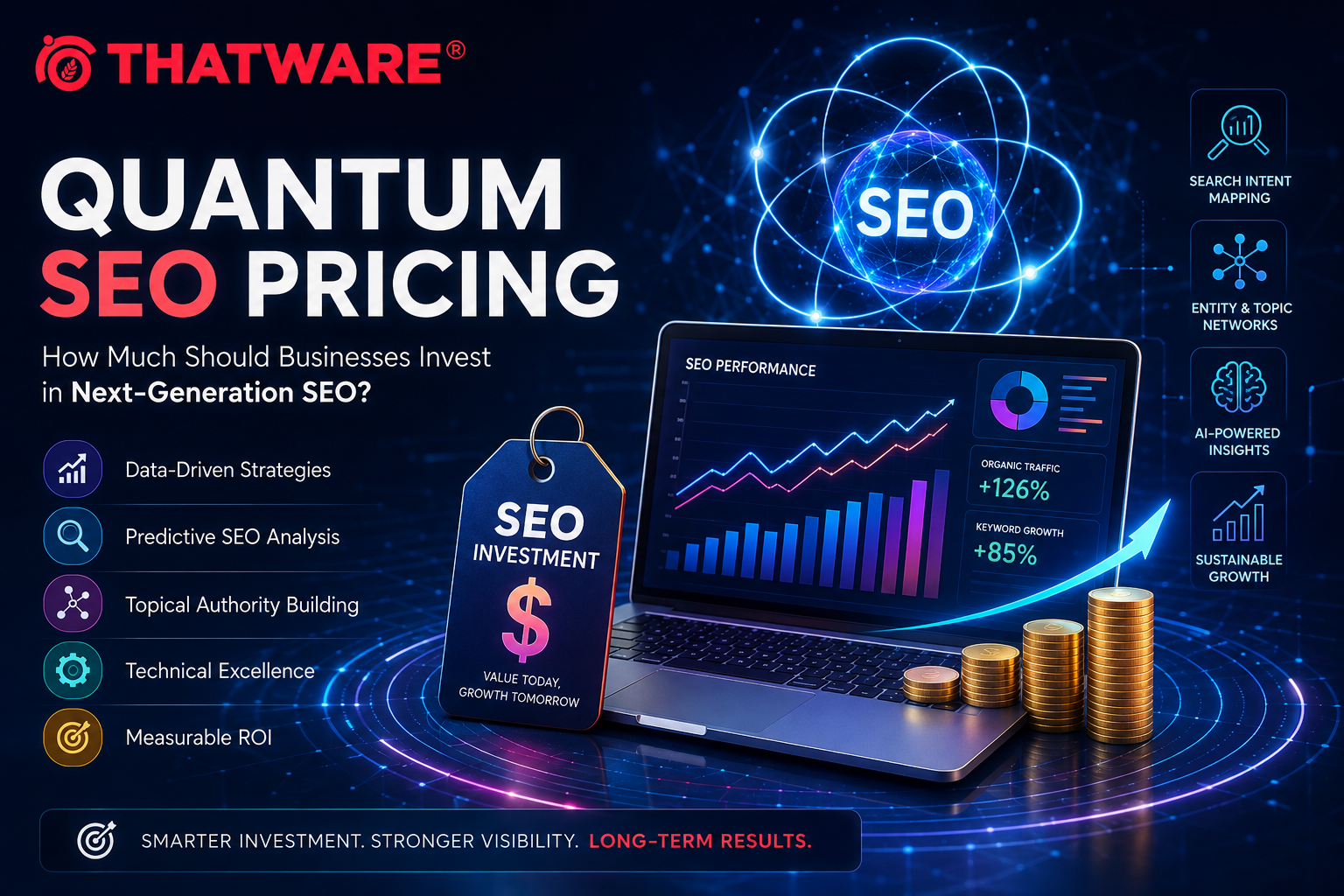
Search optimization is becoming more sophisticated as search engines increasingly understand entities, context, intent, relationships, and entire topics rather than isolated keywords. For businesses competing in crowded digital markets, traditional keyword targeting alone may not provide the strategic depth needed for sustainable organic growth. Thatware LLP approaches advanced SEO with data-driven strategies designed to help businesses identify opportunities, strengthen topical authority, and build search visibility around valuable customer journeys.
One question naturally follows: how much should a business expect to spend on quantum SEO?
The answer depends on far more than the number of keywords being targeted. Quantum SEO pricing can vary according to website size, industry competition, technical complexity, content requirements, authority-building needs, data analysis, and the level of ongoing optimization involved.
Rather than treating quantum-inspired SEO as a fixed-price product, businesses should evaluate it as a strategic growth investment. The right budget should correspond to the complexity of the search landscape and the commercial value of the opportunities being pursued.
What Is Quantum SEO and Why Does It Require a Different Budget?
Quantum-inspired SEO refers to advanced approaches that use large-scale data analysis, semantic relationships, predictive signals, search-intent modeling, and interconnected topic structures to improve organic search performance.
Traditional SEO may begin with a list of keywords and optimize individual pages around those terms. A more advanced approach considers how keywords, entities, topics, pages, users, competitors, and search intents interact across an entire website.
This broader methodology can involve:
- Semantic and entity analysis
- Advanced keyword clustering
- Search-intent mapping
- Topical authority development
- Competitor opportunity analysis
- Content architecture
- Technical SEO analysis
- SERP pattern monitoring
- Predictive content planning
- Continuous performance analysis
Because the process involves more strategic research and data interpretation, businesses should not evaluate pricing solely by comparing the monthly fee with a conventional SEO package.
The Main Factors Behind Quantum SEO Pricing
There is no universal price because every website presents a different optimization environment. Several variables can substantially influence the final investment.
Website Size and Complexity
A small business website with a few dozen important pages requires considerably less analysis than a large e-commerce platform containing thousands of product, category, location, and informational pages.
Larger websites may require:
- Enterprise-scale crawling
- Content consolidation
- Entity mapping
- Internal linking analysis
- Programmatic SEO evaluation
- Page-level prioritization
- Large-scale content planning
Consequently, website complexity is one of the first factors agencies should consider when developing a pricing strategy.
Industry Competition
Competition can dramatically affect the resources required to achieve meaningful organic visibility.
A business targeting a low-competition niche may need a relatively focused strategy. A company competing against established brands in finance, healthcare, SaaS, technology, legal services, or e-commerce may require substantially deeper research and execution.
This makes advanced SEO investment particularly important for businesses operating in highly competitive search environments.
Existing Domain Authority
An established website with strong content, quality backlinks, consistent organic traffic, and a technically healthy foundation may have a significant advantage over a new domain.
A newer website may require more foundational work before advanced strategies can generate their full impact.
Pricing can therefore reflect the amount of groundwork necessary to create a reliable search-growth foundation.
Content Production Requirements
Strategy is only valuable when it is translated into high-quality implementation.
Businesses should determine whether their SEO investment includes:
- Content briefs
- New articles
- Existing-content optimization
- Landing-page development
- Topic clusters
- Entity-focused content
- Editorial planning
- Content updates
A strategy-only engagement will naturally have different costs from a full-service program that includes research, writing, optimization, publishing, and performance monitoring.
Typical Quantum SEO Investment Models
Instead of focusing on one universal price, businesses can think about quantum SEO services through different engagement models.
Strategic Audit and Discovery
A strategic project can be suitable for businesses that want to understand their search landscape before committing to long-term execution.
This type of engagement may include:
- Website analysis
- Competitor research
- Search opportunity mapping
- Technical assessment
- Topic and entity analysis
- Content-gap identification
- Strategic recommendations
The primary benefit is clarity. Businesses can determine where their biggest organic opportunities exist before allocating a larger ongoing budget.
Monthly Optimization Program
A monthly program is better suited to businesses that need continuous research, implementation, measurement, and refinement.
Depending on the provider, an ongoing program may combine:
- Technical SEO
- Content strategy
- Semantic optimization
- Content production
- Internal linking
- Authority development
- SERP monitoring
- Competitor analysis
- Monthly reporting
This model recognizes that search visibility is not static. Competitors publish new content, search behavior changes, websites evolve, and search-engine systems continue to improve.
Enterprise-Level SEO Program
Large organizations often require a more customized approach.
Enterprise programs can involve multiple teams, large websites, international markets, thousands of URLs, multiple content categories, and complex organizational workflows.
For these businesses, enterprise SEO strategy may include centralized data analysis, automated workflows, scalable content systems, international SEO, advanced technical optimization, and cross-department coordination.
The cost is therefore determined by operational complexity rather than simply by the number of keywords.
How to Calculate a Realistic Quantum SEO Budget
A useful way to establish an SEO budget is to work backward from the business opportunity.
Step 1: Determine the Commercial Value of Organic Search
Start by estimating what a qualified organic visitor is worth to the business.
Consider:
- Average order value
- Lead value
- Conversion rate
- Customer lifetime value
- Repeat purchases
- Sales-cycle value
This creates a clearer picture of how much additional organic visibility could potentially contribute to revenue.
Step 2: Identify the Search Opportunity
Next, determine where meaningful opportunities exist.
Look beyond individual keywords and evaluate:
- Topic clusters
- Search intent
- Competitor weaknesses
- Content gaps
- Existing rankings
- SERP features
- Commercial landing pages
- High-value informational journeys
This is where predictive SEO analysis can help businesses prioritize opportunities instead of distributing resources equally across every possible keyword.
Step 3: Assess the Execution Gap
Ask what your internal team can realistically handle.
For example, you may already have:
- SEO specialists
- Writers
- Developers
- Designers
- Outreach specialists
If so, an external partner may primarily provide strategy and intelligence.
If these resources are unavailable internally, a full-service engagement may provide greater value.
Step 4: Establish a Measurement Framework
Your budget should connect to measurable outcomes.
Important metrics can include:
- Organic clicks
- Qualified organic traffic
- Keyword visibility
- Non-branded search growth
- Topical authority
- Organic conversions
- Revenue from organic search
- Conversion rate
- Cost per acquisition
Rankings remain useful, but they should not be the only measurement of success.
What Should a Quality Quantum SEO Service Include?
Businesses evaluating providers should look beyond attractive pricing.
A strong program should provide a transparent methodology and clearly defined deliverables.
Strategic Intelligence
The provider should explain:
- Why specific topics are being prioritized
- Which competitors represent the biggest threats
- Where content gaps exist
- Which pages have the greatest growth potential
- How the strategy connects to business objectives
Technical Optimization
Advanced strategy cannot compensate for fundamental technical problems.
A comprehensive program may evaluate:
- Crawlability
- Indexation
- Site architecture
- Internal links
- Page performance
- Structured data
- Canonicalization
- Duplicate content
- Mobile usability
Semantic Content Strategy
Content should be organized around meaningful topics and entities rather than isolated keyword repetitions.
A strong content architecture can help search engines understand:
- What the website specializes in
- Which subjects are closely related
- Which pages represent primary topics
- How supporting pages connect to core commercial pages
Continuous Performance Analysis
A one-time optimization can become outdated as competitors and search results evolve.
Ongoing analysis allows businesses to identify emerging opportunities, declining pages, content gaps, and changes in search behavior.
Warning Signs When Comparing Quantum SEO Providers
A low price is not automatically a bargain.
Businesses should be cautious when a provider:
Promises Guaranteed Rankings
No legitimate SEO strategy can guarantee specific Google rankings because search results depend on numerous external variables.
Uses Advanced Terminology Without Explaining the Method
Words such as AI, quantum, neural, predictive, semantic, or algorithmic should describe a genuine methodology—not simply decorate a sales pitch.
Ask the provider to explain what data is analyzed, what decisions are generated from that data, and how those decisions affect implementation.
Provides Only Keyword Reports
Keyword lists alone do not represent a sophisticated SEO strategy.
Businesses should expect broader analysis covering content, intent, technical health, competitors, entities, and website architecture.
Quantum SEO Pricing vs. Traditional SEO Pricing
The biggest difference should not simply be the monthly fee.
Traditional SEO packages may focus heavily on routine optimization activities, while a more advanced methodology emphasizes research, interconnected search opportunities, predictive analysis, semantic relationships, and continuous prioritization.
|
Factor |
Traditional SEO |
Quantum-Inspired SEO |
|
Keyword research |
Keyword lists |
Opportunity and intent modeling |
|
Content strategy |
Individual topics |
Connected topic ecosystems |
|
Optimization |
Page-focused |
Website-wide |
|
Competitor research |
Periodic |
Continuous strategic analysis |
|
Search intent |
Keyword-level |
Journey and contextual |
|
Reporting |
Rankings and traffic |
Broader growth signals |
|
Strategy |
Often campaign-based |
Data-led and adaptive |
The objective is not necessarily to replace conventional SEO techniques. Instead, advanced approaches can build upon technical SEO, content optimization, authority building, and other established practices.
How to Judge Whether the Investment Is Worth It
The right question is not simply:
“How much does quantum SEO cost?”
A better question is:
“What business value can the investment realistically create?”
Suppose an SEO program increases qualified organic traffic but produces visitors who rarely convert. The apparent traffic growth may have limited commercial value.
Conversely, a smaller increase in highly relevant organic traffic can generate substantial business results if those visitors have strong purchase or lead intent.
This is why SEO ROI measurement should form part of the strategy from the beginning.
Businesses should compare the investment against:
- Additional qualified leads
- Additional sales
- Customer acquisition costs
- Organic revenue
- Lifetime customer value
- Long-term traffic potential
A Smarter Way to Approach Quantum SEO in 2026
Businesses do not necessarily need to begin with the largest possible SEO program.
A more practical approach can be to identify a high-value search segment, establish a measurable baseline, optimize the relevant technical and content ecosystem, and evaluate performance over a defined period.
This creates an evidence-based framework for scaling the investment.
The process can be summarized as:
Research → Prioritize → Build → Optimize → Measure → Refine → Scale
This approach reduces unnecessary spending while giving businesses a clearer understanding of where advanced SEO produces measurable value.
The Future of Quantum SEO Investment
Search optimization is moving toward increasingly contextual and interconnected systems. Businesses that continue treating SEO as a simple exercise in inserting keywords may struggle to compete against organizations investing in deeper content ecosystems and data-driven strategies.
The future is likely to place greater emphasis on:
- Search intent
- Entity relationships
- Topical authority
- Predictive opportunity identification
- AI-assisted analysis
- Content quality
- User experience
- First-party business data
- Continuous optimization
As these areas become more important, quantum SEO pricing should increasingly be viewed in relation to the sophistication, scale, and business value of the program rather than as a simple monthly expense.
Conclusion
Quantum SEO pricing should not be viewed as a fixed monthly expense or compared solely with traditional SEO packages. The right investment depends on the size and complexity of the website, industry competition, existing authority, content requirements, technical needs, and the level of strategic analysis required.

 English
 Arabic
 French
 Spanish
 Portuguese
 Deutsch
 Turkish
 Dutch
Dutch
 Italiano
 Russian
 Romaian
 Portuguese (Brazil)
