
How to Build an Algorithm-Resilient SEO Strategy That Keeps Rankings Strong in 20
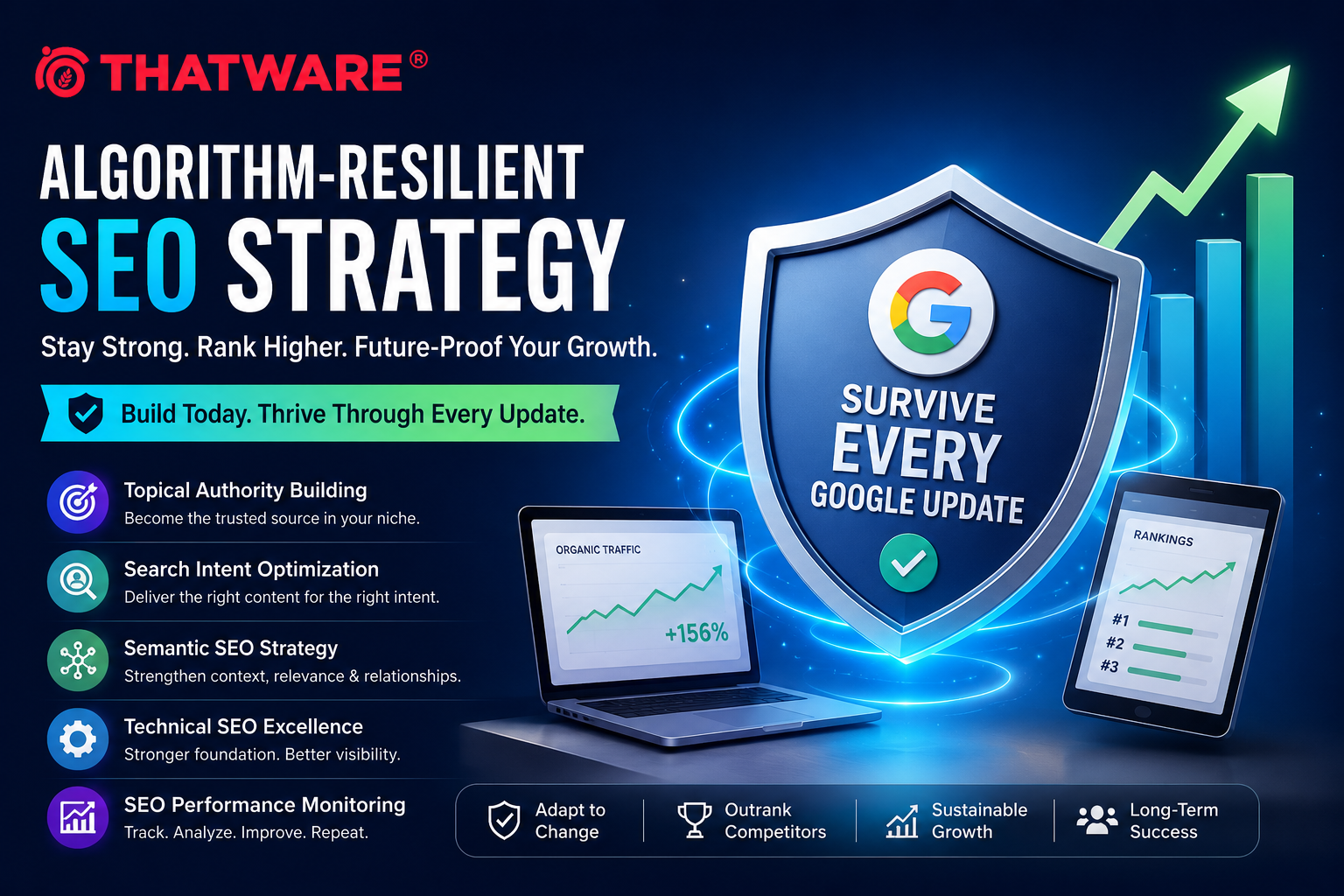
Google search is no longer a static environment where businesses can publish keyword-focused pages, build a few backlinks, and expect consistent rankings forever. Search systems continue to evolve toward understanding context, intent, entities, content quality, and the overall usefulness of a website. For brands investing in long-term organic growth, the real objective should therefore be creating a search presence capable of adapting to change.
At Thatware LLP, the focus is on developing SEO strategies that combine intelligent optimization, content depth, technical foundations, and user-focused search experiences. Rather than treating every Google update as an emergency, businesses can prepare in advance by creating a website that demonstrates genuine expertise and consistently satisfies search intent.
This approach requires more than optimizing individual pages. It requires a connected strategy built around algorithm-resistant SEO, topical authority building, search intent optimization, semantic SEO strategy, and SEO performance monitoring.
Why Google Algorithm Changes Affect Businesses Differently
A Google update does not necessarily affect every website in the same way. Two businesses targeting similar keywords can experience completely different outcomes because their underlying websites have different levels of content quality, authority, technical health, and user satisfaction.
One website may depend heavily on outdated content patterns, while another has developed a comprehensive information ecosystem around its subject.
The Problem With Short-Term SEO Tactics
Short-term SEO often focuses on visible ranking factors without considering how those factors work together.
For example, a website might have:
- Optimized title tags
- Keyword-rich headings
- A large backlink profile
- Hundreds of blog posts
- Strong technical performance
Yet rankings can remain unstable if the content does not genuinely satisfy users.
Search visibility becomes much more sustainable when optimization supports usefulness instead of attempting to manipulate individual ranking signals.
Algorithm Volatility Is Often a Strategic Warning
A sudden ranking decline should not always be viewed simply as a technical problem.
It can reveal deeper weaknesses such as:
- Thin or repetitive content
- Poor topical coverage
- Weak internal linking
- Search-intent mismatches
- Outdated information
- Unclear website expertise
- Low-value pages competing with stronger resources
- Poor content-to-query alignment
The right response is therefore diagnosis first and reaction second.
The Five Foundations of an Algorithm-Resilient SEO Strategy
A resilient SEO strategy does not attempt to predict Google's exact next move. Instead, it builds qualities that remain valuable even when ranking systems change.
1. Build Genuine Topical Authority
Topical authority building means demonstrating comprehensive knowledge around a subject rather than publishing isolated articles for unrelated keywords.
Suppose a company operates in digital marketing. Publishing one article about SEO may produce limited authority. A stronger content ecosystem could cover:
- Technical SEO
- On-page optimization
- Content strategy
- Local SEO
- Ecommerce SEO
- International SEO
- Search intent
- Structured data
- Internal linking
- SEO analytics
- Conversion optimization
These pages can then be connected through meaningful internal links.
The objective is not simply to publish more content. The objective is to make the website a useful destination for an entire topic.
2. Optimize for Search Intent, Not Just Keywords
A keyword tells you what someone typed. Search intent provides a better understanding of what that person actually wants.
A query can represent different needs:
- Learning about a subject
- Comparing solutions
- Finding a product
- Evaluating a service
- Solving a specific problem
- Completing a transaction
A page targeting the right keyword but answering the wrong intent may struggle to maintain visibility.
Search intent optimization should therefore influence the page format, information depth, examples, calls to action, headings, and supporting resources.
3. Create Content With Real Information Gain
Publishing another version of information that already exists online rarely creates a meaningful competitive advantage.
High-value content should add something useful.
That might include:
- Original examples
- First-hand observations
- Data analysis
- Practical frameworks
- Expert commentary
- Detailed comparisons
- Step-by-step processes
- Updated statistics
- Unique explanations
The question should not simply be, “Does this page contain the target keyword?”
A better question is:
“What does this page give the reader that competing pages do not?”
That mindset creates stronger content assets.
4. Strengthen Semantic Connections Across the Website
Modern search engines increasingly evaluate relationships between concepts rather than treating every keyword as an isolated phrase.
A semantic SEO strategy helps search engines understand:
- What the website specializes in
- Which topics are closely related
- How pages support one another
- Which entities are important
- What individual sections of content mean within a broader context
For example, a page about technical SEO can naturally connect to crawling, indexing, canonicalization, structured data, Core Web Vitals, JavaScript SEO, XML sitemaps, and internal linking.
These relationships make the website easier for both users and search systems to understand.
5. Monitor Performance Before Problems Become Major
SEO should not be treated as a set-and-forget activity.
SEO performance monitoring allows businesses to identify early changes in:
- Organic clicks
- Impressions
- Ranking distribution
- Indexed pages
- Search visibility
- Conversion rates
- Traffic by landing page
- Query performance
- Crawl issues
A small decline in a group of related pages may reveal an emerging problem before it becomes a major traffic loss.
Technical SEO Still Provides the Foundation
Content quality cannot compensate for a website that search engines struggle to crawl, render, or index.
A resilient strategy should regularly evaluate technical fundamentals.
Crawlability and Indexation
Check whether important pages can be discovered and indexed correctly.
Review:
- Robots directives
- XML sitemaps
- Canonical tags
- Redirect chains
- Broken links
- Duplicate URLs
- Indexing anomalies
- Orphan pages
Website Experience
A technically functional website should also provide a smooth user experience.
Important considerations include:
- Mobile usability
- Page loading performance
- Core Web Vitals
- Navigation
- Readability
- Intrusive elements
- Clear content hierarchy
Technical optimization should support the user's journey rather than become an isolated checklist.
Why Content Pruning Can Improve SEO Quality
More URLs do not automatically mean more organic traffic.
Over time, websites often accumulate:
- Outdated blog posts
- Duplicate articles
- Thin pages
- Underperforming landing pages
- Obsolete service pages
- Keyword cannibalization
- Content with little search demand
Instead of continuously adding new pages, businesses should periodically evaluate existing content.
Four Possible Actions for Weak Content
A low-performing page can be:
Updated:
Refresh facts, examples, statistics, and recommendations.
Expanded:
Add missing information and improve topical coverage.
Consolidated:
Combine overlapping pages into one stronger resource.
Removed:
Eliminate pages that provide little value and have no strategic purpose.
This creates a cleaner and more useful website.
Internal Linking Should Follow Topic Relationships
Internal links are more effective when they help users discover logically connected information.
Instead of randomly linking pages using exact-match anchor text, build pathways around user needs.
For example:
Pillar page → Supporting guide → Detailed subtopic → Practical resource
This structure can help distribute authority while making the website easier to navigate.
Create Logical Content Hubs
A strong content hub may contain:
- One comprehensive pillar page
- Several supporting articles
- Frequently asked questions
- Service or product pages
- Relevant case studies
- Supporting resources
The resulting structure communicates topical relationships much more clearly than a collection of disconnected blog posts.
Use Data to Diagnose Ranking Changes
When organic performance changes, avoid immediately rewriting every affected page.
First, identify the pattern.
Compare Different Page Groups
Ask:
- Did only one URL decline?
- Did an entire topic cluster decline?
- Did informational queries change?
- Did commercial queries change?
- Did branded traffic remain stable?
- Did impressions fall before clicks?
- Did competitors gain visibility?
- Did conversions change along with traffic?
Patterns often reveal more than individual keyword movements.
Separate Algorithm Effects From Normal Fluctuations
Not every ranking movement is caused by a Google update.
Traffic can change because of:
- Seasonality
- Search demand
- Competitor activity
- SERP feature changes
- Website changes
- Tracking issues
- Market trends
- Changes in user behavior
A disciplined analysis prevents businesses from making unnecessary SEO changes.
How AI Changes the Content Strategy
AI has dramatically increased the volume of content that can be produced.
That makes originality and expertise even more important.
Businesses can use AI to assist with:
- Research organization
- Content briefs
- Topic discovery
- Data classification
- Content auditing
- Internal-link suggestions
- SERP analysis
- Content gap identification
However, publishing large quantities of generic material without meaningful editorial value can create a website filled with pages that look similar to thousands of others.
The competitive advantage increasingly comes from combining technology with:
- Human expertise
- Original insights
- Editorial judgment
- Brand experience
- Accurate research
- Useful examples
AI should accelerate quality—not replace it.
A Practical Framework for Future-Proof SEO
Businesses looking to improve their long-term organic visibility can follow a simple cycle.
Step 1: Audit the Existing Website
Identify technical problems, weak content, duplicate topics, outdated pages, and important content gaps.
Step 2: Map the Topic Ecosystem
Determine the core subjects the business should be known for and identify related subtopics.
Step 3: Match Pages to Search Intent
Make sure each important URL has a clear purpose and satisfies the expectations behind its target queries.
Step 4: Improve Existing Content
Upgrade valuable pages before producing large quantities of new content.
Step 5: Build Strong Internal Connections
Connect related resources through logical content hubs and contextual internal links.
Step 6: Add Original Value
Introduce examples, insights, data, experience, and information that competitors cannot easily replicate.
Step 7: Monitor and Refine
Track organic performance continuously and use data to determine what needs improvement.
This cycle is much more sustainable than rebuilding an SEO strategy after every algorithm announcement.
Common SEO Mistakes That Increase Algorithm Risk
Some practices make websites unnecessarily vulnerable to ranking changes.
Publishing for Keywords Alone
A keyword should guide content planning, not dictate the entire page.
Creating Too Many Similar Pages
Multiple pages targeting almost identical search intent can dilute relevance and create unnecessary competition within the same website.
Ignoring Older Content
A website's strongest pages can gradually lose value if information becomes outdated.
Chasing Every Ranking Signal
SEO becomes inefficient when teams constantly change strategies based on speculation about individual ranking factors.
Measuring Only Rankings
Rankings matter, but they are not the final business outcome.
Also measure:
- Organic traffic
- Qualified leads
- Revenue
- Engagement
- Conversion rates
- Returning users
- Visibility across important topic groups
What Sustainable SEO Looks Like in 2026
The strongest SEO strategies are becoming less dependent on shortcuts and more dependent on building digital assets that deserve visibility.
A sustainable search presence combines:
Expertise + Useful Content + Technical Quality + Strong Architecture + Search Intent + Continuous Improvement
This does not mean rankings will never fluctuate. No legitimate SEO strategy can guarantee that.
Instead, the objective is to create a website capable of recovering, adapting, and continuing to generate value when the search environment changes.
Conclusion
Google algorithm changes are unavoidable, but constant SEO panic does not have to be.
Brands can reduce their dependence on short-term ranking tactics by building comprehensive topic coverage, improving search intent alignment, strengthening technical foundations, maintaining content quality, and monitoring organic performance consistently.
The future of SEO belongs to websites that provide genuine value rather than simply imitating the pages that currently rank. By investing in algorithm-resistant SEO, topical authority building, search intent optimization, semantic SEO strategy, and SEO performance monitoring, businesses can create a stronger foundation for sustainable organic growth.
The goal is not to “beat” the next Google update. The goal is to build a website that continues to deserve visibility even as search systems become more sophisticated.
Frequently Asked Questions
1. What is an algorithm-resilient SEO strategy?
An algorithm-resilient SEO strategy focuses on long-term website quality rather than short-term ranking manipulation. It combines useful content, topical authority, technical SEO, strong website architecture, search intent alignment, and continuous performance analysis.
2. How can topical authority protect organic rankings?
Topical authority helps establish a website as a comprehensive resource within a specific subject. Supporting related topics with useful content and contextual internal links can create stronger relationships between pages and improve the overall relevance of the website.
3. Should businesses change their SEO strategy after every Google update?
No. Businesses should first analyze whether an update has caused a meaningful and sustained performance change. Making large-scale changes based solely on temporary fluctuations or speculation can create more problems than it solves.
4. Is AI-generated content harmful for SEO?
AI itself is not the core issue. The important consideration is whether the resulting content provides genuine value, accuracy, originality, and usefulness. AI can support research and content workflows, but human expertise and editorial judgment remain important for producing high-quality resources.

 English
 Arabic
 French
 Spanish
 Portuguese
 Turkish
 Dutch
Dutch
 Italiano
 Russian
 Romaian
 Portuguese (Brazil)
 Greek
Greek
