
Cognitive Intelligence SEO Services: The Next Evolution of Search Visibility
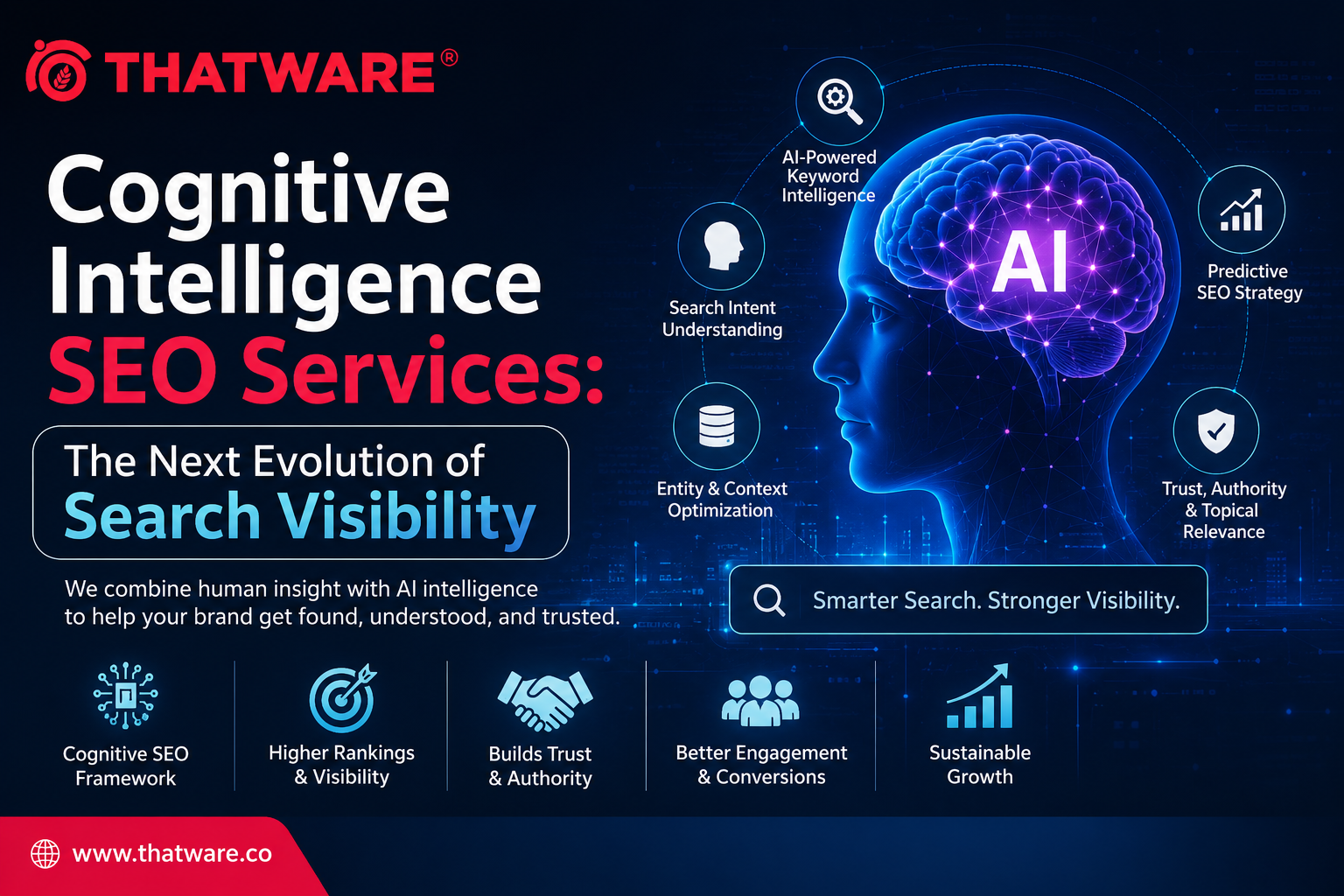
Search is no longer limited to typing keywords into Google and choosing one of ten blue links. Users now ask questions through AI assistants, generative search platforms, voice interfaces, and conversational engines. These systems interpret context, intent, entities, relationships, and meaning before producing an answer.
This shift is creating demand for cognitive intelligence seo services that go beyond conventional keyword optimization. Instead of simply helping a webpage rank for a phrase, cognitive intelligence approaches attempt to understand how search systems interpret information and how users think, search, compare, and make decisions.
For brands competing in this changing environment, cognitive intelligence seo services can become an important part of a broader AI-search strategy. ThatWare LLP combines AI, semantic search, entity optimization, LLM SEO, Answer Engine Optimization (AEO), and Generative Engine Optimization (GEO) to help businesses improve visibility across traditional and AI-powered discovery systems.
What Are Cognitive Intelligence SEO Services?
Cognitive intelligence seo services refer to an advanced SEO approach focused on understanding search behavior, user intent, semantic relationships, contextual meaning, and the way intelligent systems retrieve and interpret information.
Traditional SEO often concentrates on areas such as:
- Keyword targeting
- Technical optimization
- Content creation
- Backlink acquisition
- Page experience
- Search rankings
Cognitive intelligence SEO expands this approach by asking a deeper question: Why would a search or AI system consider this brand a trustworthy answer?
A cognitive approach can examine relationships between topics, entities, concepts, questions, content, competitors, and user journeys. This makes cognitive intelligence seo services particularly relevant as search engines increasingly use artificial intelligence to understand content.
ThatWare's current SEO ecosystem reflects this evolution through services including LLM SEO, AEO, GEO, Semantic SEO, Hyper-Intelligence SEO, AIEO, and CRSEO.
Why Cognitive Intelligence SEO Matters in AI Search
The growth of AI-generated answers has changed what visibility means.
A company may rank well traditionally but still have limited visibility when a customer asks an AI system for recommendations. Conversely, a brand with strong topical authority and consistent digital signals may become part of an AI-generated answer even when the user never visits a traditional search-results page.
This is why cognitive intelligence seo services focus on multiple layers of search visibility.
Understanding Search Intent
Search intent is more than identifying whether a keyword is informational, commercial, or transactional.
Modern search behavior can involve several intentions simultaneously. For example, someone searching for "best enterprise SEO agency" may want:
- A definition of enterprise SEO.
- A comparison of agencies.
- Pricing information.
- Proof of expertise.
- Case studies.
- A service provider to contact.
Effective cognitive intelligence seo services analyze these interconnected needs and build content that addresses the complete decision journey.
Building Semantic Relationships
AI systems do not necessarily interpret a page through isolated keywords. They can understand relationships between concepts, entities, topics, and supporting information.
For example, an SEO agency discussing AI search may need relevant connections between:
AI SEO → LLM SEO → AEO → GEO → semantic SEO → entities → search intent → AI visibility.
Creating these relationships can strengthen topical coverage and make a website easier for intelligent retrieval systems to understand.
How Cognitive Intelligence SEO Services Work
A successful cognitive SEO program requires more than publishing AI-generated articles. It needs structured research, optimization, monitoring, and continuous refinement.
1. Search and Competitor Intelligence
The first stage involves examining competitors, search results, content gaps, keyword relationships, entities, backlinks, and visibility opportunities.
The objective is to understand not only what competitors rank for, but also why their content may be considered relevant or authoritative.
2. Semantic and Entity Optimization
Entities represent identifiable people, organizations, products, places, concepts, and other subjects.
A website becomes easier to understand when its content clearly establishes relationships between relevant entities.
This is an important component of cognitive intelligence seo services because semantic clarity can help search systems connect a brand with its area of expertise.
3. Content Intelligence
Content should answer real questions rather than simply repeat keywords.
A cognitive content strategy can identify:
- Frequently asked questions
- Related concepts
- Search intent variations
- Missing information
- Comparison opportunities
- Supporting topics
- Conversion-stage questions
This creates content ecosystems rather than isolated blog posts.
4. AI Search Optimization
Modern SEO increasingly extends beyond traditional Google rankings.
ThatWare states that its approach addresses AI-powered discovery environments including Google AI Overviews, ChatGPT search, Perplexity, and voice assistants.
Therefore, cognitive intelligence seo services can work alongside GEO, AEO, and LLM SEO to improve how a brand's information is structured and presented for AI-driven discovery.
5. Continuous Measurement
Search systems continue to evolve. A strategy that works today may require adjustment tomorrow.
That makes monitoring essential.
Businesses should track:
- Organic rankings
- Organic traffic
- Click-through rates
- Conversions
- Brand mentions
- AI visibility
- Citation opportunities
- Competitor visibility
- Content performance
The objective is not simply to produce more pages. It is to continuously improve the quality and discoverability of the brand's digital information.
Cognitive Intelligence SEO vs Traditional SEO
Traditional SEO remains valuable, but the scope of search optimization is expanding.
Traditional SEO generally emphasizes ranking pages for relevant search queries. Cognitive intelligence seo services take a broader perspective by considering how systems interpret information, how concepts connect, and how users progress from questions to decisions.
A modern strategy can therefore combine:
- Technical SEO for crawlability and website health
- Semantic SEO for contextual understanding
- Entity SEO for subject recognition
- LLM SEO for large language model visibility
- AEO for direct-answer environments
- GEO for generative search
- Content strategy for topical authority
- Conversion optimization for business outcomes
This integrated approach is consistent with ThatWare's positioning around AI SEO, LLM SEO, AEO, GEO, semantic authority, and search engineering.
Practical Benefits of Cognitive Intelligence SEO Services
Businesses investing in cognitive intelligence seo services can potentially improve visibility across a wider range of discovery experiences.
Stronger Topical Authority
Comprehensive coverage helps demonstrate expertise around a subject instead of relying on individual keyword pages.
Better Content Relevance
Content can be mapped to specific user questions, search journeys, entities, and contextual relationships.
Greater AI Search Readiness
As customers increasingly interact with AI-generated answers, structured and authoritative information becomes increasingly important.
Improved User Experience
Understanding intent helps businesses provide answers that are clearer, more useful, and closer to what users actually need.
Scalable Search Strategy
A structured intelligence-driven methodology can be applied across large websites, multiple markets, industries, and content categories.
Why Choose ThatWare LLP?
ThatWare LLP presents itself as an AI-focused search company combining AI, data science, semantic engineering, LLM SEO, AEO, GEO, and advanced SEO methodologies. Its website states that the company has worked with more than 9,400 clients and reports a 95% retention rate.
Its service ecosystem includes Cognitive Resonance SEO (CRSEO), Hyper-Intelligence SEO, Semantic SEO, AI SEO, LLM SEO, AEO, and GEO.
The company also highlights a search-engineering perspective that studies algorithm behavior, search patterns, AI retrieval mechanisms, entities, and semantic authority.
For organizations preparing for AI-driven search, this broader framework can provide a more future-focused alternative to treating SEO as nothing more than keyword ranking.
Best Practices for Implementing Cognitive Intelligence SEO
Businesses can start with a practical framework:
- Audit existing content to identify gaps, duplication, weak topical coverage, and outdated information.
- Map important entities associated with the business, products, services, customers, and industry.
- Research user questions at every stage of the customer journey.
- Build topic clusters around core commercial and informational subjects.
- Strengthen internal linking between related pages.
- Improve structured information so important subjects and relationships are easier to interpret.
- Develop authoritative external signals through credible mentions, references, and relevant links.
- Measure AI and traditional search visibility rather than relying exclusively on keyword rankings.
- Continuously update the strategy as search and AI systems evolve.
The most important principle is consistency. A brand should communicate the same expertise, identity, and topical relationships throughout its website and broader digital presence.
The Future of Cognitive Intelligence SEO
Search is moving toward an environment where users expect direct, contextual, personalized answers.
That means businesses need to think beyond ranking individual pages. They need to become recognizable sources of reliable information.
This is where cognitive intelligence seo services can play an important role. By combining user intent, semantic relationships, entity understanding, content intelligence, AI search optimization, and traditional SEO fundamentals, businesses can prepare for a discovery ecosystem that increasingly relies on intelligent systems.
The future of SEO will not eliminate traditional optimization. Instead, it will expand it.
Brands that understand both search engines and AI-driven discovery will be better positioned to capture attention wherever customers search for answers.
Conclusion
The evolution from traditional search to AI-powered discovery is changing how brands need to approach online visibility. Cognitive intelligence seo services provide a framework for understanding not just keywords and rankings, but also intent, context, entities, relationships, and intelligent information retrieval.
For businesses looking to prepare their websites for the next generation of search, combining cognitive intelligence with technical SEO, semantic optimization, LLM SEO, AEO, and GEO can create a stronger and more adaptable visibility strategy.
Explore the AI-focused search solutions offered by ThatWare LLP and build a strategy designed for the changing search landscape.
Frequently Asked Questions
1. What are cognitive intelligence SEO services?
Cognitive intelligence seo services use advanced SEO methodologies to analyze user intent, semantic relationships, entities, content context, and search behavior. The objective is to make websites more understandable and relevant across traditional and AI-powered search environments.
2. Are cognitive intelligence SEO services different from traditional SEO?
Yes. Traditional SEO primarily focuses on improving organic search performance through technical SEO, keywords, content, links, and other ranking factors. Cognitive intelligence seo services broaden the approach by considering contextual understanding, semantic relationships, entities, AI retrieval, and user decision-making.
3. Can cognitive intelligence SEO help with AI search?
It can support an AI-search strategy by improving content structure, topical authority, semantic relationships, entity clarity, and overall digital information quality. It can work alongside GEO, AEO, and LLM SEO strategies.
4. Does cognitive SEO replace traditional SEO?
No. The strongest approach combines traditional SEO fundamentals with advanced intelligence-driven strategies. Technical health, useful content, authoritative links, strong user experience, and search visibility remain important.
5. Why work with ThatWare LLP for cognitive SEO?
ThatWare LLP combines AI SEO with services and frameworks covering LLM SEO, AEO, GEO, Semantic SEO, Hyper-Intelligence SEO, and Cognitive Resonance SEO. Its website describes an approach centered on AI systems, semantic authority, search engineering, and AI-driven research.

 Arabic
 French
 Spanish
 Portuguese
 Deutsch
 Turkish
 Dutch
Dutch
 Italiano
 Russian
 Romaian
 Portuguese (Brazil)
 Greek
Greek
