
CRSEO and Semantic SEO: Building Topical Authority Through Cognitive Search Optimization
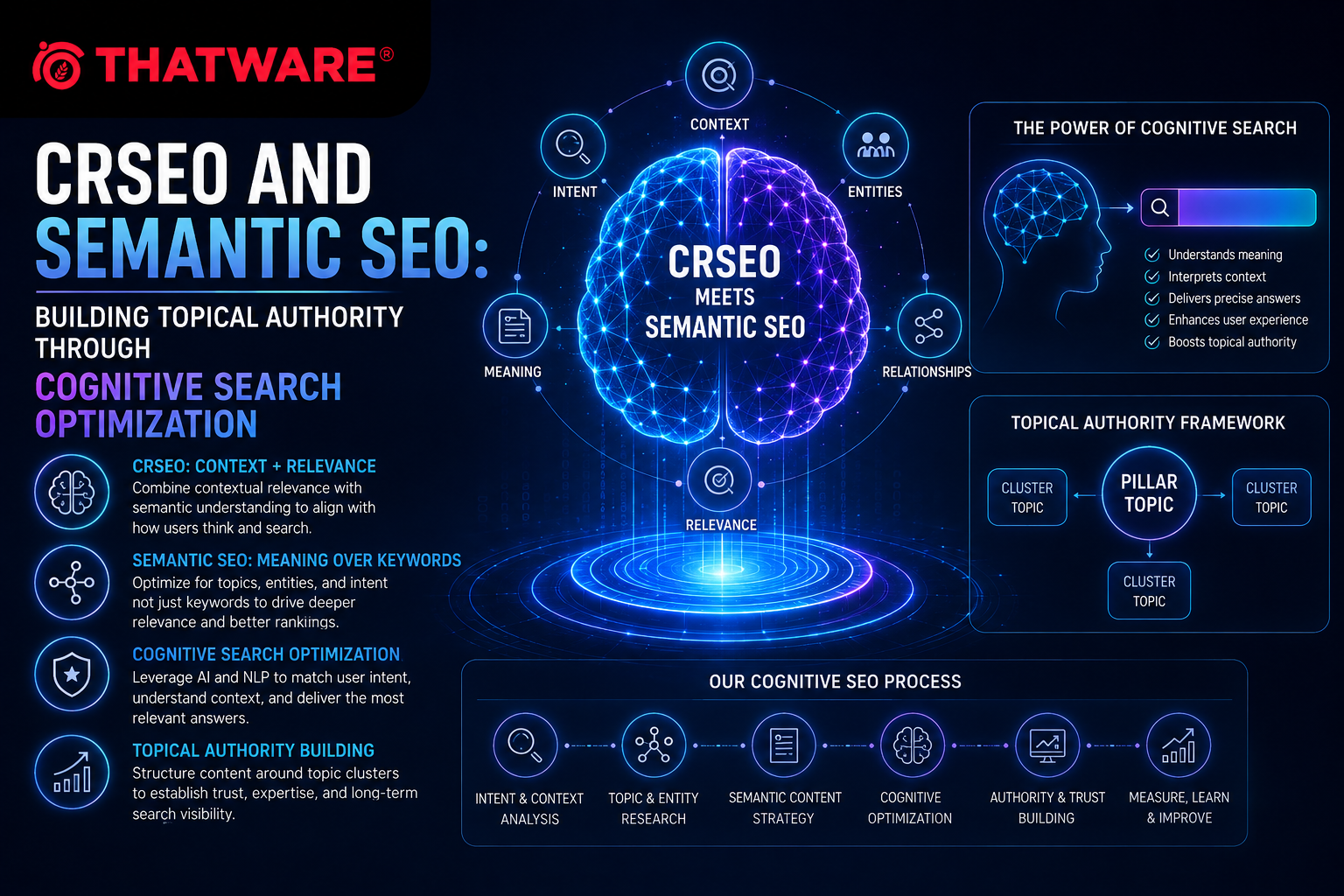
Search is no longer simply about matching keywords with web pages. Modern users expect answers that understand their intent, address their concerns, and help them make decisions. At the same time, search engines increasingly evaluate whether content demonstrates meaningful expertise across an entire subject.
That is where Thatware LLP brings together CRSEO, Semantic SEO, Cognitive search optimization, Topical authority, and User psychology in content strategy to create a more complete approach to organic visibility.
The concept behind CRSEO -Cognitive Resonance Search Engine Optimization—is especially useful when combined with semantic strategies. While Semantic SEO helps search engines understand relationships between topics, entities, concepts, and content, CRSEO focuses on whether that information actually resonates with the person searching.
The result is a strategy that does more than attract clicks. It aims to create useful, relevant, trustworthy experiences that satisfy users while strengthening a website's overall search presence.
Understanding the Relationship Between CRSEO and Semantic SEO
Semantic SEO is fundamentally about meaning and context. Instead of concentrating on one keyword repeatedly, it builds comprehensive coverage around a subject.
For example, a website targeting retirement planning may need content covering:
-
Retirement planning fundamentals
-
401(k) accounts
-
IRA and Roth IRA options
-
Contribution limits
-
Tax considerations
-
Social Security
-
Withdrawal strategies
-
Estate planning
-
Retirement income planning
Together, these topics create a connected content ecosystem.
This is how Topical authority develops. A website demonstrates that it understands a subject from multiple relevant perspectives rather than publishing isolated articles around individual keywords.
Google's current guidance similarly emphasizes original, helpful, comprehensive, people-first content rather than content created primarily to manipulate rankings.
However, semantic coverage alone does not guarantee that content will connect with its audience.
A page can be technically comprehensive while still feeling cold, confusing, generic, or disconnected from the user's immediate concern.
This is the gap that CRSEO addresses.
What CRSEO Adds to the Search Strategy
CRSEO introduces a cognitive and psychological layer to content creation.
Instead of asking only, "What information does this topic require?" a CRSEO strategy also asks:
-
What does the user already know?
-
What problem caused them to search?
-
Are they researching, comparing, evaluating, or ready to act?
-
What concerns could prevent them from trusting the information?
-
What information should appear first?
-
How much certainty does the user need?
-
What tone will make the explanation easier to understand?
These questions make User psychology in content strategy an important part of modern search optimization.
Consider a person searching for "how much should I save for retirement?"
A conventional article might immediately provide formulas, percentages, and financial terminology.
A cognitive approach recognizes that the searcher may actually be asking a deeper question: "Am I doing enough?"
The content can therefore acknowledge the uncertainty first, explain the factors affecting retirement savings, and then introduce calculations and examples.
That difference may seem small, but it changes how the content is experienced.
Cognitive Search Optimization Turns Strategy Into Execution
Cognitive search optimization can be viewed as an execution framework that works alongside semantic content architecture.
Semantic SEO determines what needs to be covered and how different topics connect.
Cognitive search optimization helps determine how those topics should be presented.
This creates a useful division:
Semantic SEO asks:
"What should this website cover?"
CRSEO asks:
"How should this information be communicated to this particular searcher?"
Cognitive search optimization considers factors such as:
-
Search intent
-
Emotional context
-
Information complexity
-
Decision-making stage
-
Trust barriers
-
Content structure
-
Tone and language
-
User expectations
When these elements work together, content becomes both structurally comprehensive and psychologically relevant.
The referenced CRSEO framework makes a similar distinction: semantic optimization addresses topical coverage, while cognitive resonance addresses the connection between information and the individual consuming it.
Building Topical Authority With a Human-Centered Architecture
Topical authority should not be treated as simply publishing more articles.
A strong authority strategy begins with a central topic and expands into closely related subtopics, questions, entities, use cases, and decision points.
For example, an ecommerce website focused on technical SEO might create a central guide around technical SEO and then build supporting content around:
-
Crawlability
-
Indexation
-
Structured data
-
Site architecture
-
Core Web Vitals
-
Canonical URLs
-
JavaScript SEO
-
Internal linking
-
Mobile optimization
-
Technical SEO audits
Internal links connect these resources, helping users navigate naturally through the subject.
However, CRSEO can make this architecture more effective by identifying the psychological needs behind each search.
A beginner may need reassurance and simple explanations.
An experienced SEO professional may want technical specifications and implementation details.
A business owner may care more about risk, cost, timelines, and expected outcomes.
The topic is the same, but the cognitive context is different.
This is why User psychology in content strategy should influence content structure rather than being treated as an afterthought.
Practical Ways to Apply CRSEO to Content
Businesses can begin integrating CRSEO without completely rebuilding their websites.
Start With Searcher Context
Before writing an article, identify what the user is trying to accomplish.
Ask whether the searcher is:
-
Learning
-
Comparing options
-
Solving a problem
-
Validating a decision
-
Looking for a service
-
Preparing to purchase
This provides the cognitive context required for better content execution.
Map Topics Semantically
Create topic clusters instead of standalone keyword pages.
Identify the main concept, related entities, supporting questions, subtopics, and adjacent subjects.
This strengthens Semantic SEO and creates a foundation for Topical authority.
Match Content Depth to Intent
Not every query requires a 3,000-word article.
A straightforward definition may need only a concise explanation, while a complex purchasing decision may require comparisons, examples, risks, processes, and FAQs.
Google explicitly notes that there is no preferred word count; usefulness and completeness matter more than writing to an arbitrary length.
Build Trust Before Asking for Action
A user who does not trust the information is unlikely to convert.
Use:
-
Clear explanations
-
Relevant evidence
-
Author information
-
First-hand insights where appropriate
-
Transparent claims
-
Helpful examples
-
Logical internal links
This supports the broader E-E-A-T principles Google discusses in its content guidance.
Measure Both Search and Behavioral Outcomes
A combined CRSEO and Semantic SEO strategy should evaluate more than rankings.
Useful measurements can include:
-
Organic impressions
-
Click-through rate
-
Rankings
-
Engaged sessions
-
Scroll behavior
-
Return visits
-
Leads
-
Conversions
-
Assisted conversions
The referenced article similarly distinguishes ranking and topical metrics from behavioral and conversion metrics when evaluating the combined approach.
Why CRSEO Matters for Modern Search
Search behavior is becoming increasingly conversational and specific. Google says users of its AI search experiences are asking longer, more specific questions and using follow-up questions to explore subjects more deeply.
That development makes context increasingly important.
A website that only targets isolated keywords can struggle to provide the depth users expect.
A website built around Semantic SEO can establish broader subject coverage.
A website that adds CRSEO and Cognitive search optimization can make that coverage more relevant to the people consuming it.
The combination creates a stronger content philosophy:
Understand the topic. Understand the searcher. Connect the two.
That is the central value of CRSEO.
CRSEO, Semantic SEO, and the Future of Content Strategy
The future of SEO is not simply about adding more keywords or publishing more pages.
It is about creating information ecosystems that search engines can understand and people can trust.
Semantic SEO provides the structural foundation.
Topical authority demonstrates depth.
Cognitive search optimization improves the execution.
User psychology in content strategy helps businesses understand why people search and what they need at different stages.
CRSEO connects these elements by making the human experience part of the optimization process.
This approach is also consistent with Google's broader emphasis on helpful, reliable, people-first content. Google advises creators to focus on whether content provides original value, demonstrates appropriate expertise, satisfies users, and is created primarily to help people rather than manipulate search rankings.
Frequently Asked Questions
What is CRSEO?
CRSEO, or Cognitive Resonance Search Engine Optimization, is an approach that considers the user's cognitive and emotional context when developing search-focused content. It complements traditional and semantic optimization by focusing on how effectively information resonates with the searcher.
How is CRSEO different from Semantic SEO?
Semantic SEO focuses primarily on meaning, entities, relationships, context, and comprehensive topic coverage. CRSEO adds a user-psychology layer by considering how information should be structured and communicated for a particular searcher's needs.
What is Cognitive search optimization?
Cognitive search optimization is a content execution approach that considers search intent, decision-making stage, emotional context, information complexity, and trust requirements when shaping content.
Can CRSEO improve topical authority?
Yes. CRSEO does not replace topical architecture. Instead, it can make content within that architecture more useful and relevant by adapting presentation to user needs. Strong Topical authority still depends on comprehensive, interconnected, authoritative coverage.
Why is user psychology important for SEO?
User psychology in content strategy helps businesses understand what users actually need from a page. Two people searching the same topic may have different levels of knowledge, concerns, motivations, and expectations. Addressing those differences can produce a more satisfying content experience.
Conclusion: Make Search Content Resonate
The strongest SEO strategies combine technical understanding with human understanding.
Semantic SEO helps a website establish meaningful topical relationships. Topical authority demonstrates comprehensive expertise. Cognitive search optimization helps shape content around the user's context, while User psychology in content strategy provides insight into motivations, concerns, and decision-making behavior.
CRSEO brings these ideas together by asking a critical question: does the content simply contain the right information, or does it actually connect with the person searching?
For brands looking to build a more intelligent, human-centered search presence, this distinction can become a meaningful competitive advantage.
Explore advanced CRSEO, Semantic SEO, and Cognitive search optimization strategies with Thatware LLP and discover how a more context-driven content strategy can support stronger topical relevance, user engagement, and long-term organic growth.

 English
 Arabic
 French
 Portuguese
 Deutsch
 Turkish
 Dutch
Dutch
 Italiano
 Russian
 Romaian
 Portuguese (Brazil)
 Greek
Greek
