
Anti-Counterfeit Packaging Market Analysis: Market Size to Reach USD 621.96 Billion by 2036
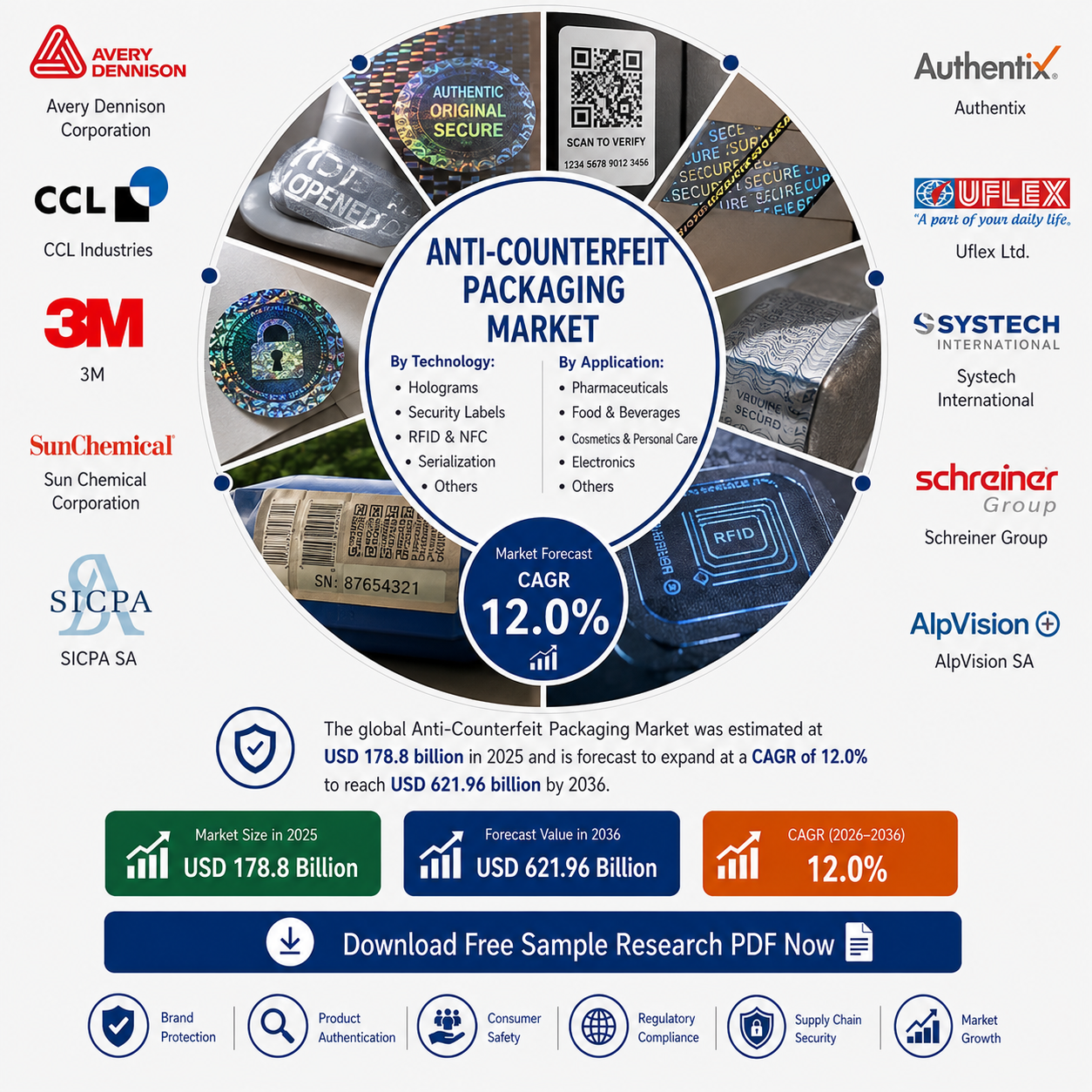
August 10, 2026 — The global Anti-Counterfeit Packaging Market is projected to grow from USD 200.26 billion in 2026 to USD 621.96 billion by 2036, expanding at a 12.0% CAGR, according to Fact.MR analysis. The market was valued at approximately USD 178.8 billion in 2025 and is expected to create an absolute dollar opportunity of USD 421.7 billion between 2026 and 2036.
Anti-counterfeit packaging combines physical, chemical, and digital technologies to authenticate products, detect tampering, verify supply chain integrity, and protect brands. Technologies include tamper-evident closures, holograms, RFID tags, QR codes, serialization, digital watermarks, color-shifting inks, and blockchain-based traceability.
Get detailed market forecasts, competitive benchmarking, and pricing trends: https://www.factmr.com/connectus/sample?flag=S&rep_id=11741
Why the Market Is Growing
Pharmaceutical serialization is a major growth engine. Regulations such as the EU FMD and U.S. DSCSA require unique product identification and track-and-trace capabilities across prescription medicine supply chains. These requirements are creating mandatory investment in packaging authentication infrastructure.
E-commerce is adding another layer of risk. Products increasingly move through distribution networks outside controlled retail environments. This makes packaging-level authentication important for brand owners that need to verify products closer to the point of purchase.
Food and beverage companies are also increasing traceability capabilities. Origin verification, batch tracking, and tamper evidence help address product safety and supply-chain requirements.
Digital authentication is changing the value proposition further. QR codes, NFC tags, encrypted data, and blockchain-backed provenance systems allow consumers to verify products using smartphones. This turns packaging from a passive security layer into a connected product interface.
Industry Evidence and Market Context
The supplied research identifies several external sources relevant to the market. The U.S. Food and Drug Administration (FDA) is cited for DSCSA pharmaceutical serialization implementation, while the European Medicines Verification Organisation (EMVO) is cited for EU FMD compliance and verification data.
The research also references the OECD for global counterfeit-goods trade estimates and identifies counterfeit goods as a major driver of brand-protection investment. These external regulatory and market forces support the increasing use of authentication and traceability technologies.
Key Market Numbers
2025 market value: USD 178.8 billion
2026 market value: USD 200.26 billion
2036 projected value: USD 621.96 billion
2026–2036 CAGR: 12.0%
Absolute dollar opportunity: USD 421.7 billion
Digital Authentication share, 2026: 37.8%
Tamper Evident Packaging share, 2026: 29.4%
Labels & Stickers share, 2026: 31.6%
Visible Security Feature share, 2026: 35.2%
Avery Dennison market share: approximately 15%
Source: Fact.MR analysis based on the supplied market research content.
Segment Analysis
Digital authentication: Digital Authentication Packaging accounts for 37.8% of authentication technology share in 2026. Serialized QR codes, NFC tags, encrypted digital watermarks, and blockchain-backed systems provide scalable authentication and consumer-level verification.
Tamper-evident packaging: This product category holds 29.4% share in 2026. Shrink bands, breakable closures, void labels, and security seals provide visible evidence of product interference without requiring specialized equipment.
Labels and stickers: Labels and stickers account for 31.6% of packaging format share in 2026. They provide a practical platform for holograms, QR codes, security inks, and other authentication features.
Visible security features: Visible security features represent 35.2% of the security-feature segment in 2026. These overt technologies allow consumers and supply-chain participants to inspect products directly.
Connected Packaging Defines the Next Phase
Connected packaging is emerging as a major product trend. It combines authentication with consumer engagement, product information, loyalty programs, reorder functions, and supply-chain analytics.
A single QR-code scan or NFC interaction can authenticate a product while also creating a digital connection between the brand and consumer. This expands the business case for anti-counterfeit investment beyond fraud prevention.
Avery Dennison Corporation holds approximately 15% market share and is investing in its atma.io connected product cloud platform. The platform links physical products with digital identities, supporting authentication, engagement, and supply-chain intelligence.
Country Growth Outlook
India leads country-level growth at 13.2% CAGR through 2036, supported by pharmaceutical serialization, e-commerce brand protection, and food traceability requirements.
China follows at 12.7%, driven by pharmaceutical track-and-trace mandates, luxury-goods authentication, and e-commerce anti-counterfeiting requirements.
The United States is projected to grow at 10.9%, supported by DSCSA compliance, consumer-goods brand protection, and food traceability.
Germany records 9.8%, while the UK, Japan, and Brazil are projected to grow at 9.5%, 9.2%, and 8.8%, respectively.
Competitive Landscape
The market includes technology providers, security-label specialists, authentication companies, and packaging manufacturers. Key participants include Avery Dennison Corporation, CCL Industries, 3M, Sun Chemical Corporation, SICPA SA, Authentix, Uflex Ltd., Systech International, Schreiner Group, and AlpVision SA.
Avery Dennison holds approximately 15% market share, according to the supplied research. CCL Industries and 3M compete through broad security-label and authentication portfolios. SICPA and Authentix maintain specialized positions in government authentication, covert markers, and forensic verification.
Competition is shifting from physical security features alone toward integrated physical-digital systems. Cloud platforms, connected packaging, authentication analytics, and consumer interaction data are becoming important differentiators.
Recent Industry Developments
Avery Dennison Corporation — 2025: The company continued expanding its atma.io connected product cloud platform, linking physical products to digital identities across food, apparel, and pharmaceutical applications.
SICPA SA — 2025: SICPA expanded digital tax-stamp and authentication programs, combining physical security features with digital verification and revenue-assurance analytics.
Uflex Ltd. — 2025: Uflex expanded holographic security packaging offerings for pharmaceutical and FMCG applications, adding multilayer visual authentication capabilities.
Analyst Perspective
Shambhu Nath Jha, Principal Consultant at Fact.MR, says digital authentication is becoming a primary technology layer rather than simply an addition to physical security features. He highlights pharmaceutical serialization as the infrastructure foundation and points to food, beverage, cosmetics, and industrial products as areas where smartphone-based verification can extend the market.
Frequently Asked Questions
What is the Anti-Counterfeit Packaging Market size in 2026?
The market is projected to reach USD 200.26 billion in 2026.
What will the market be worth by 2036?
The market is forecast to reach USD 621.96 billion by 2036.
What is the market CAGR?
The market is expected to expand at a 12.0% CAGR from 2026 to 2036.
Which authentication technology leads the market?
Digital authentication leads with 37.8% share of the authentication technology segment in 2026.
Which country is growing fastest?
India leads the listed country markets with a 13.2% CAGR, followed by China at 12.7%.
Top Trending Reports:
https://www.openpr.com/news/4506324/global-emergency-hospital-bed-market-grows-in-north-america
https://www.openpr.com/news/4506344/global-local-anesthesia-drugs-market-grows-in-north-america
https://www.openpr.com/news/4506347/global-gout-therapeutics-market-grows-in-north-america-takeda
https://www.openpr.com/news/4506350/global-elder-care-product-market-grows-in-asia-pacific
About Fact.MR
Fact.MR is a global market research and consulting firm providing market intelligence, forecasts, competitive analysis, and strategic insights across industries. Its research combines secondary research, primary interviews, demand-side modeling, and forecast validation to support business and investment decisions.

 English
 Arabic
 French
 Spanish
 Portuguese
 Deutsch
 Turkish
 Dutch
Dutch
 Italiano
 Russian
 Romaian
 Greek
Greek
