
From RPA to AI Agents: The Evolution of Intelligent Business Automation
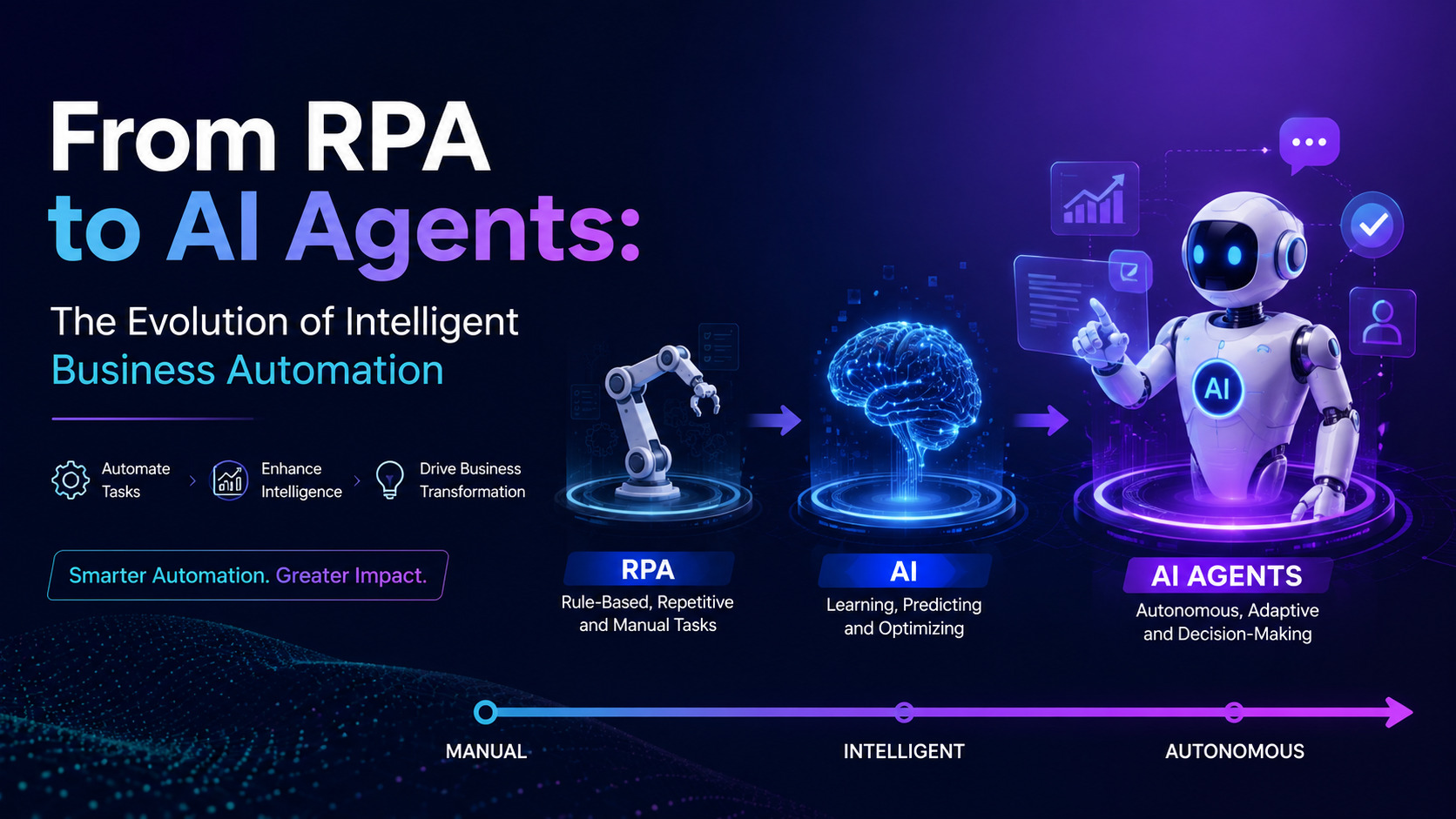
Business automation has changed significantly over the past few years. Organizations that once relied on employees to perform repetitive tasks are now using software robots, artificial intelligence, machine learning, generative AI, and AI agents to automate increasingly complex business processes.
The evolution has moved from rule-based Robotic Process Automation (RPA) to intelligent automation and, more recently, AI agent-powered workflows. While traditional RPA remains valuable for predictable tasks, AI agents can understand context, process unstructured information, make decisions within defined boundaries, and execute multiple steps across business systems.
This shift is creating new opportunities for organizations to automate not just individual tasks, but complete business workflows.
What Is Business Automation?
Business automation involves using technology to perform repetitive or structured business activities with limited manual intervention.
Common examples include:
- Data entry
- Invoice processing
- Email management
- Customer support
- Employee onboarding
- Report generation
- Lead qualification
- Document processing
- Order management
- Payment workflows
The primary goals are to reduce manual work, improve accuracy, accelerate processes, and allow employees to focus on higher-value activities.
However, automation technology has evolved considerably. What started as simple rule-based automation has developed into AI-powered systems capable of handling more dynamic and complex workflows.
The Evolution of Business Automation
The development of intelligent business automation can be broadly divided into several stages:
Manual Processes → Rule-Based Automation → RPA → Intelligent Automation → Generative AI → AI Agents
Each stage introduced new capabilities and expanded the types of processes businesses could automate.
1. Manual Business Processes
Before automation became widespread, employees performed most business processes manually.
For example, an accounts payable employee might:
- Receive an invoice by email.
- Download the invoice.
- Read the information.
- Enter the data into an accounting system.
- Verify the purchase order.
- Send the invoice for approval.
- Update a spreadsheet.
- Schedule payment.
While this process works, it can consume significant employee time and increase the risk of human error.
Businesses therefore began looking for ways to automate repetitive activities.
2. Rule-Based Automation
The next stage involved predefined rules and workflows.
A simple automation could follow a condition such as:
If invoice amount > $10,000 → Send to Finance Manager
Or:
If customer submits a support form → Create a support ticket
Rule-based automation works well when processes are predictable and structured.
Advantages
- Easy to understand
- Predictable results
- Consistent execution
- Suitable for repetitive tasks
- Relatively simple to maintain
Limitations
Rule-based systems struggle when information is unstructured or when decisions require context.
For example, a rule may detect the word "refund," but it may not understand why a customer is requesting a refund or whether the request meets company policy.
This created the need for more advanced automation technologies.
3. Robotic Process Automation (RPA)
RPA became an important step in the evolution of business automation.
Instead of relying only on predefined workflow rules, software robots could interact with applications similarly to human employees.
RPA bots can:
- Open applications
- Copy and paste information
- Enter data
- Download files
- Update spreadsheets
- Move information between systems
- Generate reports
- Trigger workflows
For example, an RPA bot could take customer information from an email and enter it into a CRM system.
Why RPA Became Popular
RPA was especially useful for businesses with repetitive processes and legacy applications.
Organizations could automate tasks without completely replacing their existing software infrastructure.
Common RPA Use Cases
- Data entry
- Invoice processing
- Payroll administration
- Report generation
- Customer onboarding
- Claims processing
- Order processing
- Data migration
However, RPA still had an important limitation: it primarily followed predefined instructions.
If the process changed significantly, the automation often needed to be reconfigured.
4. Intelligent Automation
The next evolution combined RPA with AI technologies.
This created what is often called intelligent automation.
Instead of simply executing predefined steps, intelligent automation can use technologies such as:
- Machine learning
- Natural language processing
- Computer vision
- Optical character recognition
- Predictive analytics
- AI-based classification
For example, an intelligent invoice automation system can analyze an invoice, extract information, classify it, identify anomalies, and route it to the appropriate workflow.
This allows automation to work with more variable and unstructured information.
5. Generative AI Changes Business Automation
The emergence of generative AI introduced another major shift.
Large language models can understand and generate natural language, making it possible to automate tasks involving documents, emails, conversations, and other unstructured information.
For example, an AI-powered customer support system can:
- Read a customer email.
- Understand the customer's intent.
- Analyze previous conversations.
- Retrieve relevant information.
- Generate a response.
- Escalate the issue if necessary.
Traditional RPA would struggle with several of these steps because the process requires interpretation and contextual understanding.
Generative AI therefore expanded the scope of business automation significantly.
6. The Rise of AI Agents
AI agents represent the next stage of intelligent automation.
An AI agent is an AI-powered system capable of pursuing a defined goal by reasoning through tasks, using tools, accessing information, and taking actions within a controlled environment.
Instead of simply responding to a prompt, an AI agent can potentially execute a multi-step workflow.
For example:
Goal: Qualify a New Sales Lead
An AI sales agent could:
- Read the incoming inquiry.
- Identify the customer's requirements.
- Research relevant information from approved sources.
- Analyze the lead's potential value.
- Update the CRM.
- Draft a personalized email.
- Schedule a meeting.
- Notify the sales representative.
This is significantly different from traditional automation because the system can coordinate multiple actions toward a business objective.
RPA vs AI Agents
| Feature | RPA | AI Agents |
|---|---|---|
| Logic | Rule-based | Goal-oriented |
| Data | Mostly structured | Structured + unstructured |
| Decision-making | Predefined rules | AI-assisted reasoning |
| Adaptability | Limited | Higher |
| Natural language | Limited | Strong |
| Multi-step workflows | Possible but predefined | Dynamic orchestration |
| Tool usage | Configured actions | Can use multiple tools |
| Human intervention | Often required for exceptions | Can handle some exceptions |
| Best for | Repetitive processes | Complex, dynamic workflows |
RPA and AI agents should not necessarily be viewed as competing technologies.
In many enterprise environments, they can work together.
How RPA and AI Agents Work Together
The most effective automation strategy may combine both technologies.
For example:
Customer Email → AI Agent → Intent Detection → Business Decision → RPA Bot → CRM Update → Notification
The AI agent can handle interpretation and decision-making, while RPA can execute predictable actions within legacy systems.
This hybrid model combines the strengths of both technologies.
AI Agent
Best suited for:
- Understanding context
- Processing natural language
- Classifying information
- Making bounded decisions
- Planning tasks
RPA
Best suited for:
- Data entry
- Application interaction
- Structured processes
- Repetitive actions
- Legacy system automation
Together, they can create more capable business automation workflows.
Key Benefits of AI Agent-Powered Automation
1. Automates Complex Workflows
AI agents can coordinate multiple tasks instead of automating only one isolated activity.
2. Reduces Manual Work
Employees can delegate repetitive administrative activities to AI-powered workflows.
3. Handles Unstructured Information
AI agents can work with:
- Emails
- Documents
- Chat messages
- PDFs
- Customer conversations
- Natural-language requests
4. Improves Response Times
AI agents can operate continuously and initiate actions much faster than manual workflows.
5. Enables Personalized Experiences
AI can use customer and business context to create more relevant responses and actions.
6. Supports Employees
AI agents can act as digital assistants that help employees complete complex workflows while keeping humans involved in important decisions.
AI Agent Automation Use Cases
Customer Support
AI agents can understand customer requests, retrieve information, update support systems, and escalate complex cases.
Sales Automation
AI agents can qualify leads, research prospects, update CRM records, draft emails, and schedule meetings.
Finance Automation
AI can automate invoice processing, reconciliation, payment workflows, financial document analysis, and exception identification.
Human Resources
AI agents can support recruitment, employee onboarding, policy questions, document processing, and scheduling.
IT Operations
AI agents can analyze alerts, troubleshoot common issues, create tickets, and trigger predefined remediation workflows.
Procurement
AI can analyze purchase requests, compare supplier information, process documents, and support procurement workflows.
A Practical Example: From RPA to AI Agents
Consider a traditional invoice processing workflow.
Traditional RPA
Invoice Received → Extract Data → Enter ERP → Match PO → Send Approval
The process follows predefined instructions.
Intelligent Automation
Invoice Received → OCR → AI Classification → Data Validation → PO Matching → Approval
AI improves document understanding and validation.
AI Agent Workflow
Invoice Received → AI Agent Understands Invoice → Checks Vendor History → Validates PO → Identifies Exceptions → Selects Appropriate Workflow → Requests Approval → Updates ERP → Notifies Finance
The AI agent coordinates multiple actions based on context and business rules.
This demonstrates how business automation has evolved from executing instructions to managing objectives within controlled boundaries.
Challenges of AI Agent Automation
AI agents provide powerful capabilities, but organizations should not automate every process without proper controls.
Security
AI agents may access sensitive business systems and information. Strong authentication, authorization, encryption, and access controls are essential.
Accuracy
AI systems can make incorrect decisions or generate inaccurate information. High-impact decisions should include appropriate human oversight.
Governance
Organizations need clear policies defining what AI agents can and cannot do.
Integration
AI agents often need access to CRM, ERP, databases, APIs, and other systems. Building reliable integrations can require significant technical expertise.
Monitoring
AI workflows should be monitored for performance, errors, unexpected behavior, and business impact.
Human-in-the-Loop Automation
One of the most practical approaches to AI automation is human-in-the-loop automation.
Instead of allowing AI to make every decision independently, organizations can define approval points.
For example:
AI Agent → Analyze Request → Prepare Action → Human Approval → Execute
This approach is especially useful for:
- Financial transactions
- Legal documents
- Customer refunds
- Contract decisions
- Sensitive communications
- High-value business decisions
Human oversight provides an additional layer of control while still allowing AI to handle much of the repetitive work.
How Businesses Can Move From RPA to AI Agents
Organizations do not need to replace their entire automation infrastructure immediately.
A gradual approach is often more practical.
Step 1: Identify Existing RPA Processes
Analyze your current automation workflows and identify areas where bots frequently encounter exceptions.
Step 2: Identify Unstructured Tasks
Look for processes involving emails, documents, natural language, or variable customer requests.
Step 3: Introduce AI
Use AI for classification, document understanding, summarization, prediction, or response generation.
Step 4: Connect AI With Existing Automation
Allow AI systems to trigger existing RPA bots and workflows.
Step 5: Introduce AI Agents
For suitable workflows, introduce agents capable of coordinating multiple actions.
Step 6: Add Governance
Define permissions, approval rules, monitoring, and escalation mechanisms.
Step 7: Measure Results
Track metrics such as:
- Processing time
- Automation rate
- Error rate
- Cost per transaction
- Employee productivity
- Customer satisfaction
Choosing an AI Automation Partner
Businesses moving from RPA toward AI agents should choose technology partners carefully.
Look for experience in:
- AI automation
- AI agent development
- RPA
- Workflow orchestration
- Generative AI
- API integration
- Enterprise software
- Data security
- AI governance
An experienced AI automation agency in USA can help businesses identify suitable workflows, design automation strategies, integrate AI agents with existing systems, and establish appropriate human oversight.
Organizations that require highly customized solutions may also work with an AI development company in USA to build AI agents, intelligent applications, and automation systems around their specific business requirements.
For companies that need broader software engineering, API integration, or enterprise application development, a reliable Software Development Company in Dallas can help connect AI automation with existing business infrastructure.
The Future of Intelligent Business Automation
The future of business automation is unlikely to be about choosing between RPA and AI.
Instead, businesses will increasingly combine:
RPA + AI + AI Agents + APIs + Workflow Orchestration + Human Expertise
RPA will continue to handle predictable system interactions. AI will provide intelligence for understanding and processing information. AI agents will coordinate more complex tasks, while humans will remain responsible for strategic decisions and high-impact activities.
This hybrid model can create intelligent business operations that are faster, more flexible, and more scalable.
Conclusion
The evolution from RPA to AI agents represents a major shift in business automation.
RPA made it possible to automate repetitive, rule-based tasks. Intelligent automation introduced AI capabilities that could process more complex information. Generative AI expanded automation into natural-language and unstructured-data workflows. AI agents are now taking automation further by coordinating multiple tasks toward defined business goals.
However, AI agents do not make traditional automation obsolete. The most effective business automation strategies will often combine RPA, AI, APIs, workflow orchestration, and human oversight.
For businesses, the goal should not simply be to automate as much as possible. The objective should be to automate the right processes, maintain appropriate controls, and create measurable business value.
As organizations continue their transition from RPA to intelligent, agent-powered automation, those that adopt a strategic and controlled approach will be better positioned to improve productivity, reduce operational costs, and build more agile business operations.
Frequently Asked Questions
What is the difference between RPA and AI agents?
RPA primarily follows predefined rules to execute repetitive tasks, while AI agents can understand context, process unstructured information, use tools, and coordinate multiple actions toward a defined goal.
Is RPA becoming obsolete because of AI agents?
No. RPA remains useful for predictable, structured tasks and legacy system interactions. AI agents and RPA can work together to automate more complex end-to-end workflows.
What is intelligent business automation?
Intelligent business automation combines technologies such as RPA, artificial intelligence, machine learning, generative AI, and workflow automation to automate business processes more intelligently.
Can AI agents work with existing RPA bots?
Yes. AI agents can potentially determine when an RPA bot should be triggered and provide the information required for the bot to complete its task.
What businesses can benefit from AI agent automation?
Almost any organization with repetitive or complex workflows can benefit, including businesses in finance, healthcare, retail, logistics, manufacturing, technology, customer service, and professional services.
Should businesses completely automate workflows using AI agents?
Not necessarily. Sensitive or high-impact workflows should include appropriate human oversight, approval mechanisms, access controls, and monitoring.
How can a business start moving from RPA to AI agents?
Start by evaluating existing RPA workflows, identify processes involving unstructured information or frequent exceptions, introduce AI capabilities, integrate AI with existing automation, and gradually implement AI agents where they provide measurable value.

 English
 Arabic
 French
 Spanish
 Portuguese
 Deutsch
 Turkish
 Dutch
Dutch
 Russian
 Romaian
 Portuguese (Brazil)
 Greek
Greek
