
Uber Clone Script vs 6 Months of Custom Dev in the USA
How do I launch an app like Uber in the United States? You need to conduct market research, identify your target market, get the right technology, test it, and go live.
This might be the standard answer you’ll get. But what does that actually mean when you're building an Uber clone? More importantly, which development path should you go for?
Most comparisons between Uber clone scripts and custom development stop at the obvious points. Clone scripts are faster and cheaper. Custom development gives more control. Both are true, but neither tells you what you're actually getting with each option or when one makes more practical sense than the other.
What Are You Really Getting When Building an Uber Clone?
Features are easy to compare on paper. What's harder to assess upfront is how flexible those features actually are.
-
For real-time location tracking, is Google Maps the only option?
-
Which payment gateways are available beyond PayPal?
-
How much of that can be changed without going back to the provider?
Those comparisons are important, but they don't usually make the difference in the initial stages of a business.
The real value isn’t just the app. It’s the time you save.
So when you go into building an app like Uber and not just a “ride-hailing app." You’re purchasing the opportunity to learn how your product is actually being used by your customers rather than what you think it might be used for.
What Goes Into 6 Months of Custom Development?
Ask anyone who's managed a software project, and they'll probably tell you the initial timeline is just a word on paper, but the reality is something different.
Because requirements evolve.
Every new idea feels reasonable on its own. But together, they quietly stretch a six-month development plan into a nine- or twelve-month journey.
Many people call this "scope creep," but that label doesn't capture the full picture. The actual problem is that your business requirements change even as the development progresses.
You learn something new about your customers, and naturally, you want your ride-hailing platform to reflect that insight. The development team adjusts priorities and features are rewritten.
One founder on Indie Hackers shared how his team spent months building advanced user permissions because they believed enterprise customers would expect them. After launch, nearly every early customer asked for faster onboarding instead.
The product wasn’t a failure; it simply focused on solving the wrong problem first.
This is why many seasoned founders talk about starting with an MVP that solves a real problem.
What Is the Cost of Waiting for Custom Uber Clone App Development?
You're probably informed that developing a ride-hailing app like Uber entirely from scratch can cost far over $100,000. But that is not what we are talking about here. We are talking about the cost of waiting.
While you are still building your Uber app clone, your competitors will be gathering reviews, enhancing onboarding, making connections, and learning from customers. Each month they’re live, they’re collecting insights, which you cannot buy later.
It often becomes one of the biggest differences between businesses that thrive and businesses that struggle after launch.
Waiting also delays something every startup eventually needs: proof.
You need to validate four things early: whether customers will pay, drivers will join, pricing makes sense, and acquisition costs are sustainable.
Real customer behavior is almost always more valuable than another month of internal planning.
What Happens When You Choose an Uber Clone Script?
Using an Uber clone script lets you focus your time and energy on the real parts of managing your ride-hailing business. Engaging with your customers, figuring out what works, and making decisions based on real usage.
And just because you're trimming down on development time and costs doesn't mean your business will automatically succeed.
There's a lot more that goes into making a business work.
It involves getting to know fleet owners, learning local laws, optimizing pricing, and grasping the reasons behind platform selection. Those are the conversations that form a marketplace, but they are sometimes deferred because all the focus is on development.
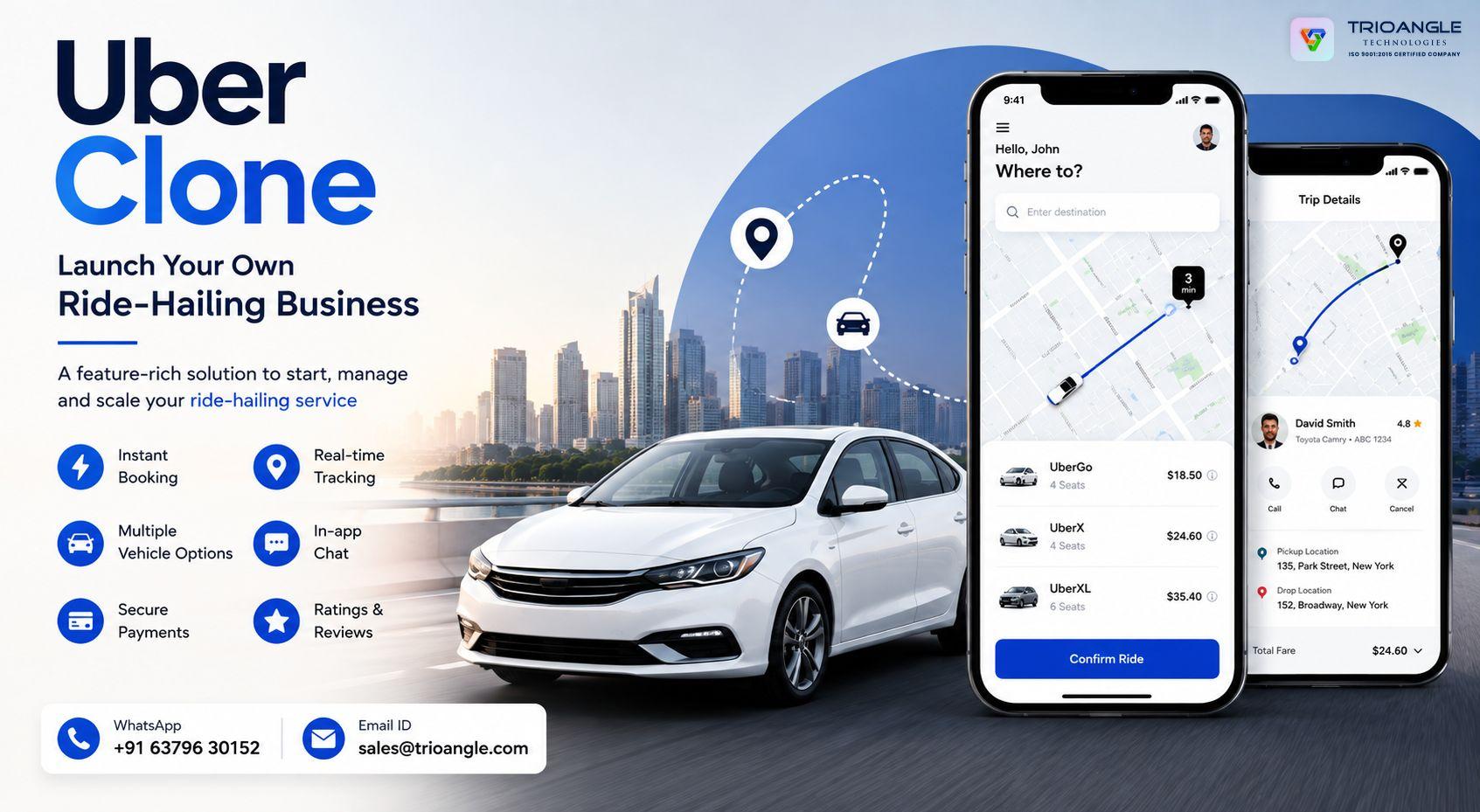
But what the Uber app clone gives you is a working platform.
-
Booking flow
-
User management
-
Payments
-
In-app communication system
-
Admin controls
Development is a continuous process; you won't be launching from square one. Instead, you'll be working on a product that has been refined through real-world experiences.
That's a much better place to begin for many founders.
Where Should Founders Really Spend Their First Budget?
It's interesting how often early-stage founders think about development as the investment. In reality, development is only one part of launching a marketplace.
If you have $100,000 to invest, one way to use it is by developing a custom Uber clone app. After a few months of waiting, you'll have a platform that fits your every requirement, from features to layout and workflow.
Just keep in mind, you'll still need drivers, customers, support staff, marketing, and some operating funds.
The next approach is different.
You use a proven platform as your starting point and spread your investment across the business itself.
That budget might go toward:
-
Customizing the platform around your brand
-
Recruiting and onboarding drivers
-
Local marketing campaigns
-
Customer acquisition
-
Operations and support
-
Legal and compliance
-
Product improvements based on early feedback
While the exact numbers can change from business to business, the principle is the same.
Customers don’t really care about the hours your developers spent building your booking system. What they remember is if the driver was punctual, if support was fast, and if the app was reliable when they needed it.
So, Which Is Better: Custom Development or an Uber App Clone?
Your users are not going to reward you for all the unseen effort. If two ride-hailing apps help a passenger book a ride in under a minute, nobody chooses one because its authentication system was written from scratch.
When you're entering the market, spending more than $100,000 on a minimum viable product (MVP) isn't a wise financial move, especially when you have to hire each specialist individually. You’re looking at $30,000 for a backend engineer, $20,000 each for your iOS and Android developers, $20,000 for your project manager, and $15,750 for a tester to build a ride-hailing app like Uber from scratch.
So, if you’re a startup, go with an Uber clone script.
But if you're running an existing business that has the funds, development time, and has received customer feedback, along with partnerships and revenue, then custom development could be a better fit.
Conclusion
So, if you're ready to move from the research phase to actually launching your ride-hailing app like Uber in the USA, ask yourself one question: do you want to spend your next six months building software or building a business?
When it comes to choosing between an Uber clone script and custom development, it might seem like a technical debate, but that's not really the case.
It's all about timing. The market doesn't hit pause while you're busy building your Uber app clone. Your first customers, drivers, and valuable lessons are waiting for you right after you launch, not just after you've developed everything.
An Uber clone script gets you there. What you do after that is what actually builds the business.

 English
 Arabic
 Spanish
 Portuguese
 Deutsch
 Turkish
 Dutch
Dutch
 Italiano
 Russian
 Romaian
 Portuguese (Brazil)
 Greek
Greek
