
Global Heterogeneous Network Market Driven by Increasing Demand for High-Speed Connectivity, IoT Expansion, and Smart City Development
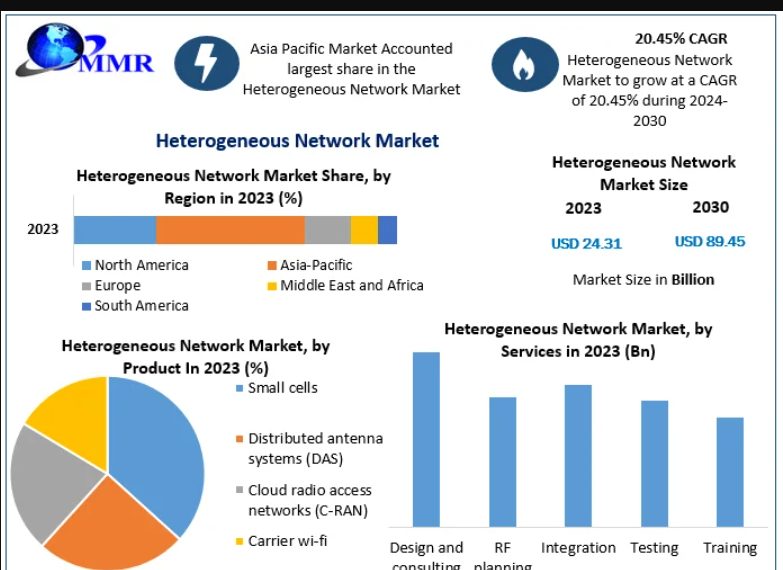
Powering Next-Generation Connectivity: Market Dynamics, Growth Drivers, and Comprehensive Forecast of the Global Heterogeneous Network (HetNet) Market
The modern telecommunications landscape is undergoing a massive transformation. With the explosive proliferation of smartphones, high-definition video streaming, internet-connected IoT devices, and 5G network rollouts, traditional homogeneous macrocell infrastructure is facing unprecedented capacity bottlenecks. To overcome these limitations, telecom operators and enterprise networks have increasingly adopted multi-layered architectures. The Global Heterogeneous Network (HetNet) Market has consequently emerged as a vital foundational framework, blending macrocells, small cells, distributed antenna systems (DAS), and carrier Wi-Fi to deliver seamless, high-speed, and cost-effective coverage.
Driven by surging mobile data traffic, network densification initiatives, and the rapid expansion of smart cities, the global heterogeneous network market is experiencing robust, long-term expansion. This comprehensive press release offers an in-depth, data-driven review of market drivers, product segmentations, technology frameworks, regional trajectories, and strategic investment insights designed for telecom executives, network architects, and industry stakeholders.
𝐃𝐨𝐰𝐧𝐥𝐨𝐚𝐝 𝐅𝐫𝐞𝐞 𝐏𝐃𝐅 𝐁𝐫𝐨𝐜𝐡𝐮𝐫𝐞 @https://www.maximizemarketresearch.com/request-sample/66700/
The Paradigm Shift: Why HetNets Replaced Traditional Homogeneous Architectures
For decades, cellular networks relied primarily on large, high-power macro base stations to provide widespread outdoor coverage. However, as subscribers migrated indoors and data consumption skyrocketed, macrocells struggled to penetrate thick building walls or handle dense traffic concentrations in urban centers. Building more macrocells is financially and spatially prohibitive.
Heterogeneous Networks (HetNets) solve this challenge by integrating traditional macro radio access networks (RAN) with a diverse mosaic of low-power small cells (pico cells, femto cells, and micro cells), carrier Wi-Fi, and Cloud-RAN architectures. By deploying small cells closer to end-users, HetNets offload heavy traffic, eliminate coverage holes, improve spectral efficiency, and ensure uninterrupted indoor connectivity while lowering overall capital and operational expenditures for network operators.
Market Dynamics: Key Growth Drivers, Restraints, and Strategic Opportunities
Primary Growth Drivers: Explosion of Mobile Data Traffic and 5G Densification
The accelerated expansion of the global heterogeneous network market is propelled by several macro-level technological trends:
-
Relentless Growth in Mobile Data Consumption: The global surge in video streaming, cloud gaming, social media, and data-intensive mobile applications requires high-capacity networks that only densified HetNet configurations can provide.
-
Rapid Expansion of 5G and Advanced Wireless Technologies: The transition toward 5G New Radio (NR) requires dense networks of small cells operating on higher frequency bands (such as millimeter wave) to maintain stable, low-latency connections.
-
Smart Cities and IoT Proliferation: The mass deployment of connected devices across urban environments necessitates robust, multi-technology network coverage that bridges cellular and Wi-Fi domains seamlessly.
Market Restraints: Deployment Complexities and Interference Management
Despite monumental performance benefits, certain structural challenges constrain rapid deployment:
-
Cell Interference Challenges: Managing co-tier and cross-tier interference between macrocells and neighboring small cells requires sophisticated coordination techniques like enhanced Inter-Cell Interference Coordination (eICIC).
-
High Deployment and Backhaul Hurdles: Acquiring physical sites for small cells, securing municipal permits, and provisioning reliable backhaul connectivity can create logistical delays for operators.
Lucrative Opportunities: AI-Driven Network Automation and Cloud Integration
The integration of Artificial Intelligence (AI) and machine learning into Self-Organizing Networks (SON) represents a transformative commercial opportunity. AI-powered SON tools can automatically configure, monitor, and optimize heterogeneous network parameters in real time, minimizing manual engineering overhead. Furthermore, the convergence of Cloud-RAN (C-RAN) with virtualized network functions (VNFs) opens vast avenues for flexible, software-driven network scaling.
Granular Segment-Wise Analysis of the Heterogeneous Network Market
A detailed look at market segmentation clarifies the specific hardware components, technology categories, and end-user verticals driving commercial revenue expansion.
1. By Component & Product Segmentation
The market is broadly categorized into Hardware, Software, and Services. Product-wise, it encompasses Small Cells, Distributed Antenna Systems (DAS), Cloud-RAN (C-RAN), and Carrier Wi-Fi.
-
Small Cells Segment: Commands a dominant market share. Encompassing femtocells, picocells, and microcells, small cells are the primary building blocks of network densification, offering superior indoor coverage and traffic offloading capabilities.
-
Cloud-RAN (C-RAN): Rapidly expanding as operators centralize baseband processing to reduce power consumption and enhance coordination across multi-node environments.
2. By Technology Segmentation
Key technologies include LTE WAN, eICIC, and 5G NR.
-
5G NR Integration: Represents the fastest-growing technology tier, driving massive investments as telecom providers upgrade infrastructure to support ultra-reliable low-latency communications (URLLC) and enhanced mobile broadband (eMBB).
3. By End-User Vertical Segmentation
End-user verticals encompass Telecommunications, Commercial Enterprises, Residential, Transportation, and Government/Smart Cities.
-
Telecommunications Operators: Stand as the primary revenue contributor, continuously investing in HetNet infrastructure to manage network congestion and improve subscriber quality of experience (QoE).
Regional Market Vision: Geographic Dominance and Growth Frontiers
North America: The Established Telecommunications Leader
North America commands a substantial market share in the global heterogeneous network ecosystem. This dominance is anchored by early 5G commercial rollouts, mature cloud infrastructure, heavy capital investments by major tier-1 telecom operators, and an aggressive push toward enterprise private wireless networks.
Asia Pacific: The Fastest-Growing Regional Powerhouse
The Asia Pacific region is projected to register the fastest growth rate throughout the forecast period. Rapid urbanization, massive smartphone user bases, government-backed smart city initiatives, and aggressive 5G infrastructure deployments across China, South Korea, Japan, and India are fueling high-volume market demand.
Europe: Industrial Automation and Regulatory Standardization
Europe maintains a steady and lucrative market footprint, driven by strict regulatory frameworks, widespread adoption of Industry 4.0 manufacturing automation, and the rigorous integration of carrier Wi-Fi with cellular backhaul networks.
Strategic Decision-Making and Competitive Positioning
The global heterogeneous network market features a dynamic competitive landscape populated by major telecom infrastructure vendors and specialized software providers. Key market participants shaping strategic developments include:
-
Samsung Electronics Co., Ltd.
-
Cisco Systems, Inc.
-
Nokia Corporation
-
Telefonaktiebolaget LM Ericsson
-
Huawei Technologies Co., Ltd.
-
ZTE Corporation
-
NEC Corporation
-
Comba Telecom Systems Holdings Ltd.
For full access to the comprehensive strategic report, visit:https://www.maximizemarketresearch.com/market-report/global-heterogeneous-network-market/66700/
Strategic Recommendations for Industry Stakeholders:
-
Prioritize Automated SON Integration: Network operators should invest heavily in AI-driven Self-Organizing Network (SON) software to streamline multi-vendor small cell configuration and reduce operational expenses.
-
Embrace Cloud-Native Architecture: Transitioning toward virtualized C-RAN and Open RAN architectures ensures greater vendor interoperability and flexible scalability.
-
Target High-Density Commercial Verticals: Expanding deployment focus toward high-demand environments such as enterprise campuses, airports, stadiums, and smart manufacturing plants secures high-value commercial contracts.
Conclusion
The Global Heterogeneous Network Market stands at the absolute center of modern wireless connectivity. As mobile data demands surge and 5G infrastructure matures, heterogeneous networking has transitioned from a supplementary solution into core telecom architecture. Stakeholders equipped with clear market foresight, advanced cloud-native strategies, and agile deployment roadmaps are exceptionally positioned to drive operational efficiency and capture long-term market dominance.
About Maximize Market Research
Maximize Market Research is a multifaceted market research and consulting company with professionals from several industries. Some of the industries we cover include medical devices, pharmaceutical manufacturers, science and engineering, electronic components, industrial equipment, technology and communication, cars and automobiles, chemical products and substances, general merchandise, beverages, personal care, and automated systems. To mention a few, we provide market-verified industry estimations, technical trend analysis, crucial market research, strategic advice, competition analysis, production and demand analysis, and client impact studies.
Contact Maximize Market Research
3rd Floor, Navale IT Park, Phase 2
Pune Bangalore Highway, Narhe,
Pune, Maharashtra 411041, India
sales@maximizemarketresearch.com
+91 96071 95908, +91 9607365656

 English
 Arabic
 French
 Spanish
 Portuguese
 Deutsch
 Dutch
Dutch
 Italiano
 Russian
 Romaian
 Portuguese (Brazil)
 Greek
Greek
