
CRSEO and Semantic SEO: Building Content That Ranks and Actually Connects
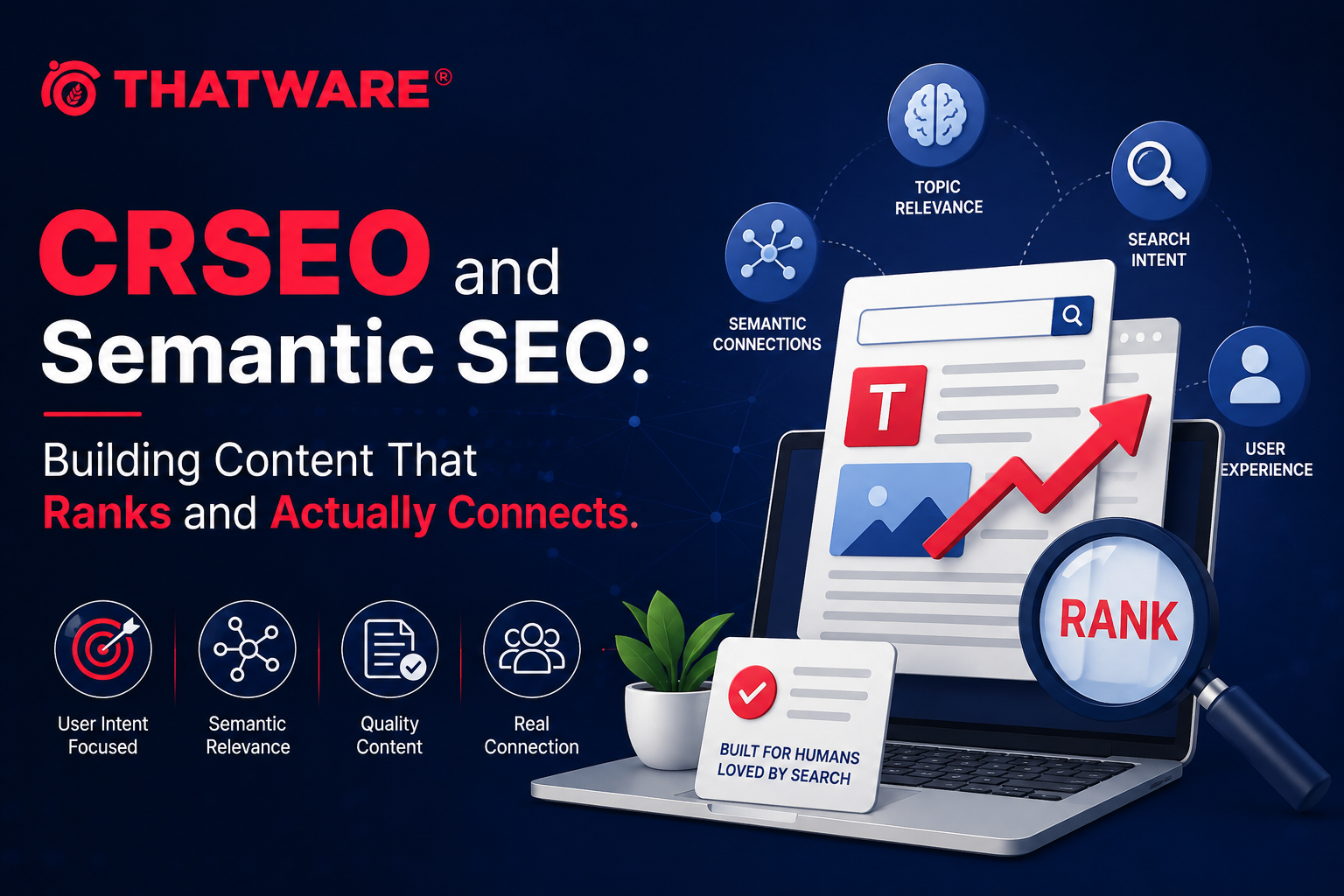
Most content teams treat SEO as a single lever: hit the right keywords, cover the topic thoroughly, and rankings should follow. But there's a quieter reason so much "well-optimized" content still underperforms — it's built for algorithms, not for the person reading it at 11 p.m., anxious, comparing options, or hesitating before a purchase decision. That's the gap CRSEO was built to close. Agencies like Thatware LLP have leaned into this approach precisely because semantic SEO alone, while essential, doesn't account for the emotional and cognitive state of the person on the other side of the screen. This post breaks down what CRSEO actually is, why it isn't a competitor to semantic SEO, and how to start applying both together.
What Is CRSEO, Exactly?
CRSEO stands for Cognitive Resonance SEO — content optimization built around how a reader's mind is actually working in a given moment, not just around keyword coverage. Where traditional optimization asks "have we covered this topic thoroughly enough," CRSEO asks a different question: does this specific paragraph match the mental state of the person reading it right now?
That distinction matters because search behavior isn't uniform. Someone typing "best CRM for small teams" at the start of their research is in an exploratory mindset. Someone typing "Salesforce vs HubSpot pricing" three days later is in a comparative one. Same underlying topic, two completely different cognitive modes — and content that ignores the difference tends to send readers straight back to the results page.
Semantic SEO Builds the Map, CRSEO Builds the Trust
Semantic SEO already does something search engines reward heavily: it organizes a site's content into a cohesive, entity-rich structure so Google can recognize topical authority. Cornerstone pages, supporting clusters, internal linking that mirrors how concepts relate — this is the architecture layer, and it's non-negotiable for competitive rankings.
What semantic SEO doesn't do on its own is account for the reader's internal state. A page can be topically flawless and still lose a visitor in the first ten seconds because it opens with jargon, buries the reassurance the reader needed, or asks for a decision before earning trust.
This is where the two frameworks stop being separate strategies and start functioning as one system:
-
Semantic SEO decides what gets covered and how it's structured.
-
CRSEO decides how each section is written so it actually holds attention.
Bringing the Two Together: A Practical Framework
Combining CRSEO with semantic SEO doesn't mean abandoning either process — it means sequencing them correctly:
-
Map the topical cluster first. Identify the cornerstone page, supporting subtopics, and the entities Google needs to see connected. Standard semantic SEO groundwork.
-
Identify the reader's cognitive mode per page. Is this page for someone just discovering the topic, comparing options, evaluating a decision, or confirming they made the right one?
-
Match tone and pacing to that mode. Exploratory content can afford broader framing. Comparative content needs clear, scannable contrasts. Evaluative content needs credibility signals up front.
-
Acknowledge the emotional undercurrent before the facts. Whatever anxiety, urgency, or skepticism the reader likely carries, name it early instead of assuming data alone will land.
-
Track behavioral metrics alongside rankings. Time on page and scroll depth reveal whether the resonance layer is actually working — rankings alone won't tell you that.
A Quick Example
Picture a skincare brand publishing a guide on adult acne. The semantic SEO plan is straightforward: a cornerstone guide, supporting pages on ingredients, routines, and dermatologist-recommended treatments, all interlinked around the "adult acne" entity cluster.
Without a CRSEO layer, that guide might open with ingredient chemistry. With it, the same guide opens by acknowledging that adult acne often carries an embarrassment that teenage acne didn't — and that the reader isn't doing anything wrong. The topical coverage doesn't change. The moment the reader decides whether to keep reading does.
Common Mistakes When Combining the Two
-
Treating CRSEO as a tone tweak instead of a structural decision. It should influence what goes first, not just word choice.
-
Skipping the semantic groundwork. Emotionally resonant content built on a weak topical structure still struggles to rank.
-
Optimizing only for rankings. If rankings climb but engagement metrics stay flat, that's usually a sign the resonance layer is missing.
-
Applying one emotional tone to an entire cluster. Exploratory and evaluative pages need different pacing, not the same voice repeated everywhere.
Metrics That Actually Show This Is Working
When semantic SEO and CRSEO are applied together, two categories of metrics tend to move in tandem:
Ranking-side signals:
-
Keyword and topic-cluster rankings
-
Featured snippet and entity-level visibility
-
Organic traffic growth across the cluster
Behavior-side signals:
-
Time on page and scroll depth
-
Return visit rate
-
Conversion or lead-form completion rate
Google has repeatedly pointed to experience and trust signals (part of its broader E-E-A-T guidance) as part of what separates content that ranks briefly from content that holds its position — and behavioral engagement feeds directly into that picture.
Conclusion
Semantic SEO and CRSEO were never meant to compete for the same job. One builds the structure search engines trust; the other builds the connection readers respond to. Used together, they produce content that doesn't just rank on page one — it keeps people there and brings them back. If you're evaluating how to layer a psychology-driven approach onto your existing content architecture, Thatware LLP's CRSEO services are worth a closer look as a starting point.
FAQs
1. What does CRSEO stand for?
Cognitive Resonance SEO — an approach that shapes content around a reader's emotional and cognitive state rather than keywords alone.
2. Is CRSEO a replacement for semantic SEO?
No. CRSEO works alongside semantic SEO — semantic SEO builds the topical structure, CRSEO shapes how each piece within that structure is written.
3. How do I know if my content needs a CRSEO layer?
If pages rank reasonably well but show high bounce rates or low time on page, that's often a sign the structure is solid but the content isn't resonating emotionally.
4. Does CRSEO apply to every industry?
Yes, though it matters most in decision-heavy or emotionally charged categories like healthcare, finance, and legal services, where reader trust directly affects conversion.
5. How long before I see results from combining CRSEO and semantic SEO?
Ranking movement from semantic SEO can take weeks to months depending on competition; behavioral improvements from CRSEO, like time on page, are often visible sooner.

 English
 Arabic
 French
 Spanish
 Portuguese
 Deutsch
 Turkish
 Dutch
Dutch
 Italiano
 Russian
 Romaian
 Portuguese (Brazil)
