
Global Automatic Emergency Braking Market Competitive Landscape Analysis by Leading Companies, Market Share, Business Strategies and Growth Outlook
Global Automatic Emergency Braking (AEB) Market Size, Share, Trends, and Strategic Outlook 2026–2035
Introduction: Revolutionizing Automotive Safety and Collision Avoidance
In the modern automotive landscape, the primary purpose of a vehicle extends far beyond simple transport; it encompasses an absolute commitment to occupant protection, pedestrian safety, and proactive accident mitigation. As traffic congestion intensifies globally and urban centers experience rising vehicle densities, human error remains a primary catalyst for devastating road collisions. To counter this vulnerability, the automotive industry has undergone a paradigm shift, transitioning from passive safety structures to active, intelligence-led Advanced Driver Assistance Systems (ADAS).
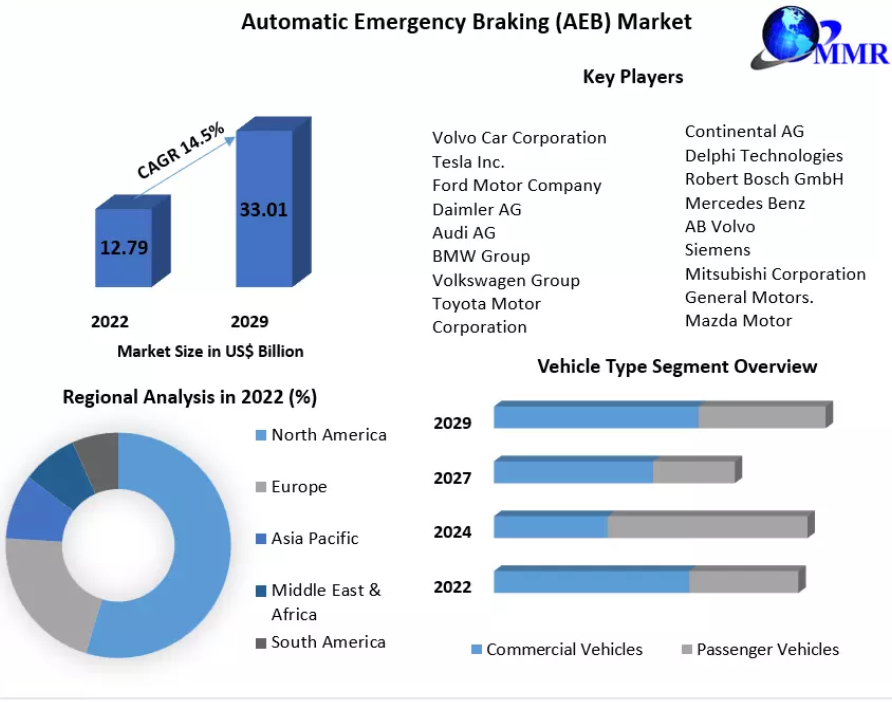
At the epicenter of this safety revolution is the global Automatic Emergency Braking (AEB) market. By utilizing continuous environmental monitoring sensors, radar arrays, and machine-learning decision logic, AEB systems autonomously apply braking force when a driver fails to react to an imminent collision. Market intelligence evaluations demonstrate that the Global Automatic Emergency Braking (AEB) Market is experiencing robust expansion, valued at tens of billions of dollars, with projections indicating a surge toward USD 33.01 Billion by 2029, expanding at a steady compound annual growth rate (CAGR of 5.0% to 7.9% across various forecasting scopes). This comprehensive market analysis evaluates the core growth catalysts, technological breakthroughs, structural segmentations, and strategic corporate decisions shaping the future of vehicular safety.
𝐃𝐨𝐰𝐧𝐥𝐨𝐚𝐝 𝐅𝐫𝐞𝐞 𝐏𝐃𝐅 𝐁𝐫𝐨𝐜𝐡𝐮𝐫𝐞 @https://www.maximizemarketresearch.com/request-sample/13062/
Defining Automatic Emergency Braking (AEB) and System Architecture
An Automatic Emergency Braking system is an active safety technology designed to monitor traffic conditions ahead, calculate collision risks, and autonomously engage the vehicle's braking mechanism if the driver fails to take corrective action in time. Often working in tandem with Forward Collision Warning (FCW) systems, AEB does not merely attempt to soften an impact; its primary objective is to prevent crashes entirely or significantly reduce collision velocities to minimize injuries.
Modern AEB architectures integrate a sophisticated network of hardware and software components:
-
Perception Sensors (Radar, LiDAR, and Cameras): High-resolution optical cameras and long-range radar units measure the distance and relative velocity of preceding vehicles, pedestrians, and cyclists.
-
Electronic Control Unit (ECU) and Perception Processors: The computational brain that ingests sensor telemetry, executes sensor-fusion algorithms, and evaluates potential threat scenarios in milliseconds.
-
Acousto-Optic Warning Systems: Immediate visual and audible alerts deployed to prompt immediate driver reaction prior to autonomous brake actuation.
-
Braking Actuation Mechanisms: High-performance disc brake systems capable of executing rapid hydraulic pressure build-up to guarantee minimal stopping distances.
Primary Market Drivers Propelling Global Expansion
1. Stringent Regulatory Mandates and NCAP Safety Ratings
Governments and safety organizations worldwide are overhauling vehicle compliance standards. Regulatory bodies and safety ratings entities—such as the National Highway Traffic Safety Administration (NHTSA), the Insurance Institute for Highway Safety (IIHS), and Euro NCAP—are aggressively updating safety protocols to mandate AEB installation as a standard factory feature rather than an optional luxury. Furthermore, major insurance agencies offer lower premiums for AEB-equipped vehicles, heavily incentivizing consumer adoption.
2. Escalating Urban Traffic Congestion and Accident Statistics
Global traffic congestion has driven a dramatic rise in low-speed rear-end collisions, fender-benders, and pedestrian incidents within densely populated metropolitan areas. Because human reaction times can be hindered by fatigue or distraction, autonomous safety interventions have become essential. Low-speed and pedestrian-focused AEB configurations address these specific urban vulnerabilities, protecting vulnerable road users (VRUs) effectively.
3. Integration of Sensor Fusion and Artificial Intelligence
The convergence of advanced sensor fusion—combining radar, LiDAR, and vision cameras—with artificial intelligence has elevated AEB reliability. Modern machine learning processors can distinguish between stationary objects, erratic pedestrians, and fast-moving vehicles in adverse weather conditions or during nighttime driving. These technological leaps reduce false-positive activations and boost consumer trust in autonomous safety features.
Comprehensive Market Segmentation Analysis
The global automatic emergency braking market is structurally categorized based on system type, technology, brake type, vehicle category, and regional footprint.
By System Type
-
Low-Speed AEB Systems: Capturing a major share of the urban safety market, these systems are specifically engineered to mitigate stop-and-go traffic shunts and parking lot impacts where city accidents occur most frequently.
-
High-Speed and Pedestrian AEB Systems: Designed for highway and arterial transit speeds, focusing heavily on preventing catastrophic rear-end crashes and protecting vulnerable pedestrians and cyclists.
By Technology
-
Radar-Based Systems: Lead the technology segment due to their weather-resilient performance, long-range tracking capabilities, and cost-effective integration for automakers.
-
Camera and LiDAR-Based Systems: Experiencing rapid growth as sensor costs decline and autonomous driving architectures demand high-resolution 3D environmental mapping.
By Brake Component
-
Disc Brakes: Maintain an overwhelming market share due to superior stopping power, exceptional heat dissipation under repeated emergency braking cycles, and rapid hydraulic response times.
By Vehicle Type
-
Passenger Vehicles: Represent the dominant consumer segment, driven by high consumer safety consciousness and regulatory mandates across global family cars and SUVs.
-
Commercial Vehicles and Electric Vehicles (EVs): Expanding rapidly as fleet operators mandate active collision avoidance to minimize liability, lower insurance overhead, and safeguard high-value cargo.
Competitive Landscape
Regional Market Dynamics and Geographic Footprint
-
North America: Commands a leading revenue share in the global AEB market. This dominance is sustained by rigorous federal safety legislation, widespread consumer demand for advanced driver-assistance features, and proactive fleet modernization initiatives across commercial transport.
-
Asia-Pacific (APAC): Recognized as a rapidly accelerating regional market. Explosive automotive manufacturing growth in nations like China, India, and Japan, coupled with the rising adoption of safety-compliant vehicles and local tier-1 supplier partnerships, is catalyzing structural expansion.
-
Europe: Characterized by strict Euro NCAP safety benchmarks, proactive government regulations mandating active braking, and high consumer awareness regarding vehicle safety ratings.
Strategic Business Decisions and Clear Market Vision for Enterprises
To maintain a competitive advantage in a fast-consolidating automotive technology sector, Tier-1 suppliers and vehicle original equipment manufacturers (OEMs) must execute proactive, forward-looking strategies:
-
Invest in Advanced Sensor Fusion R&D: Move beyond single-sensor reliance by integrating redundant radar, camera, and solid-state LiDAR architectures to guarantee fail-safe collision detection in complex operating environments.
-
Standardize AEB Across Economy Vehicle Tiers: Rather than restricting active safety packages to luxury vehicle trims, automakers should integrate basic AEB as a standard baseline across entry-level models to capture broad consumer segments and satisfy upcoming global regulations.
-
Collaborate with Fleet Operators and Shared Mobility Providers: Forge strategic partnerships with commercial logistics fleets and ride-hailing networks by offering retrofittable or customized AEB safety packages that reduce operational liability and insurance premiums.
-
Prepare for Autonomous Vehicle (AV) Integration: Align AEB software pipelines with broader autonomous driving stacks, ensuring that emergency braking logic transitions smoothly into fully autonomous vehicle operating systems.
Conclusion
The global automatic emergency braking market has evolved from a premium luxury add-on into an absolute non-negotiable pillar of modern automotive safety. Driven by uncompromising government mandates, rising consumer safety awareness, and continuous breakthroughs in sensor fusion and artificial intelligence, the industry offers exceptional long-term opportunities for component manufacturers and vehicle brands. Organizations that prioritize technological precision, cost efficiency, and seamless regulatory compliance will secure a dominant market position and lead the charge toward a crash-free automotive future.
About Maximize Market Research
Maximize Market Research is a multifaceted market research and consulting company with professionals from several industries. Some of the industries we cover include medical devices, pharmaceutical manufacturers, science and engineering, electronic components, industrial equipment, technology and communication, cars and automobiles, chemical products and substances, general merchandise, beverages, personal care, and automated systems. To mention a few, we provide market-verified industry estimations, technical trend analysis, crucial market research, strategic advice, competition analysis, production and demand analysis, and client impact studies.
Contact Maximize Market Research
3rd Floor, Navale IT Park, Phase 2
Pune Bangalore Highway, Narhe,
Pune, Maharashtra 411041, India
sales@maximizemarketresearch.com
+91 96071 95908, +91 9607365656

 English
 Arabic
 French
 Spanish
 Portuguese
 Deutsch
 Turkish
 Dutch
Dutch
 Italiano
 Russian
 Romaian
 Portuguese (Brazil)
