
LLP Compliance in India: The Complete Annual Compliance Checklist (2026 Guide)
A Limited Liability Partnership (LLP) is one of the most preferred business structures in India because it combines the operational flexibility of a partnership with the limited liability protection of a company. However, registering an LLP is only the first step — staying compliant with the Ministry of Corporate Affairs (MCA) and Income Tax Department is what keeps your business legally active, credible, and penalty-free.
This guide walks you through everything you need to know about LLP compliance in India — from mandatory filings after incorporation to the full annual compliance checklist, due dates, penalties, and how to avoid common mistakes.
What Is LLP Compliance?
LLP compliance refers to the set of statutory filings, disclosures, and record-keeping obligations that every LLP registered under the LLP Act, 2008 must fulfil, regardless of turnover, profit, or business activity. Even LLPs with zero transactions during the year are required to complete these filings. Skipping them doesn't just mean fines — it can lead to your LLP being marked "defaulting" on MCA records or, eventually, struck off the register.
Broadly, LLP compliance is divided into three categories:
- Compliances after incorporation (one-time, event-based)
- Annual compliance for LLP (recurring every financial year)
- Event-based compliance (triggered by specific changes, such as a change in partners or registered office)
LLP Compliances After Incorporation
Once your LLP is registered, there are a few immediate obligations you shouldn't overlook:
- LLP Agreement filing – The LLP Agreement must be filed with the Registrar in Form 3 within 30 days of incorporation. This document governs the rights, duties, and profit-sharing ratio among partners.
- PAN and TAN application – Mandatory for opening a bank account and for tax compliance.
- Bank account opening – A current account in the LLP's name is required to route all business transactions.
- GST registration – Required if turnover crosses the prescribed threshold or if the nature of business mandates registration regardless of turnover.
- Maintaining books of accounts – LLPs must maintain proper books of accounts on a cash or accrual basis from day one.
- Statutory registers – Registers of partners, contributions, and other records should be maintained and updated regularly.
Getting these post-incorporation compliances right sets the foundation for smooth annual filings later.
LLP Annual Compliance Checklist
Here is the core LLP compliance checklist every designated partner should track each financial year:
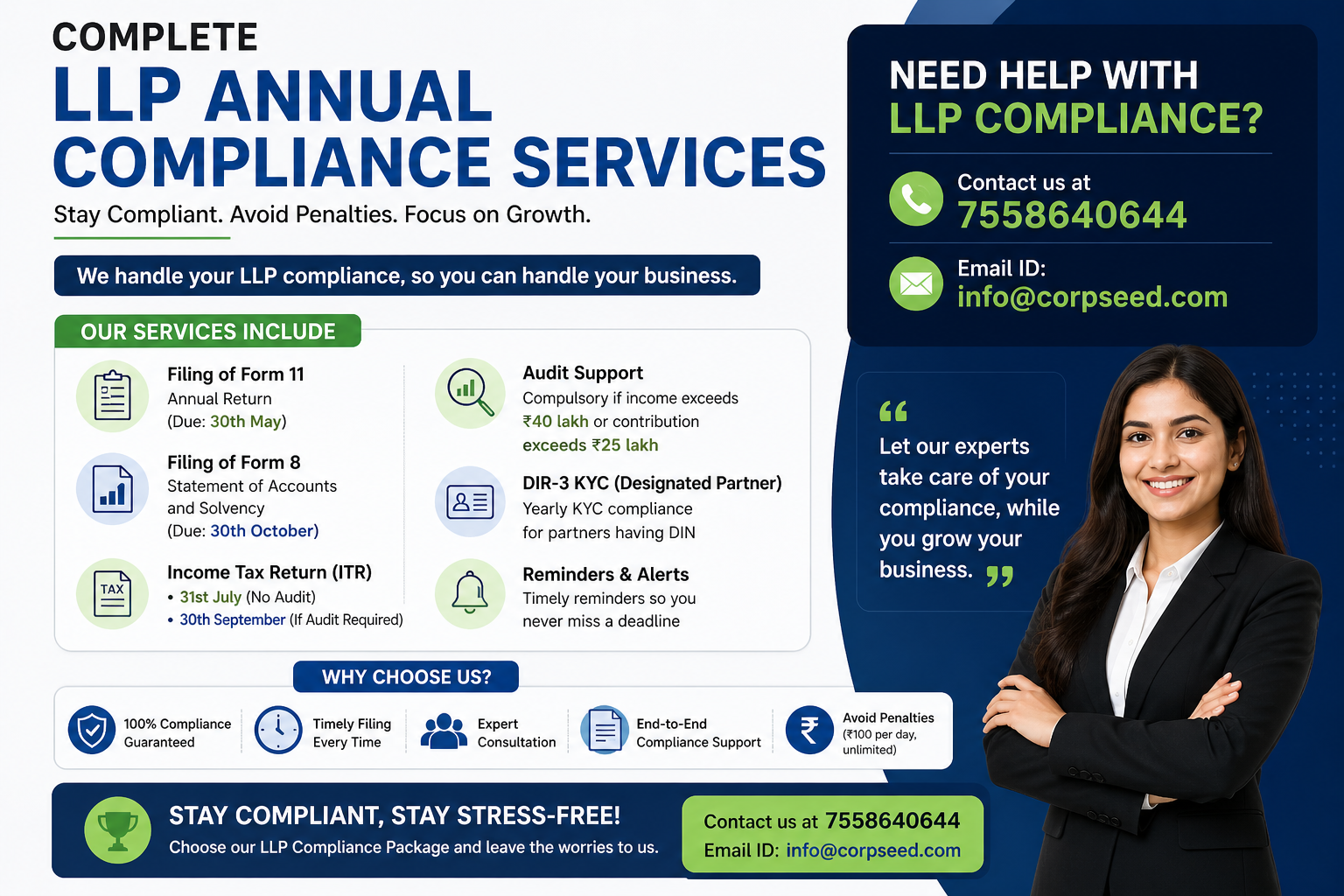
1. Form 11 – Annual Return
Form 11 captures details of partners, their contributions, and any changes in the management structure during the year. It must be filed with the ROC by 30th May every year, irrespective of business turnover. Since Form 11 cannot be revised once filed, accuracy is essential, and the contribution figures must match those reported in Form 8.
2. Form 8 – Statement of Account and Solvency
Form 8 discloses the LLP's financial position — assets, liabilities, and a declaration of solvency. It must be filed by 30th October each year and needs to be digitally signed by designated partners. If the LLP's annual turnover exceeds ₹40 lakh or partner contribution exceeds ₹25 lakh, the accounts must additionally be certified by a practising Chartered Accountant.
3. Income Tax Return (ITR-5)
Every LLP, whether profitable or not, must file ITR-5 with the Income Tax Department. The deadline is 31st July for LLPs not requiring a tax audit, and 31st October for LLPs whose accounts are subject to tax audit under the Income Tax Act.
4. Tax Audit (if applicable)
LLPs with turnover exceeding ₹1 crore (or lower thresholds in specified cases) must get their accounts audited under Section 44AB, with the audit report filed in Form 3CA/3CB and 3CD.
5. DIR-3 KYC
Every designated partner holding a DIN must complete DIR-3 KYC annually to keep their DIN active. Missing this deadline results in DIN deactivation and a reactivation fee.
6. GST Returns and TDS Filings
If registered under GST, LLPs must file monthly or quarterly GST returns. Similarly, TDS returns are due quarterly if the LLP is deducting tax at source.
7. Event-Based Filings
Beyond the recurring annual compliance for LLP, certain events trigger additional filings — such as a change in partners (Form 4), change of registered office, or amendment to the LLP Agreement (Form 3).
Penalties for Non-Compliance
The consequences of missing LLP compliance deadlines are steep and, importantly, uncapped:
- Late filing of Form 11 or Form 8: ₹100 per day, per form, with no maximum limit — a delay of even a few months can add up to tens of thousands of rupees.
- Continuous default: Can lead to disqualification of designated partners and the LLP being marked as "defaulting" on MCA records.
- Prolonged non-filing: The Registrar may initiate proceedings to strike off the LLP from its records altogether.
This is precisely why treating annual compliance as a priority — not an afterthought — protects both the business and its partners from unnecessary financial and legal exposure.
Why Timely LLP Compliance Matters
- Avoids penalties: On-time filing prevents daily late fees from accumulating.
- Preserves legal status: Keeps your LLP active and in good standing with the ROC.
- Builds credibility: Banks, investors, and vendors check MCA compliance history before extending credit or entering partnerships.
- Smoother fundraising and loans: A clean compliance record makes due diligence faster during loan approvals or investment discussions.
- Prevents partner disqualification: Keeps designated partners eligible to hold DIN/DPIN in other entities.
Simplify LLP Compliance With Expert Support
Managing LLP compliance in-house means tracking multiple due dates, form versions, certification requirements, and portal updates throughout the year — a process that becomes complex as your business grows. A dedicated LLP compliance package takes this burden off your plate by handling Form 11, Form 8, ITR-5, DIR-3 KYC, and event-based filings on your behalf, so you never miss a deadline.
If you'd rather focus on running your business than tracking ROC due dates, Corpseed's LLP Annual Compliance service covers end-to-end filing support, documentation, and expert guidance tailored to your LLP's compliance needs.
FAQs on LLP Compliance
1. What is the due date for LLP annual compliance? Form 11 (Annual Return) is due by 30th May, and Form 8 (Statement of Account and Solvency) is due by 30th October each financial year. Income Tax Return (ITR-5) is due by 31st July for non-audit cases and 31st October for audit cases.
2. Is annual compliance mandatory for LLPs with zero turnover? Yes. Even LLPs with no business activity or transactions during the year must file Form 11 and Form 8. Non-filing still attracts penalties and can eventually lead to striking off.
3. What happens if I miss the LLP compliance deadline? Late filing attracts a penalty of ₹100 per day per form, with no upper cap. Continued default can lead to disqualification of designated partners and removal of the LLP's name from the register.
4. Is a tax audit mandatory for all LLPs? No. Audit is required only if the LLP's turnover exceeds ₹40 lakh or partner contribution exceeds ₹25 lakh (for certification under the LLP Act), or if turnover exceeds ₹1 crore under the Income Tax Act. Other LLPs can self-certify their accounts.
5. What compliances are required immediately after LLP incorporation? Filing the LLP Agreement (Form 3) within 30 days, applying for PAN/TAN, opening a bank account, and, where applicable, registering for GST are the key compliances after incorporation.
6. Can Form 11 be revised after filing? No. Once Form 11 is filed, it cannot be revised or refiled, so it's important to verify all details — especially partner contributions — before submission.
7. Do I need a Company Secretary or CA for LLP compliance? Form 8 requires certification by a practising CA/CS/CMA if turnover or contribution thresholds are crossed. A practising Company Secretary must certify Form 11 only if contribution exceeds ₹50 lakh or turnover exceeds ₹5 crore.
8. How can I ensure my LLP stays compliant every year? Maintaining updated books of accounts, tracking due dates on a compliance calendar, and opting for a professional LLP compliance package are the most reliable ways to stay on top of ROC and tax filings without last-minute stress.

 English
 Arabic
 French
 Spanish
 Portuguese
 Deutsch
 Turkish
 Italiano
 Russian
 Romaian
 Portuguese (Brazil)
 Greek
Greek
