
Hair Transplant: Procedure, Benefits, Cost, Recovery, and Results
Hair loss is a common concern among men and women, affecting confidence, appearance, and overall self-esteem. While hair loss may occur due to genetics, hormonal changes, aging, medical conditions, stress, or nutritional deficiencies, modern medical advancements have made hair restoration more effective and natural-looking than ever before. A hair transplant is one of the most popular and reliable solutions for individuals experiencing permanent hair loss or thinning hair.
A hair transplant is a surgical procedure in which healthy hair follicles are taken from a donor area, usually the back or sides of the scalp, and transplanted into areas experiencing hair loss. These transplanted follicles continue to grow hair naturally, providing long-lasting results when performed by an experienced hair transplant specialist.
In this comprehensive guide, we will explore everything you need to know about hair transplantation, including techniques, benefits, eligibility, procedure, recovery, side effects, cost, results, and frequently asked questions.
What Is a Hair Transplant?
A hair transplant is a minimally invasive surgical procedure designed to restore hair in areas of the scalp affected by hair loss. It involves transferring hair follicles from a donor area with sufficient hair density to bald or thinning areas.
The donor area is generally located at the back or sides of the scalp because hair follicles in these regions are usually more resistant to the hormones responsible for hereditary hair loss. These follicles are carefully extracted and implanted into the recipient area to create natural hair growth.
Hair transplantation is commonly performed to treat:
-
Male pattern baldness
-
Female pattern hair loss
-
Receding hairline
-
Bald patches on the scalp
-
Thinning crown
-
Hair loss due to scars or injuries
-
Hair loss following certain surgical procedures
-
Eyebrow hair loss
-
Beard and moustache hair loss
Hair transplant surgery does not create new hair follicles. Instead, it redistributes healthy hair follicles from one area of the body to another.
What Causes Hair Loss?
Hair loss can occur for several reasons. Understanding the underlying cause is essential before choosing a hair transplant procedure.
1. Genetic Hair Loss
Genetic hair loss, also known as androgenetic alopecia, is one of the most common causes of hair loss in men and women. It occurs due to inherited genetic factors and sensitivity to hormones, particularly dihydrotestosterone (DHT).
In men, genetic hair loss often begins with a receding hairline or thinning at the crown. In women, it generally appears as diffuse thinning across the scalp, particularly around the central parting.
2. Hormonal Changes
Hormonal changes can affect the hair growth cycle. Conditions involving thyroid hormones, hormonal imbalances, and certain reproductive or metabolic changes may contribute to hair thinning or excessive shedding.
3. Stress and Lifestyle Factors
Physical or emotional stress can sometimes trigger temporary hair shedding, known as telogen effluvium. This condition may develop after illness, surgery, significant stress, rapid weight loss, or other major life changes.
4. Nutritional Deficiencies
Low levels of certain nutrients, including iron, protein, vitamin B12, or other essential nutrients, may contribute to hair loss in some individuals.
5. Medical Conditions
Certain autoimmune conditions, scalp infections, inflammatory scalp disorders, and other medical problems may cause hair loss. Some forms of hair loss may permanently damage follicles and require specific treatment.
6. Aging
As people age, hair follicles may become smaller, hair growth may slow, and hair density may decrease. These changes can affect both men and women.
Types of Hair Transplant Techniques
Several hair transplant techniques are available today. The choice of technique depends on the patient's hair loss pattern, donor hair availability, scalp condition, goals, and the surgeon's assessment.
1. FUE Hair Transplant
FUE, or Follicular Unit Extraction, is one of the most widely used hair transplant techniques. In this method, individual hair follicular units are extracted from the donor area using a small punch instrument.
The extracted follicles are then implanted into the recipient area using specialized instruments.
The FUE procedure generally involves:
-
Shaving or trimming the donor area, depending on the technique.
-
Administering local anesthesia.
-
Extracting individual hair follicles.
-
Preparing recipient sites in the thinning or bald area.
-
Implanting the extracted follicles.
-
Providing post-operative care instructions.
FUE is popular because it does not require a long linear incision in the donor area. It usually leaves small dot-like scars that may be difficult to notice when healed and the surrounding hair is sufficiently long.
Benefits of FUE Hair Transplant
-
No large linear scar.
-
Minimally invasive extraction technique.
-
Generally faster donor-area healing than traditional strip surgery.
-
Suitable for many patients with different hair loss patterns.
-
Natural-looking results when follicles are properly placed.
-
Can be used for scalp, beard, and eyebrow restoration.
2. FUT Hair Transplant
FUT, or Follicular Unit Transplantation, is another established hair restoration technique. In this procedure, a strip of scalp containing healthy hair follicles is surgically removed from the donor area.
The strip is then carefully dissected into individual follicular units under magnification. These grafts are subsequently implanted into the recipient area.
FUT may be suitable for individuals who need a large number of grafts and have an appropriate donor area.
Benefits of FUT Hair Transplant
-
Can provide a large number of grafts in a single session.
-
Efficient utilization of donor follicles in suitable patients.
-
The extracted follicular units are prepared under microscopic magnification.
-
May be appropriate for some patients with extensive hair loss.
The main disadvantage of FUT is that it leaves a linear scar in the donor area. Recovery may involve more discomfort or restrictions than FUE, and the scar can become visible with very short hairstyles.
3. DHI Hair Transplant
DHI, or Direct Hair Implantation, is a hair transplantation approach commonly associated with the use of specialized implantation pens.
In many DHI procedures, hair follicles are extracted individually, similar to FUE, and then loaded into implantation instruments that allow the surgeon or trained implantation team to place follicles into the recipient area.
DHI is not necessarily a completely separate follicle extraction method from FUE. It is often distinguished by the implantation approach.
Benefits of DHI Hair Transplant
-
Precise implantation of hair follicles.
-
May provide better control over implantation angles and directions.
-
Can be useful for hairline refinement and smaller areas.
-
May reduce the time grafts spend outside the body when the procedure is efficiently organized.
-
Does not require a linear donor scar.
The suitability of DHI depends on the patient's scalp, donor area, hair characteristics, and the expertise of the medical team.
Who Is a Good Candidate for Hair Transplant?
Hair transplantation is not suitable for everyone. A proper consultation and assessment are essential to determine whether the procedure can provide satisfactory results.
A good candidate for a hair transplant generally:
-
Has stable or reasonably predictable hair loss.
-
Has sufficient healthy donor hair.
-
Has realistic expectations about hair density and coverage.
-
Is in generally good health.
-
Does not have an untreated scalp condition affecting hair follicles.
-
Understands the procedure, recovery, risks, and limitations.
Hair transplant surgery may not be recommended for individuals with extensive hair loss and insufficient donor hair, certain active inflammatory scalp disorders, uncontrolled medical conditions, or some forms of rapidly progressing or scarring hair loss.
Younger patients may require additional assessment because their hair loss pattern may continue to progress for many years.
Hair Transplant Procedure: Step-by-Step
A hair transplant procedure is performed under local anesthesia and usually takes several hours, depending on the number of grafts, technique, and complexity.
Step 1: Consultation and Hair Assessment
The surgeon evaluates the patient's scalp, donor area, recipient area, hair density, hair characteristics, and hair loss pattern.
The consultation may include:
-
Medical history.
-
Hair loss history.
-
Scalp examination.
-
Donor hair density assessment.
-
Hairline design.
-
Graft estimation.
-
Discussion of expected results.
-
Evaluation of possible risks.
Step 2: Hairline Design
The hairline is designed according to the patient's facial structure, age, hair characteristics, and future hair loss possibilities.
A natural hairline generally includes irregularities and gradual transitions rather than a perfectly straight line. Proper hairline planning is important because the transplanted hair may remain for many years.
Step 3: Preparation of the Donor Area
The donor area is prepared according to the selected technique. Hair may be shaved or trimmed, and the scalp is cleaned and sterilized.
Local anesthesia is administered to reduce discomfort during extraction.
Step 4: Hair Follicle Extraction
In FUE-based procedures, individual follicular units are extracted from the donor area using a specialized punch.
The extraction process requires careful attention to avoid damaging follicles and to maintain donor-area density.
Step 5: Preparation of Grafts
Extracted follicles are sorted, inspected, and prepared for implantation.
Hair follicular units naturally contain one, two, three, or sometimes more hair follicles. These grafts are selected and distributed according to the recipient area's requirements.
Single-hair grafts may be particularly useful for creating a natural-looking hairline, while multi-hair grafts may be used to improve density behind the hairline.
Step 6: Recipient Area Preparation
Small recipient sites are created in the areas where hair restoration is required.
The surgeon considers the angle, direction, depth, spacing, and pattern of implantation to achieve a natural appearance.
Step 7: Hair Graft Implantation
The prepared follicles are implanted into the recipient area.
Depending on the technique, implantation may be performed using forceps, specialized implanter pens, or other instruments.
The surgeon and medical team carefully place the grafts to match the patient's natural hair pattern.
Step 8: Post-Procedure Care
After the procedure, the patient receives instructions regarding scalp washing, sleeping position, medication, activity restrictions, and follow-up appointments.
Following these instructions is essential to protect the transplanted follicles during the early healing period.
Benefits of Hair Transplant
Hair transplantation offers several benefits for individuals experiencing permanent hair loss.
1. Natural-Looking Hair Growth
Modern hair transplant techniques allow surgeons to place follicles according to natural hair growth patterns. When properly performed, transplanted hair can blend with existing hair.
2. Long-Lasting Results
Hair follicles taken from suitable donor areas are generally more resistant to the hormonal factors responsible for hereditary hair loss.
Transplanted hair can continue growing for many years, although the surrounding non-transplanted hair may continue to thin.
3. Improved Confidence
Hair restoration may help individuals feel more comfortable with their appearance and improve confidence in personal and professional settings.
4. Permanent Hair Restoration in Transplanted Areas
Transplanted follicles can produce hair for the long term. However, hair transplant surgery does not prevent future hair loss in untreated areas.
5. Low Maintenance
Once the transplanted hair has fully grown, it can generally be washed, cut, styled, and maintained like natural hair.
6. Customized Hair Restoration
Hair transplantation can be tailored to individual needs, including hairline restoration, crown coverage, beard restoration, moustache restoration, and eyebrow transplantation.
Hair Transplant for Men
Male pattern baldness is one of the most common reasons for hair transplantation. It often affects the frontal hairline, temples, and crown.
A hair transplant for men may help restore:
-
Receding hairline.
-
Frontal baldness.
-
Temple areas.
-
Crown thinning.
-
Extensive scalp hair loss.
The surgeon must consider future hair loss when designing the hairline. Creating an excessively low hairline may use too many donor grafts and may not look natural as the patient ages.
Hair Transplant for Women
Women may experience hair thinning due to genetics, hormonal changes, medical conditions, nutritional deficiencies, or other causes.
Hair transplantation may be an option for women with certain patterns of hair loss, including:
-
Frontal hairline recession.
-
Localized thinning.
-
Hair loss caused by scars.
-
Certain stable forms of hair loss.
However, diffuse thinning across the scalp may make hair transplantation unsuitable because the donor area may also be affected.
Women should undergo a detailed medical evaluation before considering hair transplant surgery.
Hair Transplant for Beard and Moustache
Beard transplantation is a cosmetic procedure used to improve beard density or fill areas where facial hair is absent or sparse.
Hair follicles are generally taken from the scalp donor area and implanted into the beard region.
Beard hair transplantation may be performed to address:
-
Patchy beard growth.
-
Sparse cheeks.
-
Uneven beard density.
-
Beard scars.
-
Weak moustache growth.
-
Desired beard shape or contour.
The implantation angle is especially important in beard transplantation because facial hair grows at different angles depending on the location.
Hair Transplant for Eyebrows
Eyebrow transplantation is a procedure designed to restore eyebrow density, shape, or fullness.
It may be considered for individuals with sparse eyebrows caused by genetics, scars, trauma, or certain stable conditions.
The surgeon carefully places hair follicles to match the natural direction of eyebrow hair growth.
Because transplanted eyebrow hairs may grow longer than normal eyebrow hairs, regular trimming may be necessary.
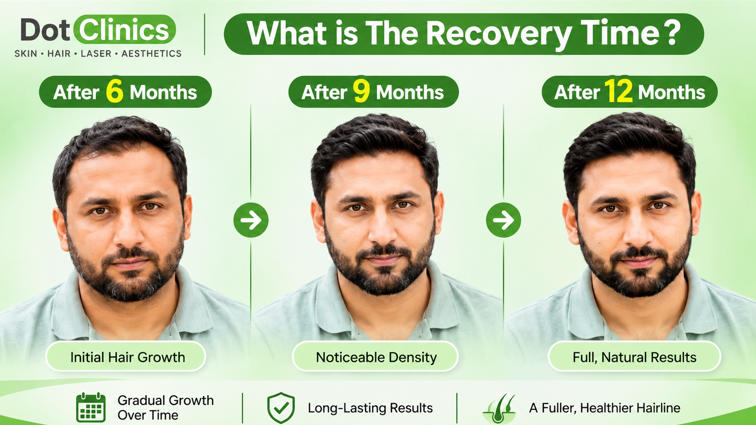
Hair Transplant Recovery Timeline
Recovery after hair transplantation occurs gradually. The transplanted follicles require time to heal and establish themselves in the recipient area.
Days 1–3
-
Mild swelling may occur.
-
The scalp may feel tender.
-
Small crusts may develop around grafts.
-
The donor area may feel uncomfortable.
-
Patients should follow prescribed washing instructions.
Days 4–10
-
Scabs gradually begin to fall off.
-
Redness may remain.
-
The scalp continues healing.
-
Patients should avoid rubbing or scratching the recipient area.
Weeks 2–4
-
Transplanted hair shafts may begin shedding.
-
This is a normal part of the hair transplant process.
-
The follicles generally remain beneath the skin.
Months 2–3
-
Some patients may experience temporary shedding of existing hair, known as shock loss.
-
The scalp generally begins recovering from the initial procedure.
-
Visible hair growth may still be limited.
Months 3–4
-
Early new hair growth may begin.
-
Newly growing hairs may appear thin or uneven.
-
Growth varies between patients.
Months 5–6
-
Hair growth becomes more noticeable.
-
Density may gradually improve.
-
Hair shafts may become thicker.
Months 7–9
-
More substantial growth may become visible.
-
The transplanted hair may begin to blend with surrounding hair.
-
Hair texture and density continue improving.
Months 10–12
-
Many patients see significant improvement.
-
Hairline appearance becomes more mature.
-
Hair density may continue developing.
Months 12–18
-
Additional maturation and thickening may occur, particularly in the crown.
-
Final results may take longer depending on the individual.
Hair Transplant Before and After Results
Hair transplant results vary from person to person. Factors such as graft survival, donor hair quality, hair thickness, hair color, scalp characteristics, hair loss progression, and surgical technique influence the final appearance.
The results of hair transplantation are not immediate. Transplanted hair commonly sheds during the early weeks before new growth begins.
Patients should avoid judging the outcome too early because hair density and thickness continue to improve over several months.
Is Hair Transplant Painful?
Hair transplantation is generally performed under local anesthesia, which helps reduce pain during the procedure.
Patients may experience some discomfort during the administration of local anesthesia. After the anesthesia takes effect, extraction and implantation are usually much more comfortable.
After surgery, mild pain, swelling, tenderness, itching, or tightness may occur.
These symptoms are generally temporary and can be managed with medications and care instructions provided by the surgeon.
Hair Transplant Side Effects and Risks
Although hair transplantation is generally considered safe when performed by qualified professionals, it is still a surgical procedure and may involve risks.
Possible side effects include:
-
Swelling of the forehead or scalp.
-
Temporary redness.
-
Pain or tenderness.
-
Itching.
-
Small scabs.
-
Temporary numbness.
-
Infection.
-
Bleeding.
-
Folliculitis.
-
Temporary shock loss.
-
Poor graft survival.
-
Uneven hair growth.
-
Visible scarring.
-
Unnatural hairline.
-
Donor-area thinning.
-
Rarely, complications related to anesthesia or other medical factors.
Patients should select a qualified and experienced hair transplant surgeon and follow all post-operative instructions.
Hair Transplant Aftercare
Proper aftercare helps protect transplanted follicles and supports recovery.
1. Follow Washing Instructions
The scalp should be washed according to the surgeon's instructions. Gentle washing is important during the early recovery period.
Avoid aggressive rubbing, scratching, or pulling on the transplanted hair.
2. Avoid Scratching
Itching is common during healing, but scratching can damage the recipient area and increase the risk of complications.
3. Sleep Carefully
Patients are often advised to sleep with the head elevated during the first few nights to reduce swelling.
Avoid unnecessary pressure on the transplanted area.
4. Avoid Intense Exercise
Strenuous exercise, heavy lifting, and activities that increase sweating or pressure may need to be avoided temporarily.
The surgeon will advise when these activities can safely resume.
5. Avoid Sun Exposure
Direct sunlight and excessive heat may irritate the healing scalp.
Patients should follow their surgeon's recommendations regarding hats, sun protection, and outdoor activity.
6. Avoid Smoking
Smoking may affect blood circulation and wound healing. Avoiding smoking during the recovery period is strongly recommended.
7. Follow Medication Instructions
Patients should use prescribed medications as directed and avoid taking additional medications without consulting their medical provider.
8. Attend Follow-Up Visits
Follow-up appointments allow the surgeon to evaluate healing, monitor hair growth, and address any complications.
Hair Transplant Cost
The cost of a hair transplant varies depending on several factors.
These include:
-
Number of grafts required.
-
Hair transplant technique.
-
Surgeon experience.
-
Clinic facilities.
-
Medical team expertise.
-
Geographic location.
-
Complexity of the procedure.
-
Whether additional treatments are included.
In Pakistan, hair transplant pricing is generally quoted according to the number of grafts, package, clinic, and technique. Prices can vary considerably between clinics and may change over time.
A consultation is the best way to determine the estimated number of grafts and total cost.
Patients should avoid selecting a clinic solely on the basis of price. The surgeon's experience, graft handling, safety standards, donor-area management, and quality of care are important factors to consider.
Hair Transplant in Pakistan
Hair transplantation has become increasingly popular in Pakistan, with patients seeking solutions for hair loss, receding hairlines, thinning crowns, and beard restoration.
Major cities, including Lahore, Multan, Islamabad, Karachi, and Faisalabad, have clinics offering different hair restoration techniques.
Patients considering hair transplantation in Pakistan should carefully evaluate the clinic and surgeon before making a decision.
Important considerations include:
-
Qualifications and experience of the surgeon.
-
Proper medical assessment.
-
Hygiene and sterilization standards.
-
Appropriate surgical facilities.
-
Transparent graft estimates.
-
Realistic expectations.
-
Before-and-after photographs of actual patients.
-
Post-operative care.
-
Clear communication about complications and risks.
Hair transplantation is a long-term investment in appearance, and selecting the right medical provider can make a significant difference.
Hair Transplant at Dot Clinics
Dot Clinics provides aesthetic and hair-related treatment services in Lahore and Multan, Pakistan. Individuals experiencing hair loss can seek professional consultation to discuss hair restoration options and determine whether hair transplantation may be suitable for their condition.
A hair transplant consultation may help patients understand:
-
The cause of their hair loss.
-
The condition of their donor area.
-
The number of grafts required.
-
Suitable hair transplant techniques.
-
Hairline design.
-
Expected results.
-
Recovery and aftercare.
-
Potential risks and complications.
-
Treatment costs.
Hair transplant planning should be customized according to the patient's hair loss pattern, donor hair availability, age, and long-term goals.
Patients interested in hair restoration should seek an appropriate medical assessment before undergoing any procedure.
Frequently Asked Questions About Hair Transplant
1. Is a hair transplant permanent?
Hair transplanted from suitable donor areas is generally resistant to the hormonal factors responsible for hereditary hair loss and may continue growing for many years. However, surrounding non-transplanted hair may continue thinning over time.
2. How many grafts are needed for a hair transplant?
The number of grafts depends on the size of the bald area, hair loss pattern, donor density, desired coverage, and hair characteristics. Some patients may require 1,500 grafts, while others may need 3,000 or more.
3. How long does a hair transplant procedure take?
A hair transplant may take approximately 4 to 8 hours, although the duration depends on the number of grafts, technique, and complexity.
4. When does transplanted hair start growing?
New hair growth commonly begins around 3 to 4 months after surgery. Growth becomes more noticeable over the following months, with substantial results often visible around 10 to 12 months.
5. Does transplanted hair fall out?
The transplanted hair shafts commonly shed during the first few weeks. This is known as shock loss or post-transplant shedding. The transplanted follicles generally remain in the scalp and begin producing new hair later.
6. Can a hair transplant fail?
Yes. Some grafts may not survive or grow as expected. Graft survival depends on several factors, including surgical technique, follicle handling, patient health, scalp condition, and aftercare.
7. Can women undergo hair transplantation?
Yes, some women are suitable candidates for hair transplantation. However, women with diffuse thinning or certain medical causes of hair loss may not be suitable. A detailed evaluation is necessary.
8. Can a hair transplant be performed on the beard?
Yes. Beard transplantation can restore beard density, fill patchy areas, or improve beard shape using hair follicles taken from a donor area.
9. Can I wear a cap after a hair transplant?
Patients may be allowed to wear a loose, clean cap after a specific period, depending on the surgeon's instructions. Tight hats should be avoided during the early healing period.
10. When can I return to work after a hair transplant?
Many patients return to desk-based work within a few days, depending on swelling, discomfort, and the nature of their work. Jobs involving strenuous activity may require a longer recovery period.
11. Can transplanted hair be cut or styled?
Yes. Once the transplanted hair has fully healed and grown, it can generally be cut, styled, and maintained like natural hair.
12. Is FUE better than FUT?
FUE and FUT are both established hair transplant techniques. FUE avoids a linear scar, while FUT can be useful for harvesting a large number of grafts in selected patients. The best technique depends on individual needs, donor characteristics, and the surgeon's assessment.
13. Can I undergo a second hair transplant?
Yes, some patients may undergo a second hair transplant to improve density or address additional hair loss. However, donor hair availability and long-term planning must be considered.
14. Does a hair transplant require lifelong medication?
Not every patient requires lifelong medication after a hair transplant. However, some individuals may benefit from medications prescribed to help manage ongoing hair loss. Treatment should be individualized and discussed with a qualified medical professional.
15. When can I see the final hair transplant results?
Many patients see substantial results around 12 months, although additional maturation may occur up to 18 months or longer, particularly in the crown area.
Conclusion
Hair transplantation is an effective hair restoration option for many individuals experiencing permanent hair loss, thinning hair, receding hairlines, beard gaps, or certain forms of hair loss caused by scars. Modern techniques such as FUE, FUT, and DHI allow surgeons to restore hair using carefully selected follicles from donor areas.
A successful hair transplant depends on proper patient selection, experienced surgical planning, careful graft handling, natural hairline design, appropriate aftercare, and realistic expectations.
Although hair transplant surgery can provide long-lasting and natural-looking results, it is not suitable for everyone. A professional consultation is essential to assess the cause of hair loss, donor hair availability, treatment options, risks, and expected outcomes.
With appropriate planning and care, hair transplantation can help individuals restore hair coverage, improve their appearance, and feel more confident.

 English
 Arabic
 French
 Spanish
 Portuguese
 Deutsch
 Dutch
 Italiano
 Russian
 Romaian
 Portuguese (Brazil)
 Greek
