
Robot Fleet Management Software Market Valuation to Reach US$ 2177.65 million by 2034
The robot fleet management software from OTTO Motors coordinates industrial material movement, traffic control, and job dispatch across complex manufacturing and distribution centers.
Market Size and Growth Outlook
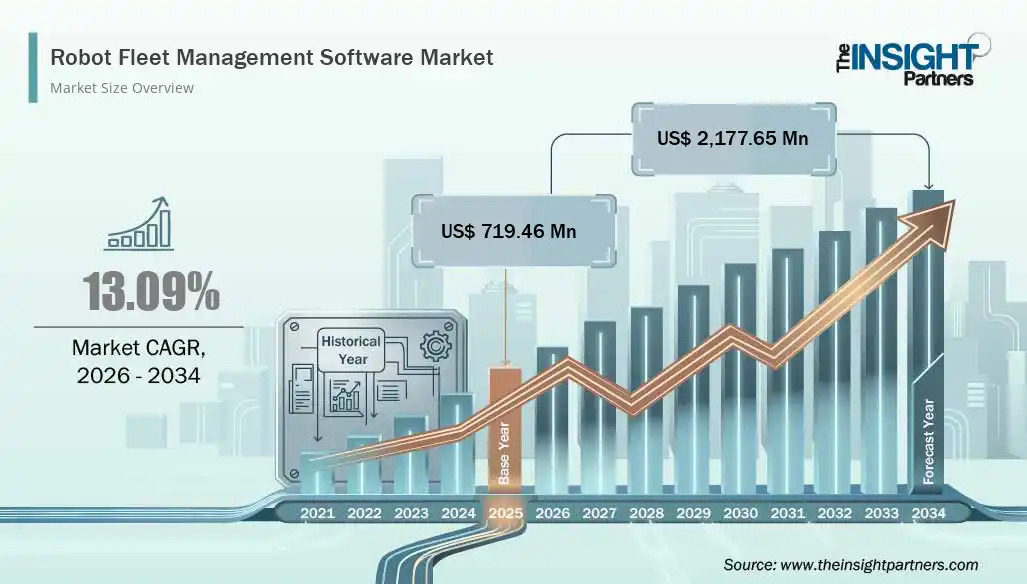
The Robot Fleet Management Software market was valued at US$ 719.46 million in 2025 and is expected to reach US$ 2177.65 million by 2034; it is estimated to record a CAGR of 13.09% during 2026-2034.
Key Growth Drivers
- Cost savings:- Automation lowers labor-intensive tasks and cuts waste, but the savings depend on running the fleet well. Fleet software helps companies get a return on their robot investments by raising utilization and reducing unplanned downtime. Predictive maintenance and remote troubleshooting also mean fewer on-site interventions.
- Safety and compliance:- When people and machines share space, safety becomes a design requirement. Fleet management systems can enforce speed limits, restricted zones, and priority rules, and they keep logs that support audits and regulatory reporting. For industries such as healthcare and manufacturing, that traceability is a significant benefit.
Get Sample PDF @ https://www.theinsightpartners.com/sample/TIPRE00027355
Market Segmentation
By component, it separates software from services. Software covers the core platforms, while services include implementation, integration, training, and ongoing support. Because every site has its own layout, workflows, and legacy systems, services often play a large role in successful rollouts.
By deployment, it distinguishes on-premise from cloud-based models. On-premise setups appeal to organizations with strict data control, latency, or security requirements, such as some manufacturing and defense-adjacent environments. Cloud-based platforms offer faster setup, easier scaling across multiple sites, and simpler updates, which is why they are increasingly attractive to distributed enterprises.
By end user, it covers logistics and third-party logistics (3PL), manufacturing, construction, and healthcare. Logistics and 3PL operators are natural early adopters because of the scale of their warehouse automation and the pressure to speed up delivery. Manufacturers use fleets for material transport and line-side delivery. Construction is a newer area, where robots handle inspection, surveying, and material movement. Healthcare facilities use them for delivery of supplies, specimens, and meals, freeing clinical staff for patient care.
Regional Perspective
The report covers North America, Europe, Asia-Pacific, South and Central America, and the Middle East and Africa, with country-level analysis for markets including the United States, Canada, Mexico, the UK, Germany, France, Italy, Russia, China, India, Japan, Australia, Brazil, Argentina, South Africa, Saudi Arabia, and the UAE. The United States is highlighted as a key market, supported by the efficiency, cost, and safety drivers described above.
Different regions have different motivations. Mature industrial economies are driven by labor shortages and the need to modernize existing facilities. Fast-growing Asian economies combine large manufacturing and e-commerce sectors with strong government interest in automation. Emerging markets in the Middle East and Latin America are building new logistics and industrial infrastructure, which gives them a chance to adopt automation from the start rather than retrofit it.
Competitive Landscape
- Addverb Technologies Private Limited
- Amazon Web Services, Inc.
- Bridge Robotics Ltd.
- Fetch Robotics, Inc.
- Formant
- Freedom Robotics
- Meili Robots
- Movio Robotics
- Omron Corporation
- OTTO Motors
Emerging Trends and Opportunities
Several trends are likely to shape the market through 2034.
Smarter logistics.:-The Insight Partners highlights the rise of smart robot fleet solutions in logistics, where coordination software helps meet rising demand for fast, accurate fulfillment.
Delivery automation:- Robots are increasingly moving goods inside facilities and, in some cases, across campuses and neighborhoods. Managing these assets reliably is a growing opportunity for software providers.
Human-centered design:- The report notes the importance of the human element in fleet management technology. Interfaces that let supervisors understand, trust, and intervene in robot operations will matter as much as the underlying algorithms, particularly as robots work alongside people.
Interoperability:- Many sites run robots from several manufacturers. Platforms that can orchestrate mixed fleets through common standards and open interfaces stand to gain, since operators generally want to avoid being locked into one vendor.
Strategic Takeaways
For technology providers, the message is to invest in interoperability, strong integration tooling, and analytics that translate robot data into business outcomes. For enterprises, fleet management software should be considered at the start of a robotics program, not as an afterthought, because the control layer determines whether a collection of robots delivers real productivity. For investors, the sector offers exposure to automation growth through software, which typically carries different economics from hardware.
Future Outlook
The Insight Partners’ analysis presents robot fleet management software as a small but rapidly expanding part of the automation economy. With a market value of US$ 719.46 million in 2025 and a forecast of US$ 2,177.65 million by 2034 at a 13.09% CAGR, it is set for steady, sustained growth. As robots spread across logistics, manufacturing, construction, and healthcare, the software that coordinates them will increasingly determine how much value organizations capture from their automation investments.
About The Insight Partners
The Insight Partners delivers market intelligence and consulting services to help clients make informed decisions. The firm covers industries such as Aerospace and Defense, Automotive and Transportation, Semiconductor and Electronics, Biotechnology, Healthcare IT, Manufacturing, Medical Devices, Technology, Media, and Chemicals and Materials.
Contact Us:
If you have any queries about this report or if you would like further information, please contact us:
Contact Person: Ankit Mathur
E-mail: sales@theinsightpartners.com
Phone: +1-646-491-9876
Also Available in :

 English
 Arabic
 French
 Spanish
 Portuguese
 Deutsch
 Turkish
 Dutch
 Italiano
 Russian
 Romaian
 Greek
