
Offshore Structural Analysis Software Market Value to US$ 1,866.93 Million by 2034
The Offshore developers are implementing innovative structural analysis software to improve design accuracy, reduce maintenance costs, and ensure long-term sustainability of critical offshore assets.
Market Overview
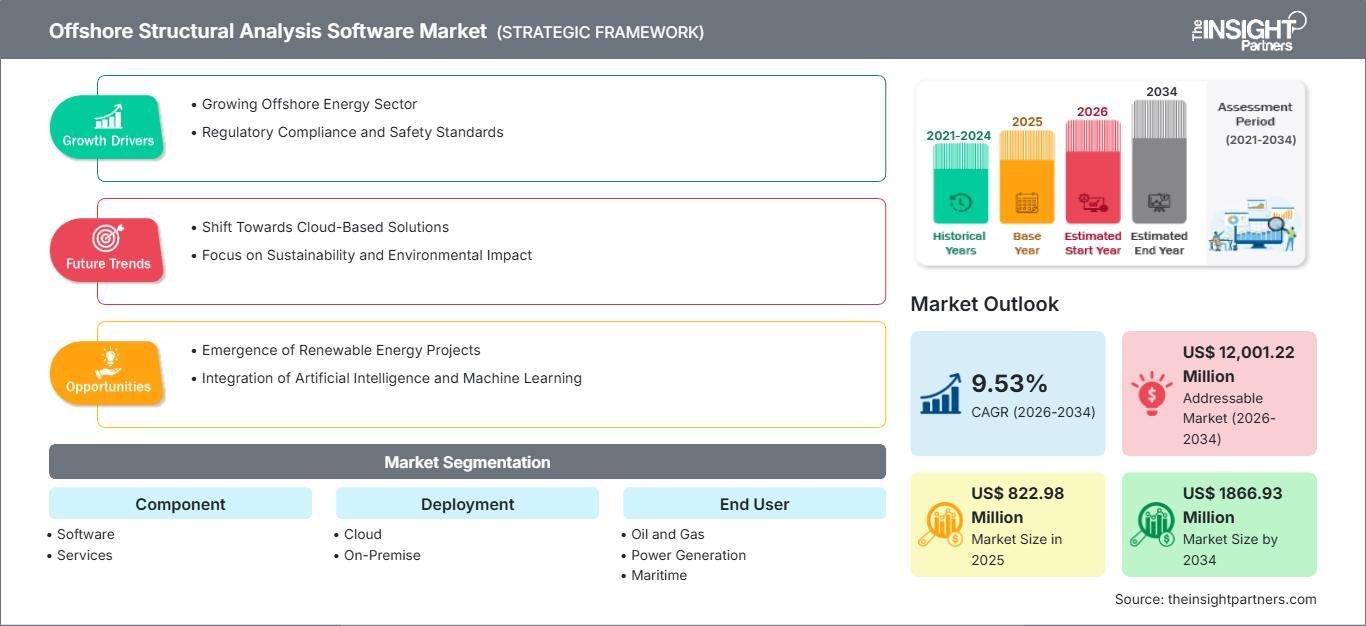
According to The Insight Partners, The global Offshore Structural Analysis Software market was valued at US$ 822.98 million in 2025 and is expected to reach US$ 1866.93 million by 2034; it is estimated to record a CAGR of 9.53% during 2026-2034.
What Offshore Structural Analysis Software Does
- Static and dynamic analysis, which evaluates how structures respond to loads from waves, currents, wind and operations.
- Fatigue and fracture assessment, which predicts how repeated stress cycles affect welded joints and critical members over time.
- Seismic and extreme-event analysis, which tests designs against rare but severe conditions.
- Installation and transportation analysis, which checks structural behavior during lifting, towing, launching and load-out.
- Integrity management, which supports inspection planning and life-extension studies for ageing assets.
Because offshore failures carry very high safety, environmental and financial costs, regulators and classification societies expect rigorous documented analysis. That expectation is a durable source of software demand.
Get Sample PDF @https://www.theinsightpartners.com/sample/TIPRE00006063
Key Growth Drivers
- Expansion of offshore energy :- Oil and gas companies are still investing in deepwater and ultra-deepwater developments, where structures must handle greater depths, higher pressures and more demanding environments. At the same time, offshore wind is expanding in Europe, Asia Pacific and North America. Fixed-bottom and floating wind foundations require detailed structural, hydrodynamic and fatigue analysis, which adds a new customer base beyond traditional energy.
- Ageing infrastructure and life extension :- Many platforms in mature basins such as the North Sea and the Gulf of Mexico are operating beyond their original design life. Operators need to show these assets can continue safely, which creates demand for reassessment, fatigue re-analysis and structural health evaluation. Software that links inspection data with analysis models is especially useful here.
- Pressure to cut cost and risk :-Offshore projects are expensive, and design errors found late are costly to fix. Virtual testing lets engineers compare many design options early, optimize material use and reduce over-engineering. Better analysis can also shorten project schedules, which matters in an industry sensitive to capital costs.
- Stricter safety and regulatory standards :-Offshore operations are tightly regulated, and standards for structural integrity, environmental loading and safety keep evolving. Software that embeds recognized codes and automates compliance checks saves engineering time and reduces the risk of non-compliance.
- Digitalization and digital twins:-Operators increasingly want a live digital representation of each asset. Structural analysis models feed these digital twins, which combine design data, sensor readings and inspection findings to support predictive maintenance and operational decisions.
Technology Trends Shaping the Market
- Cloud and flexible deployment:-Complex finite element and hydrodynamic simulations need heavy computing power. Cloud-based deployment gives engineering teams scalable processing, easier collaboration across offices and contractors, and faster turnaround on large parametric studies. On-premise installations remain relevant for organizations with strict data-security needs, so a hybrid approach is common.
- Integration of AI and machine learning:-Vendors are exploring machine learning to speed up repetitive analyses, build surrogate models that approximate expensive simulations, and spot patterns in inspection and monitoring data. These tools are meant to support engineers, not replace the validation that offshore design requires.
- Multiphysics and coupled analysis:- Floating structures and wind turbines involve interactions between aerodynamics, hydrodynamics, mooring behavior and structural response. Demand is growing for software that handles these coupled effects in one workflow instead of passing data between separate tools.
- Interoperability:-Engineering teams want analysis software to connect smoothly with CAD, BIM and asset management systems. Open data exchange and integrated engineering environments cut manual rework and reduce transcription errors.
Segment Perspective
By component, the Offshore Structural Analysis Software Market splits into software and services. Software licenses form the technical core, while services such as consulting, implementation, training, customization and support help organizations get value from complex tools. Offshore analysis requires specialized expertise, so services are a meaningful part of overall spending.
By deployment, buyers choose between cloud and on-premise models. Cloud adoption is rising because of scalability and collaboration benefits, though security, data sovereignty and legacy workflows keep many organizations on local installations.
By end user, demand comes mainly from oil and gas operators, engineering and design firms, shipbuilding and marine companies, renewable energy developers, and government and research bodies. Oil and gas has historically been the largest user, but offshore wind and other marine renewables are an increasingly important growth area.
Regional Dynamics
North America has a long offshore tradition in the Gulf of Mexico and growing wind ambitions along the Atlantic coast, supported by a strong base of engineering firms and software vendors. Europe combines mature North Sea oil and gas assets with the world’s most developed offshore wind sector, so it needs both life-extension tools and new-build design software.
Asia Pacific is a major growth region. Large offshore wind pipelines in China, Taiwan, South Korea and Japan, along with offshore energy activity in India and Australia, are raising demand for design and analysis capability. The Middle East and Africa continue to invest in offshore oil and gas, while South and Central America, led by deepwater activity off Brazil, add further demand.
Challenges and Restraints
The Offshore Structural Analysis Software Market faces several obstacles. Licensing costs for advanced simulation suites can be high, which limits adoption among smaller firms. Offshore analysis also takes specialized skills, and a shortage of experienced structural and hydrodynamic engineers can slow uptake. Oil price volatility affects capital spending in oil and gas, which can delay or cancel projects and reduce software investment. Finally, integrating new tools with legacy systems and established workflows takes time and change management.
Opportunities Ahead
Several opportunities stand out. Floating offshore wind, still early in commercialization, needs sophisticated coupled analysis and could become a significant growth area. Decommissioning and repurposing of ageing platforms will require structural assessment of removal, reuse and conversion options. Subscription and cloud-based pricing can lower the barrier to entry for mid-sized firms and emerging markets. Vendors that pair analysis tools with integrity management, monitoring and digital twin capabilities can also move from selling standalone software to providing ongoing asset-lifecycle support.
Competitive Landscape
- Bentley Systems, Incorporated
- DNV Group.
- John Wood Group PLC
- Dlubal Software GmbH
- Orcina Ltd.
- Ramboll Group A/S
- SAFI Structural Engineering Software
- Stewart Technology Associates
- Zebec Marine Consultant and Services
- Viking Systems
Future Outlook
Offshore structural analysis software supports the safe and economical design, operation and life extension of structures in some of the most demanding environments on Earth. Cloud deployment, AI-assisted workflows, multiphysics modeling and digital twins are shaping how the software is built and sold. Vendors that combine technical depth, open integration and flexible commercial models are best placed to benefit, while the shift toward renewables is widening the field of potential customers.
About The Insight Partners
The Insight Partners delivers market intelligence and consulting services to help clients make informed decisions. The firm covers industries such as Aerospace and Defense, Automotive and Transportation, Semiconductor and Electronics, Biotechnology, Healthcare IT, Manufacturing, Medical Devices, Technology, Media, and Chemicals and Materials.
Contact Us:
If you have any queries about this report or if you would like further information, please contact us:
Contact Person: Ankit Mathur
E-mail: sales@theinsightpartners.com
Phone: +1-646-491-9876
Also Available in :
Korean | German | Japanese | French | Chinese | Italian | Spanish

 English
 Arabic
 French
 Spanish
 Portuguese
 Deutsch
 Turkish
 Dutch
 Italiano
 Russian
 Portuguese (Brazil)
 Greek
