
Mirrorless Cameras Industry Trends, Market Demand & Growth Opportunities 2026–2034
Mirrorless Cameras Market Trends, Demand, Growth & Future Outlook 2026–2034
Mirrorless Cameras Market Size
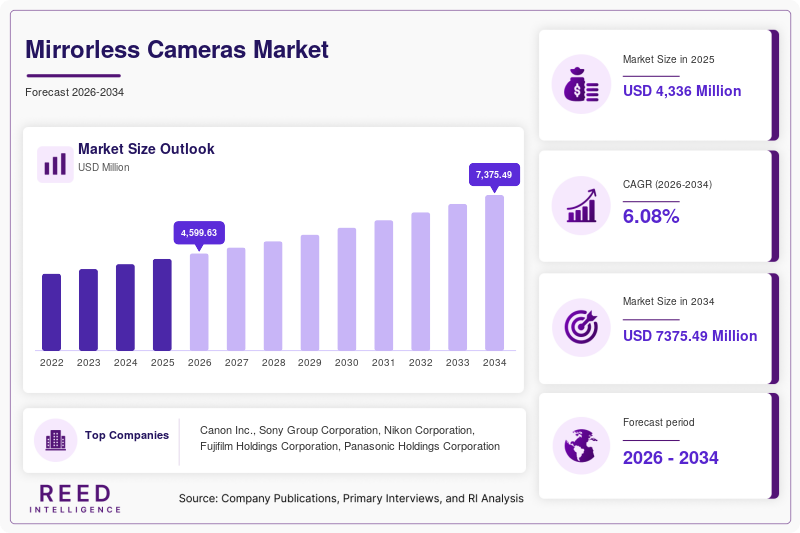
The global Mirrorless Cameras Market was valued at USD 4,336 million in 2025 and is projected to grow from USD 4,599.63 million in 2026 to approximately USD 7,375.49 million by 2034, registering a CAGR of 6.08% during the forecast period from 2026 to 2034.
The Mirrorless Cameras Market comprises digital cameras that use electronic viewfinders or rear displays instead of the optical mirror mechanism found in traditional DSLR cameras. These systems offer interchangeable lenses, advanced autofocus, high-resolution imaging, image stabilization, and increasingly sophisticated video capabilities. They serve professional photographers, photography enthusiasts, filmmakers, content creators, sports and wildlife photographers, and consumers seeking dedicated imaging equipment.
Market growth is supported by demand for high-quality photography and video production, the expansion of online content creation, and improvements in image sensors, autofocus algorithms, image processors, and lens systems. Mirrorless cameras increasingly support both still photography and video workflows, including subject tracking, high-resolution recording, in-body image stabilization, and advanced color profiles.
Request a Sample: https://reedintelligence.com/market-analysis/mirrorless-cameras-market/request-sample
Key Takeaways
-
Market Size (2026): USD 4,599.63 million.
-
Projected Market Size (2034): Approximately USD 7,375.49 million.
-
CAGR (2026–2034): 6.08%.
-
Key Market Drivers: Demand for high-quality photography, growth in video production, technological advancements, and expansion of the creator economy.
-
Major Sensor Types: Full-frame, APS-C, Micro Four Thirds, and other sensor types.
-
Major Applications: Professional photography, amateur photography, sports and wildlife photography, and videography and content creation.
-
Key Distribution Channels: Online and offline retail.
-
Leading Region: Asia Pacific is identified as the dominant region in several third-party market estimates, although its precise share varies with market definition.
Mirrorless Cameras Market Trends
The Mirrorless Cameras Market is experiencing continued development in autofocus technology, image processing, sensor performance, and video recording capabilities. Eye and subject detection, high-speed continuous shooting, improved low-light performance, and advanced stabilization help photographers and filmmakers capture demanding scenes. Manufacturers are also expanding lens ecosystems and improving camera ergonomics.
Another important trend is the convergence of photography and video production. Content creators increasingly seek equipment that supports photography, livestreaming, short-form video, and professional production within a single camera system. Mirrorless models with reliable autofocus, flexible recording options, and improved connectivity are positioned to serve these combined requirements.
The market is also influenced by competition between dedicated cameras and smartphones. Camera manufacturers are responding by emphasizing interchangeable lenses, optical flexibility, specialized shooting controls, and imaging performance for professional and enthusiast applications.
Mirrorless Cameras Market Drivers
Growing Demand for High-Quality Photography and Video Content
The expansion of digital content creation, social media publishing, online video, independent filmmaking, and professional visual communication supports demand for dedicated imaging equipment. Mirrorless cameras offer interchangeable lenses, advanced autofocus, high-resolution sensors, and video controls that appeal to users seeking greater creative flexibility than many general-purpose devices provide.
Professional applications such as weddings, events, commercial photography, journalism, and documentary production also contribute to demand for capable camera systems.
Technological Advancements in Camera Systems
Improvements in autofocus tracking, sensor performance, image stabilization, image processing, and video recording are strengthening mirrorless camera capabilities. Eye detection, subject tracking, high-speed shooting, and advanced low-light performance help users capture complex scenes.
Manufacturers are also expanding compatible lens options and refining camera ergonomics. These developments can encourage upgrades among existing users and attract photographers transitioning from DSLR systems.
Mirrorless Cameras Market Restraints
Competition from Smartphones
Modern smartphones offer convenient photography, automated scene optimization, computational imaging, and increasingly capable video recording. For casual users, these features may reduce the need to purchase dedicated cameras, particularly entry-level models.
Camera manufacturers must demonstrate the benefits of dedicated imaging systems through optical quality, interchangeable lenses, specialized controls, autofocus capabilities, and performance in demanding photographic situations.
High System Costs and Long Replacement Cycles
The total cost of a mirrorless camera system extends beyond the camera body to include interchangeable lenses, batteries, memory cards, lighting equipment, and accessories. Professional-grade lenses and full-frame camera bodies can require substantial investment.
Many users also retain camera bodies for several years before upgrading. These factors may reduce purchase frequency, particularly among price-sensitive consumers and amateur photographers.
Mirrorless Cameras Market Opportunities
Expansion of the Creator Economy and Video Production
Growing demand for online video, livestreaming, short-form content, and independent production creates opportunities for cameras optimized for both photography and video. Manufacturers can target creators through dedicated video modes, reliable autofocus, improved stabilization, compact designs, and simplified recording workflows.
Models that combine strong imaging performance with accessible controls may appeal to vloggers, small production companies, educators, and independent filmmakers.
Growth in Emerging Markets and Entry-Level Camera Systems
Rising interest in photography, expanding retail access, and online distribution create opportunities in emerging markets. Manufacturers can reach broader customer groups through compact camera bodies, affordable lenses, beginner-friendly controls, and bundled accessories.
Educational content, creator partnerships, and product demonstrations can also help consumers understand the advantages of interchangeable-lens cameras compared with smartphones and fixed-lens devices.
Mirrorless Cameras Market Segmentation Analysis
By Sensor Type
The market is segmented into full-frame, APS-C, Micro Four Thirds, and other sensor types.
Full-frame cameras appeal to professional photographers and advanced enthusiasts who prioritize image quality, low-light performance, depth-of-field control, and high-end lens compatibility. APS-C cameras offer a more compact and often more affordable alternative for travel, everyday photography, wildlife, and content creation. Micro Four Thirds systems serve users seeking portability and compact lens options.
Dominant segment: Full-frame cameras are identified as a leading sensor-format segment in the supplied source's regional assessment. However, a directly comparable global market share for each sensor format was not independently verified.
Fastest-growing segment: The supplied information does not establish a verified fastest-growing sensor format or its specific CAGR.
By Application
The market includes professional photography, amateur photography, sports and wildlife photography, videography and content creation, and other applications.
Professional photography remains important because mirrorless systems are used for weddings, portraits, commercial assignments, journalism, sports, wildlife, and event coverage. These users often prioritize autofocus accuracy, image quality, burst performance, durability, and access to specialized lenses.
Videography and content creation are also important applications, supported by demand for advanced recording formats, stabilization, reliable subject tracking, and flexible audio and connectivity options. Amateur and travel photography contribute to demand for compact, versatile, and easy-to-use camera systems.
Dominant segment: The supplied information identifies professional photography as an important application but does not establish a verified global application-level market share.
Fastest-growing segment: A directly comparable, independently verified CAGR by application was not available in the supplied source.
By Distribution Channel
The market is segmented into online and offline distribution channels.
Online retail provides consumers with broad product selection, detailed specifications, reviews, price comparisons, and access to specialist retailers. E-commerce also enables manufacturers and authorized dealers to reach consumers in areas with fewer physical camera stores.
Offline distribution remains relevant because customers can compare camera ergonomics, viewfinders, menu systems, and lens handling in person. Specialist camera retailers can provide demonstrations, technical advice, and after-sales support.
Dominant segment: The supplied information does not establish a verified global market-share percentage for online or offline distribution.
Fastest-growing segment: A comparable verified growth rate for either channel was not available in the supplied material.
Mirrorless Cameras Market Regional Analysis
North America Mirrorless Cameras Market
North America is a significant market for mirrorless cameras, supported by professional photography services, independent video production, online content creation, and demand from photography enthusiasts. The United States and Canada have established retail networks, specialist camera stores, and active communities of photographers and filmmakers.
Demand is supported by camera systems offering high-resolution imaging, advanced autofocus, interchangeable lenses, and hybrid photo-video capabilities. Market development depends on replacement demand, product innovation, consumer spending, and the growth of creator-focused camera systems.
The supplied information does not establish a directly comparable North American market share or CAGR for the market valuation used in this report.
Europe Mirrorless Cameras Market
Europe represents an established market supported by professional photography, travel, events, filmmaking, and consumer demand for high-quality imaging equipment. Germany, the United Kingdom, France, Italy, and other European markets contribute to demand for interchangeable-lens camera systems.
Specialist retailers and established photography communities support sales of camera bodies, lenses, and accessories across different price tiers. Market performance is influenced by consumer spending, product replacement cycles, professional equipment investment, and the availability of compatible lenses and accessories.
Asia Pacific Mirrorless Cameras Market
Asia Pacific is identified as the dominant region in several published mirrorless-camera market estimates. One third-party report estimates that the region accounted for approximately 55% of global market revenue in 2025. However, that report uses a different market valuation from the USD 4,336 million global market value supplied here. Its regional share should therefore be treated as an indicative external estimate, not as a verified share of this report's market valuation.
The region benefits from established camera manufacturing ecosystems, major electronics companies, and demand from photography enthusiasts and content creators in markets such as China and Japan. India, South Korea, Australia, and Southeast Asian markets also present opportunities as photography and creator communities develop.
Regional demand is influenced by product innovation, e-commerce, video production, smartphone competition, consumer purchasing power, and the cost of camera systems.
Latin America Mirrorless Cameras Market
Latin America presents opportunities as professional photography, event services, travel content, and independent video production create demand for dedicated imaging equipment. Brazil and Mexico are important consumer markets, supported by retail channels and professional photography communities.
Compact interchangeable-lens systems and entry-level camera kits can appeal to consumers moving beyond smartphone photography. Market growth may be affected by import costs, currency fluctuations, product availability, and differences in purchasing power.
Online retailers and authorized distributors can help expand access to camera bodies, lenses, and accessories.
Middle East & Africa Mirrorless Cameras Market
The Middle East and Africa market is influenced by demand from professional photographers, event services, travel content creators, media organizations, and consumers interested in advanced photography. Gulf markets benefit from specialist retailers and demand for high-end consumer electronics, while African markets vary in camera availability, affordability, and access to specialist support.
Opportunities include creator-focused cameras, travel photography systems, and compact mirrorless models that offer advanced features at more accessible price points. Import costs, price sensitivity, and limited access to specialized retail and servicing may constrain adoption in some markets.
Mirrorless Cameras Market Competitive Landscape
The Mirrorless Cameras Market is characterized by competition among manufacturers developing camera bodies, image sensors, autofocus systems, image processors, interchangeable lenses, and supporting accessories. Competition centers on image quality, autofocus performance, continuous shooting, video capabilities, ergonomics, lens selection, and system pricing.
Canon Inc. is a major participant in the interchangeable-lens digital camera market through its EOS R mirrorless system. Its portfolio spans entry-level APS-C models, advanced enthusiast cameras, and full-frame systems for professional photography and video. Canon's lens ecosystem and investment in imaging technologies support its competitive position across multiple customer segments.
The supplied source states that Canon reported its interchangeable-lens digital cameras held the leading global market share for 23 consecutive years through 2025, based on the company's own market survey.
Key Market Players
-
Canon Inc.
-
Sony Group Corporation
-
Nikon Corporation
-
Fujifilm Holdings Corporation
-
Panasonic Holdings Corporation
-
OM Digital Solutions Corporation
-
Leica Camera AG
-
Hasselblad
-
Ricoh Imaging Company, Ltd.
-
Sigma Corporation
Mirrorless Cameras Market Recent Developments
September 2026 – Nikon announces the Z5IIC full-frame mirrorless camera. Nikon announced the Z5IIC, a full-frame camera with a Z mount designed to make high-quality photography and video more accessible. The company highlighted intuitive shooting modes and access to creator-developed Imaging Recipes, extending its entry-level full-frame offering.
May 2026 – Canon unveils the EOS R6 V and RF20-50mm F4 L IS USM PZ lens. Canon announced a full-frame EOS V-series camera focused on video production alongside a power-zoom lens. According to the supplied source, the camera was designed for creators and advanced videographers, with features including a 7K-capable sensor, RAW video recording, and in-body image stabilization.
Mirrorless Cameras Market Segments
By Sensor Type
-
Full-Frame
-
APS-C
-
Micro Four Thirds
-
Other Sensor Types
By Application
-
Professional Photography
-
Amateur Photography
-
Sports and Wildlife Photography
-
Videography and Content Creation
-
Other Applications
By Distribution Channel
-
Online
-
Offline
By Region
-
North America
-
Europe
-
Asia Pacific
-
Latin America
-
Middle East & Africa
Frequently Asked Questions
What is the size of the Mirrorless Cameras Market?
The global Mirrorless Cameras Market was valued at USD 4,336 million in 2025. It is projected to reach USD 4,599.63 million in 2026 and approximately USD 7,375.49 million by 2034, registering a CAGR of 6.08% during 2026–2034.
What factors are driving the Mirrorless Cameras Market?
Key growth factors include demand for high-quality photography and video content, technological improvements in autofocus and image processing, expansion of the creator economy, and the increasing use of mirrorless systems for both photography and video production.
Which sensor types are included in the Mirrorless Cameras Market?
The market includes full-frame, APS-C, Micro Four Thirds, and other sensor types. These formats serve different requirements in image quality, portability, system cost, and photographic application.
Which region dominates the Mirrorless Cameras Market?
Asia Pacific is identified as the leading region in several third-party market estimates. However, regional share figures differ by market definition, and the supplied information does not establish a directly comparable percentage for the global valuation used in this report.
Who are the key players in the Mirrorless Cameras Market?
Key players listed in the supplied source include Canon Inc., Sony Group Corporation, Nikon Corporation, Fujifilm Holdings Corporation, Panasonic Holdings Corporation, OM Digital Solutions Corporation, Leica Camera AG, Hasselblad, Ricoh Imaging Company, and Sigma Corporation.
Conclusion
The Mirrorless Cameras Market is projected to grow steadily through 2034, supported by demand for high-quality photography, the expansion of video production and content creation, and improvements in camera technology. Advanced autofocus, image stabilization, sensor performance, and hybrid photo-video capabilities are helping mirrorless systems serve professional photographers, enthusiasts, and creators.
At the same time, smartphone competition, high system costs, and long replacement cycles remain important challenges. Manufacturers that combine strong imaging performance with accessible product options, versatile lens ecosystems, and creator-oriented features may be well positioned to address changing customer needs.
Full Report: https://reedintelligence.com/market-analysis/mirrorless-cameras-market

 English
 Arabic
 French
 Spanish
 Portuguese
 Deutsch
 Turkish
 Dutch
Dutch
 Italiano
 Romaian
 Portuguese (Brazil)
 Greek
Greek
