
Electronic Cartography Market to Reach USD 53.6 Billion by 2036; India Emerges as the Fastest-Growing Country
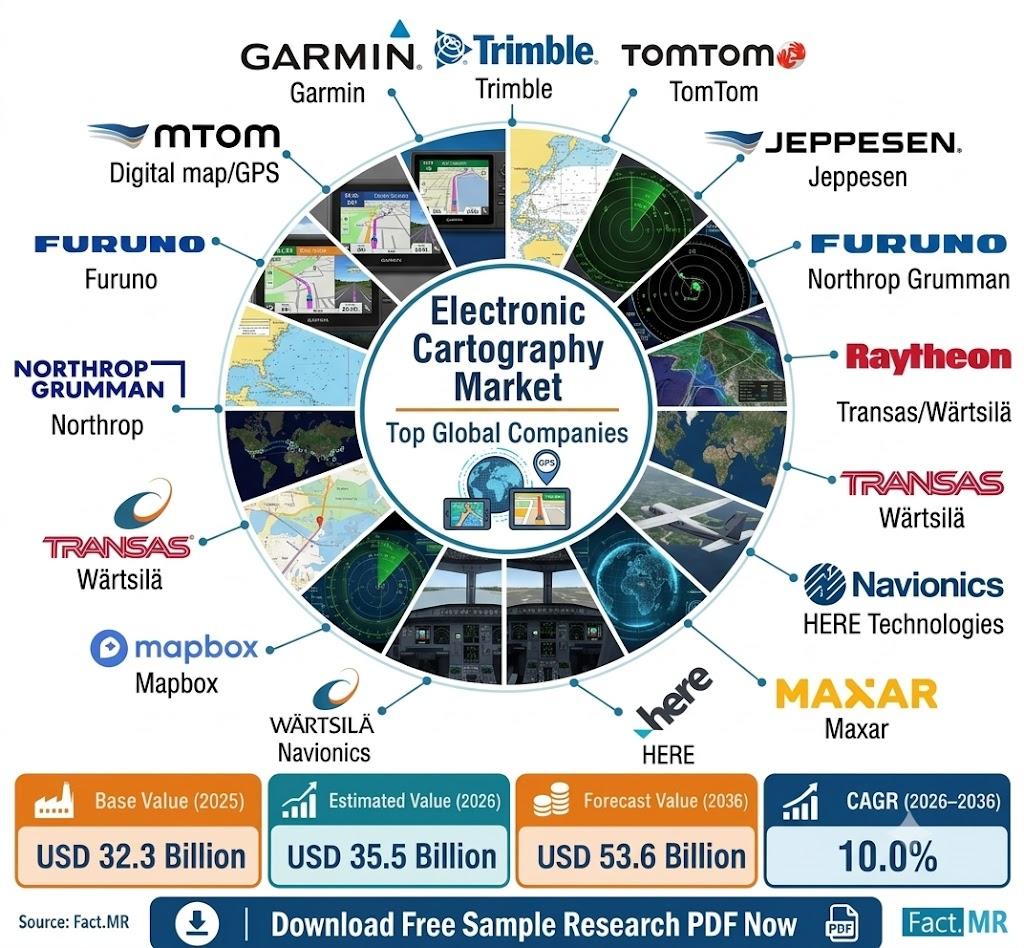
The global electronic cartography market is projected to reach USD 53.6 billion by 2036, up from an estimated USD 35.5 billion in 2026, according to Fact.MR. The report identifies India as the fastest-growing country among the five markets profiled, with a projected compound annual growth rate (CAGR) of 11.4%, followed by China at 10.9%. The market's published forecast figures, however, require clarification because the stated 10.0% CAGR does not reconcile with the reported market values.
Electronic cartography systems convert geographic information into digital maps used for navigation, geographic information systems (GIS), transportation planning, aviation, maritime operations and defense applications. Their commercial relevance is expanding as logistics providers, automotive businesses and infrastructure planners depend on accurate location data, route optimization and regularly updated maps.
Get detailed market forecasts, competitive benchmarking, and pricing trends:https://www.factmr.com/connectus/sample?flag=S&rep_id=14649
The market is also moving from static digital maps toward platforms that integrate satellite imagery, sensor information and other dynamic data sources. These capabilities can support more frequent map updates and predictive routing, although the associated data acquisition, processing and maintenance costs remain important considerations for buyers.
Where growth is fastest
Fact.MR's country forecasts indicate that India and China are expected to outpace the other profiled markets through 2036.
- India — 11.4% CAGR: The report links growth to increasing adoption of digital mapping in transportation, logistics and urban planning. The National Geospatial Policy, issued by the Government of India in February 2022, is identified as a framework supporting private-sector participation.
- China — 10.9% CAGR: Large-scale navigation systems and location-based services support demand. The report also identifies the National Geospatial Information policy, updated in 2021, as part of the country's mapping infrastructure context.
- United States — 10.2% CAGR: Automotive navigation, defense and enterprise mapping applications support demand. The report highlights the ongoing National Spatial Data Infrastructure initiative.
- Japan — 10.1% CAGR: Transportation and infrastructure applications underpin adoption. The Society 5.0 initiative is identified as a framework promoting geospatial integration.
- Australia — 9.9% CAGR: Demand reflects continued geospatial data integration and mapping adoption, although the report describes the market as relatively mature.
The source does not provide country-level CAGR figures for European markets in the supplied summary. European growth rates therefore cannot be ranked or added to the headline without further source verification.
What leads the market
Commercial users account for approximately 65% of the electronic cartography market in 2026, according to Fact.MR. Transportation, logistics, aviation, maritime and tourism businesses use digital mapping for route planning, asset tracking, navigation and operational management. Their requirements include reliable location information and compatibility with existing operational systems.
Navigation systems represent around 60% of the market by component in 2026. These systems combine digital maps, positioning technologies and route-optimization functions to provide navigation support across automotive, aviation, marine and mobile applications.
The report also identifies navigation charts as a component of the market and defense as a separate end-user segment. Transportation, aviation and GIS applications are highlighted as areas of continued adoption, although the supplied summary does not provide individual application shares.
The hurdle: Data costs and restrictions
The cost of maintaining accurate, current mapping data remains a central challenge for electronic cartography providers. Satellite imagery, data acquisition, continuous processing and platform maintenance can increase operating expenses, particularly for services that require frequent updates.
Regulatory restrictions governing geospatial information can also affect how mapping data is collected, managed and used across markets. For buyers, these factors make data quality, interoperability, update frequency and long-term supplier reliability important considerations alongside initial purchase costs.
The report identifies ISO 19115 geographic information metadata standards and Open Geospatial Consortium specifications as relevant to interoperability and mapping accuracy. It does not identify a specific newly enacted regulation or compliance deadline that would independently establish an immediate market-wide purchasing trigger.
Industry investment and competitive positioning
Competition includes geospatial software companies, navigation providers, satellite-data businesses and defense-focused technology suppliers. The report identifies Esri, Inc., Hexagon AB, TomTom N.V., Garmin Ltd. and Maxar Technologies Inc. among established participants, alongside BAE Systems plc, RTX Corporation, Thales Group, Honeywell International Inc. and Fugro N.V.
The supplied report summary also describes several dated company and policy developments:
- January 2023: Zenrin Co., Ltd. expanded its digital mapping databases, according to the report.
- March 2023: Esri expanded its GIS and mapping platforms. The report references its March 2023 ArcGIS Solutions release.
- April 2023: Alibaba Group Holding Limited expanded mapping and location-based services, according to the report.
- May 2023: MapmyIndia expanded digital mapping and navigation platforms, according to the report's India analysis. The source bibliography separately references an April 2023 MapmyIndia press release, so the date and description should be checked before publication.
These developments provide context for mapping-platform and database activity; they should not be interpreted as evidence of market share gains unless independently supported by the underlying research.
The report profiles BAE Systems plc, RTX Corporation, Esri, Inc., Fugro N.V., Hexagon AB, Garmin Ltd., Maxar Technologies Inc., TomTom N.V., Honeywell International Inc. and Thales Group. It also lists Garmin's Navionics brand. Competition is described as depending on data accuracy, update frequency, analytics capabilities and integration with navigation and mission-critical systems.
Analyst perspective
Shambhu Nath Jha, Principal Consultant at Fact.MR, said: “In this updated edition of the Electronic Cartography Market report, industry participants will observe that demand is driven by steady expansion of digital mapping applications across navigation, logistics, and geospatial analytics. Electronic cartography systems are evolving toward real time, data integrated platforms that support continuous updates and advanced spatial analysis. Providers that enhance data accuracy, system integration, and real time processing capabilities will maintain competitive positioning as geospatial applications expand through 2036.”
What this means for technology buyers
- Evaluate lifecycle costs, not just licensing costs. Procurement teams should assess the cost and frequency of data updates, satellite imagery, processing and ongoing platform maintenance before selecting a mapping provider.
- Prioritize interoperability and data accuracy. Transportation operators, logistics businesses and enterprise GIS teams should examine how well mapping systems integrate with their existing positioning technologies, fleet systems and operational databases.
- Match investments to regional demand. Suppliers evaluating geographic expansion can use the report's country forecasts to compare projected growth in India, China, the United States, Japan and Australia, while separately verifying local data-use requirements and customer needs.
The findings are based on Fact.MR's electronic cartography market assessment, which combines primary interviews with geospatial software providers, mapping specialists and navigation-system developers with desk research and a hybrid market-sizing approach.
Top Trending Reports:
Osmometers Market https://www.openpr.com/news/4539428/osmometers-market-to-reach-usd-166-million-by-2036-as-clinical
Immunofluorescence Assays Market https://www.openpr.com/news/4539441/immunofluorescence-assays-market-to-reach-usd-6-3-billion
Fetal and Neonatal Heart Monitor Market https://www.openpr.com/news/4539476/fetal-and-neonatal-heart-monitor-market-to-reach-usd-2-8-billion
Age-Related Macular Degeneration Market https://www.openpr.com/news/4539462/age-related-macular-degeneration-market-to-reach-usd-26-9
About Fact.MR
Fact.MR provides market research and analysis covering industry demand, market sizing, forecasts and competitive positioning. Its electronic cartography market assessment examines navigation charts and navigation systems, commercial and defense end users, regional demand and market developments through 2036.

 English
 Arabic
 French
 Spanish
 Portuguese
 Deutsch
 Dutch
Dutch
 Italiano
 Russian
 Romaian
 Portuguese (Brazil)
 Greek
Greek
