
Lysosomal Acid Lipase Deficiency Treatment Market Projected to Reach USD 1.9 Billion by 2036
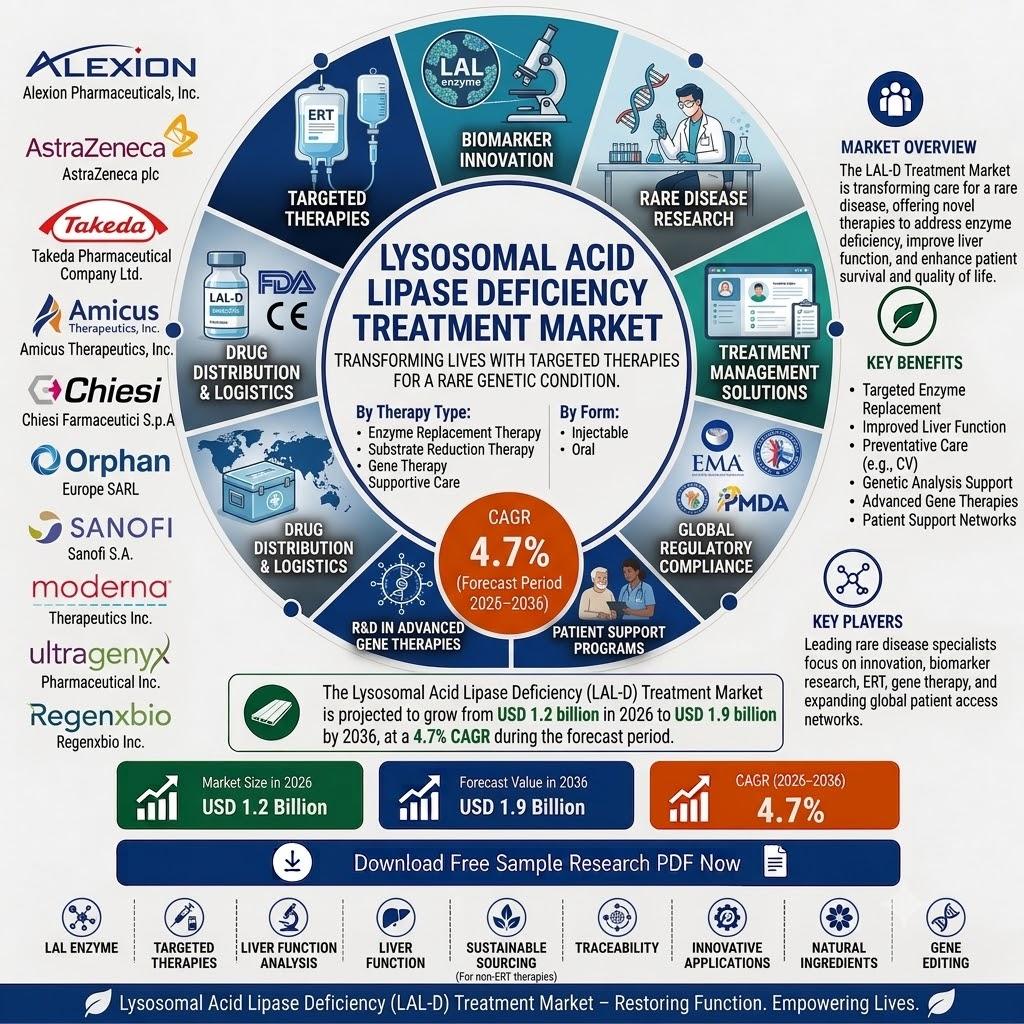
A market research and competitive intelligence provider, has estimated that the global lysosomal acid lipase deficiency treatment market will reach approximately USD 1.9 billion by 2036, rising from USD 1.2 billion in 2026 at a CAGR of 4.7%. The market was valued at approximately USD 1.1 billion in 2025.
The market is being shaped by broader newborn screening, expanding rare disease diagnostic infrastructure, and continued demand for enzyme replacement therapy. The market is expected to create an absolute dollar opportunity of USD 0.7 billion between 2026 and 2036.
Get detailed market forecasts, competitive benchmarking, and pricing trends: https://www.factmr.com/connectus/sample?flag=S&rep_id=11639
Enzyme Replacement Therapy Holds 55% of Product Segment
Enzyme replacement therapy accounts for 55% of the product segment in 2026. Sebelipase alfa remains the only approved disease-specific enzyme replacement therapy for LAL deficiency and is administered through intravenous infusion in hospitals or specialty clinics.
Hospitals represent 58% of end-use share in 2026. The figure reflects the need for monitored intravenous administration in controlled clinical environments.
Fact.MR is a market research and competitive intelligence company that provides market sizing, forecasting, and industry analysis across global markets.
The covers enzyme replacement therapy, supportive pharmacotherapy, gene therapy approaches, and small molecule therapies used to manage LAL deficiency.
The market addresses a rare inherited disorder involving deficient lysosomal acid lipase activity and resulting lipid accumulation. Greater recognition of both infantile-onset Wolman disease and late-onset cholesteryl ester storage disease is widening the population considered for treatment.
Diagnostic Expansion Broadens the Identified Patient Base
Newborn screening programs are becoming a key factor in identifying LAL deficiency earlier. Screening expansion is particularly relevant across North America and parts of Europe, where rare disease diagnostic infrastructure is more established.
The treatment landscape is also changing beyond established enzyme replacement. Clinical pipelines include AAV-based gene delivery targeting hepatic cells, substrate reduction therapy, and lipid-lowering pharmacological support.
Gene therapy approaches are the fastest-growing product sub-segment described in the Fact.MR analysis. Clinical programs are evaluating AAV-based hepatic gene delivery as a potential one-time treatment alternative.
This creates a different development pathway for the market. Instead of repeated intravenous treatment, successful gene therapy could potentially restore enzyme production through a single administration.
Shambhu Nath Jha, Principal Consultant at Fact.MR, said, “The lysosomal acid lipase deficiency treatment market is transitioning from a single-product category into a multi-modal therapeutic landscape. While sebelipase alfa remains the standard of care, gene therapy candidates in clinical development could shift the treatment model from chronic infusion to durable correction.”
Wolman Disease Treatment Accounts for 50%
Wolman disease treatment is expected to represent 50% of the application segment in 2026. The severe infantile-onset form requires rapid intervention after diagnosis, creating an important treatment demand base for enzyme replacement therapy.
Cholesteryl ester storage disease represents another major application area. Greater recognition among hepatologists and cardiologists is supporting diagnosis of late-onset LAL deficiency in adult patients with progressive liver disease and cardiovascular risk.
The market's commercial structure is closely tied to the economics of rare disease treatment. The extremely small patient population limits overall volume, while high treatment costs and reimbursement conditions influence market development across countries.
Shambhu Nath Jha added, “The commercial opportunity is shaped less by patient volume and more by per-patient treatment cost, orphan drug pricing protection, and the pace at which screening programs expand the diagnosed population in both developed and emerging markets.”
USA and Germany Lead Country Growth
The USA is projected to expand at a 4.9% CAGR through 2036, while Germany is forecast to grow at 4.8%. Japan follows at 4.6%, with the UK at 4.5%, China at 4.4%, India at 4.3%, and Brazil at 4.2%.
In the United States, demand is supported by orphan drug reimbursement, specialty infusion centers, and rare disease treatment infrastructure. The country also has clinical trial activity focused on gene therapy approaches for LAL deficiency.
Germany's market is supported by rare disease registries, structured treatment pathways, and reimbursement mechanisms for enzyme replacement therapy.
Japan's 4.6% CAGR reflects advanced genetic testing capabilities and national rare disease treatment policies. China and India are expanding their diagnostic and screening programs, creating additional opportunities for patient identification.
North America currently leads global demand. Europe follows with established rare disease treatment networks, while Asia Pacific represents an emerging opportunity as diagnostic capabilities and screening programs expand.
Competitive Landscape Centers on Established and Pipeline Therapies
The competitive landscape remains concentrated around sebelipase alfa and companies involved in rare disease treatment development.
Alexion Pharmaceuticals, Inc., AstraZeneca plc, Takeda Pharmaceutical Company Ltd., Amicus Therapeutics, Inc., Chiesi Farmaceutici S.p.A, Orphan Europe SARL, Sanofi S.A., Moderna Therapeutics Inc., Ultragenyx Pharmaceutical Inc., and Regenxbio Inc. are among the companies covered in the Fact.MR analysis.
Alexion Pharmaceuticals holds an established position through sebelipase alfa. Other pharmaceutical companies participate through broader rare disease portfolios, supportive therapies, clinical infrastructure, or pipeline programs.
Ultragenyx Pharmaceutical Inc. is advancing rare disease gene therapy programs involving AAV-based delivery systems. Regenxbio Inc. is also developing AAV gene therapy technologies relevant to rare disease applications.
The market is therefore being influenced by both current treatment utilization and future pipeline development.
About the Lysosomal Acid Lipase Deficiency Treatment Market Report
The Fact.MR study covers the global lysosomal acid lipase deficiency treatment market across product type, application, end use, formulation, and region. The forecast period extends from 2026 to 2036.
The research covers more than 30 countries and combines secondary research, primary interviews, and forecast modelling. The methodology uses more than 80 secondary sources and benchmarks more than 30 company product portfolios.
The analysis also evaluates disease prevalence, diagnostic rates, treatment utilization, orphan drug reimbursement policies, infusion center density, clinical trial enrollment, pricing trends, and regulatory milestones.
To View Top Reports
https://www.pikumil.com/blogs/188123/Industrial-Air-Table-Market-Poised-to-Reach-USD-328-5
https://sierra-le.com/blogs/20431/Global-Industrial-Air-Table-Market-Expected-to-Hit-USD-328
https://ikofficial.com/blogs/46602/Industrial-Air-Table-Industry-Set-to-Reach-USD-328-5
About Fact.MR
Fact.MR is a market research and competitive intelligence firm providing syndicated and customized research reports across technology, healthcare, chemicals, food and beverage, automotive, and other industries. The company combines primary research, secondary research, and market modelling to provide forecasts and strategic market intelligence for businesses worldwide.

 English
 Arabic
 French
 Spanish
 Portuguese
 Deutsch
 Turkish
 Italiano
 Russian
 Romaian
 Portuguese (Brazil)
 Greek
Greek
