
Aerogel Market Growth Through Material Innovation
Some industrial problems are not caused by a lack of materials but by having too much of them. Thick insulation consumes valuable space. Heavy protective materials increase system weight. Conventional thermal barriers can become difficult to integrate when equipment is compact, mobile, or exposed to extreme operating conditions. Aerogels are gaining attention because they approach these problems from a different direction, combining extremely low density with strong thermal insulation and a highly porous structure.
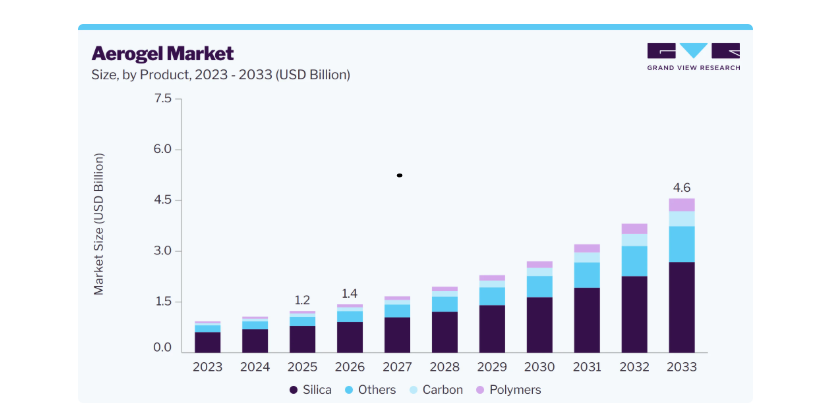
The global Aerogel Market was valued at USD 1.2 billion in 2025 and is projected to increase from USD 1.4 billion in 2026 to USD 4.6 billion by 2033, representing an 18.0% CAGR from 2026 to 2033. North America accounted for 44.1% of global revenue in 2025.
Key Highlights
The market's current structure is centered on silica aerogels, which accounted for 64.1% of revenue in 2025, while supercritical drying represented 70.6% of the technology landscape. In terms of physical format, aerogel blankets held 64.9% of revenue, and oil & gas accounted for 60.3% of end-use demand. At the same time, polymer aerogels are emerging as a faster-growing material category, showing that the market is gradually expanding beyond its traditional insulation base.
From Material Science to Industrial Demand
The commercial story of aerogels begins with their unusual structure. A conventional solid material is mostly occupied by the material itself, whereas an aerogel contains an interconnected nanoporous structure with a very high proportion of air. That structure contributes to its low density and thermal-insulation capability.
Download a free sample report or claim your copy of this full market intelligence report
The reason this matters commercially is simple: when industries need thermal protection, they increasingly want to achieve it without adding unnecessary thickness or weight.
Rising energy-efficiency requirements
↓
Demand for thinner and lighter insulation
↓
Interest in high-performance thermal materials
↓
Aerogel adoption in demanding industrial applications
↓
Expansion into new formats and material types
↓
Broader use across energy, transportation and construction
That progression is helping aerogels move from highly specialized applications toward a broader advanced-materials market.
Oil & Gas Created the First Large Commercial Base
Oil & gas remains the strongest end-use foundation for the market. Aerogels can be incorporated into insulation systems for pipelines, processing facilities, offshore platforms, and other equipment where controlling heat transfer is important. The attraction is not simply insulation performance. Industrial operators often have to work within tight spatial constraints, and insulation thickness can directly affect installation requirements. Aerogel-based systems can offer high thermal resistance within relatively compact assemblies, creating value where space itself becomes an engineering constraint.
The dominance of this sector has also helped drive the development of flexible aerogel blankets, which can be wrapped around equipment and integrated into industrial insulation systems.
Why Blankets Have Become So Important
Blankets accounted for the largest form share in 2025. Their success is closely tied to practicality. A highly efficient material would have limited commercial impact if it were difficult to install. Blanket formats make aerogel easier to incorporate into pipes, equipment, walls, and other structures where flexibility is useful. This is particularly important for industrial retrofits. Existing infrastructure often has limited room for additional insulation, so a thinner material with high thermal performance can be easier to integrate than traditional bulky alternatives.
Panel-based aerogels are also gaining momentum and are projected to grow at a 21.5% CAGR from 2026 to 2033. Their increasing application in buildings, vehicles, and aerospace reflects the same underlying demand for high insulation performance with reduced thickness and weight.
Silica Still Defines the Market, but It Is Not the Whole Story
Silica aerogels accounted for 64.1% of market revenue in 2025, supported by their established use in thermal insulation and related applications. However, material innovation is widening the market. Polymer aerogels are projected to grow at 22.0% over the forecast period, supported by demand in defense, construction, electronics, transportation, and other applications where mechanical properties can be important. Carbon aerogels add yet another dimension. Their electrical conductivity and high surface area create opportunities in energy storage, catalysis, adsorption, and other advanced applications. Grand View Research currently estimates the carbon aerogel market separately at USD 124.6 million in 2025, with an 18.1% CAGR through 2033.
This means the market is gradually becoming less dependent on one material composition and more connected to application-specific performance.
Manufacturing Is the Hidden Competitive Factor
Aerogel performance attracts attention, but manufacturing determines commercial scalability. Supercritical drying accounted for 70.6% of the market in 2025 and remains a widely used method because it can preserve the material's porous architecture while minimizing structural collapse.
Yet the same production complexity contributes to high manufacturing costs. This remains one of the important restraints on widespread adoption. The long-term competitive question is therefore not simply who can produce an aerogel with excellent insulation. It is who can produce it consistently, at larger volumes, at lower cost, and in a form that matches the customer's application.
Electric Vehicles Are Creating a Different Use Case
The emergence of electric vehicles is giving aerogels another commercial pathway. EV batteries require thermal management, and manufacturers are increasingly concerned with balancing performance, safety, package size, and vehicle weight. Aerogel-based materials can be considered for thermal barriers, battery protection, and related applications because of their insulating characteristics and low density.
This is an important shift for the market because it connects aerogels with a rapidly developing technology ecosystem rather than only with established heavy industries.
Construction Adds the Space-Efficiency Argument
Buildings offer another long-term opportunity. As energy-performance requirements become more demanding, insulation systems need to reduce heat transfer while fitting within increasingly constrained construction assemblies. Aerogels can provide high thermal performance with comparatively low thickness, which can be valuable in renovation projects, high-performance buildings, and locations where preserving floor area or architectural features matters.
The European market is particularly influenced by energy-efficiency goals, while construction activity in the Middle East is generating demand for advanced materials in large infrastructure and sustainable-building projects.
North America Leads, but Regional Growth Is Becoming More Distributed
North America held the largest global share at 44.1% in 2025, supported by demand from oil & gas, aerospace, automotive, construction, and other industries. The U.S. market alone generated USD 558.3 million in 2025 and is forecast to reach USD 1.78 billion by 2033, growing at 15.9% CAGR.
Europe is developing around energy-efficiency requirements and advanced building applications, while Asia Pacific is benefiting from industrialization, automotive production, and materials innovation. The Middle East & Africa region is expected to record the fastest growth rate at 20.1%, according to Grand View Research.
Key Companies
The competitive landscape includes Aspen Aerogels, Inc., Cabot Corporation, Aerogel Technologies, LLC, Active Aerogels, LDA, BASF SE, JIOS Aerogel Corporation, Nano Technology Co., Ltd., Dow Inc., and Enersens. Companies are increasingly focusing on production scale, application-specific products, cost reduction, and expansion into energy, transportation, construction, and advanced industrial systems.
The Real Opportunity Behind Aerogels
The market is growing because aerogels can address a combination of problems at once. They can reduce heat transfer, limit material thickness, contribute to weight reduction, and support thermal protection in demanding environments. That combination gives aerogels a role in areas where conventional insulation may not be sufficient from a space, weight, or performance perspective. With the market projected to reach USD 4.6 billion by 2033, the next phase will depend on making this exceptional material easier and more economical to manufacture and integrate at industrial scale.
About us:
Grand View Research, a market research and consulting company, provides syndicated research reports, customized research reports, and consulting services. Grand View Research database is used by the world's renowned academic institutions and Fortune 500 companies to understand the global and regional business environment. Our database features thousands of statistics and in-depth analysis on 46 industries in 25 major countries worldwide.

 English
 Arabic
 French
 Spanish
 Portuguese
 Deutsch
 Turkish
 Dutch
Dutch
 Italiano
 Russian
 Portuguese (Brazil)
 Greek
Greek
