
Acrylic Resins Market Growth Across Industrial Applications
The acrylic resins market is being shaped by a change that is happening quietly across paints, coatings, adhesives, packaging, construction, and automotive manufacturing. Formulators are no longer evaluating resins only on performance. Environmental regulations, VOC reduction, durability, weather resistance, application requirements, and lifecycle expectations are increasingly influencing material selection at the same time.
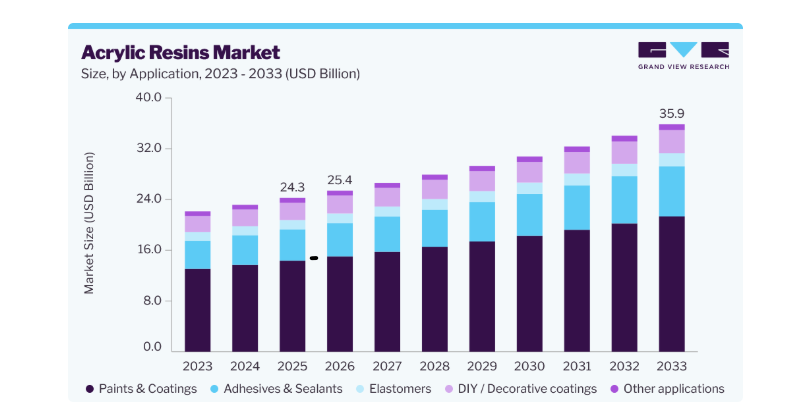
The global Acrylic Resins Market was valued at USD 24.3 billion in 2025 and is projected to grow from USD 25.4 billion in 2026 to USD 35.9 billion by 2033, representing a 5.0% CAGR from 2026 to 2033. Asia Pacific accounted for 47.2% of global revenue in 2025, according to Grand View Research.
Key Highlights
The current market is led by acrylates, thermoplastic acrylic resins, water-based formulations, paints and coatings, and building and construction applications. Acrylates accounted for 59.6% of chemistry revenue in 2025, thermoplastic acrylic resins represented 63.8%, water-based acrylic resins generated 59.1%, paints and coatings captured 59.2%, and building and construction contributed 33.7%. At the faster-growth end of the market, hybrid acrylics are projected to expand at 8.0%, adhesives and sealants at 7.7%, and packaging at 7.6% through 2033.
Why Are Acrylic Resins Still So Widely Used?
The answer starts with versatility. Acrylic resins can provide combinations of adhesion, flexibility, clarity, weather resistance, UV stability, and durability that make them useful across a large range of formulations. This allows the same broad resin family to participate in architectural coatings, industrial finishes, adhesives, sealants, automotive products, packaging materials, and consumer applications.
Acrylates have maintained the largest chemistry position because they offer a practical balance of performance and formulation flexibility. Methacrylates become valuable when stronger durability and clarity are needed, while hybrid acrylics are increasingly being developed for applications where conventional resin characteristics alone are not sufficient.
The market is therefore not simply expanding because manufacturers need more resin. It is expanding because formulators are asking for more specific combinations of properties.
Download a free sample report or claim your copy of this full market intelligence report
Is Sustainability Changing the Resin Business?
Yes, and it is changing the formulation process itself. The transition from solvent-heavy systems toward water-based and low-VOC technologies is becoming increasingly important as environmental regulations tighten. Water-based acrylic resins already account for more than half of market revenue, and their relevance is closely connected with applications in architectural coatings, packaging, and adhesives. This does not mean performance is being sacrificed for sustainability. Instead, the industry is attempting to achieve both.
The development challenge is becoming:
Lower VOCs + strong adhesion + durability + weather resistance + regulatory compatibility
That combination is pushing manufacturers toward formulation innovation rather than simply replacing one solvent with another.
What Makes Hybrid Acrylics Interesting?
Hybrid acrylics represent one of the clearest examples of where the market is heading. By combining acrylic chemistry with polyurethane, epoxy, silicone, or other compatible systems, formulators can create materials with improved mechanical strength, chemical resistance, durability, or application-specific performance. Grand View Research projects hybrid acrylics to be the fastest-growing chemistry segment, with an 8.0% CAGR through 2033. The significance goes beyond one segment. Hybridization allows acrylic technology to enter demanding applications where a conventional acrylic formulation may face limitations.
That makes hybrid systems particularly relevant to industrial coatings, protective finishes, automotive applications, and other environments where longer service life matters.
Can One Resin Serve Every Application?
Not really, and that is precisely why segmentation is becoming more important. The market contains thermoplastic and thermosetting acrylic resins, as well as water-based and solvent-based formulations. Each has a different performance profile.
Thermoplastic acrylic resins held 63.8% of the market in 2025, supported by their processing characteristics, flexibility, clarity, UV resistance, and broad use in coatings and adhesives. Thermosetting systems, meanwhile, are gaining attention where crosslinking can provide stronger chemical resistance, heat stability, and mechanical performance.
Instead of one standard resin dominating every application, the industry is moving toward material selection based on what the finished product actually needs to do.
Where Is the Next Demand Coming From?
Paints and coatings remain the largest application at 59.2% of revenue in 2025, but the next growth story is developing across adhesives, sealants, packaging, electronics, and other specialized applications. Adhesives and sealants are projected to grow at 7.7%, supported by demand for strong bonding, flexibility, resistance to moisture, and performance across changing temperatures. Packaging is forecast to grow at 7.6%, with water-based and low-VOC formulations becoming increasingly relevant to food-contact and primary-packaging applications.
These segments matter because they reduce the market's dependence on construction and decorative coatings alone.
Why Does Asia Pacific Matter So Much?
Asia Pacific accounted for 47.2% of the global market in 2025, supported by urbanization, manufacturing capacity, infrastructure development, raw-material availability, and expanding industrial activity. China is a major contributor because of its extensive manufacturing base and domestic consumption. India is also becoming increasingly important. Grand View Research estimates the Indian acrylic resins market could reach USD 7.79 billion by 2033, expanding at a 7.6% CAGR from 2026 to 2033.
This regional growth reflects not only higher resin consumption but also the expansion of industries that depend on coatings, adhesives, packaging, and industrial materials.
What Could Hold the Market Back?
Raw-material volatility remains an important concern because acrylic acid and related petrochemical feedstocks can influence manufacturing economics. At the same time, the transition away from solvent-based systems can require reformulation, equipment adjustments, and additional development work. Acrylic resins also face competition from polyurethane, epoxy, polyester, and other resin systems in demanding applications. That means suppliers need to demonstrate not only sustainability but also clear technical value.
Key Companies
Companies profiled in the market include Guangdong Yinyang Environment-Friendly New Materials Co., Ltd., Sichuan Decision New Material Technology Co., Ltd., Anhui Elite Industrial Co., Ltd., Xiamen WangQin Chemical Technology Co., Ltd., BASF SE, Arkema, Evonik Industries AG, Mitsubishi Chemical Group, Kamsons, and Orson Chemicals.
Competition is increasingly centered on formulation quality, sustainability, regional reach, specialty products, and the ability to develop resins for increasingly specific end-use requirements.
The Bigger Question for the Industry
The future of the acrylic resins market will depend on whether manufacturers can keep improving performance while reducing environmental impact. The market is already moving in that direction. Water-based systems are expanding, hybrid acrylics are growing faster, and applications such as packaging and adhesives are opening additional demand channels.
The next phase is therefore less about producing more of the same resin and more about producing smarter formulations for a changing industrial environment.
About us:
Grand View Research, a market research and consulting company, provides syndicated research reports, customized research reports, and consulting services. Grand View Research database is used by the world's renowned academic institutions and Fortune 500 companies to understand the global and regional business environment. Our database features thousands of statistics and in-depth analysis on 46 industries in 25 major countries worldwide.

 English
 Arabic
 French
 Portuguese
 Deutsch
 Turkish
 Dutch
Dutch
 Italiano
 Russian
 Romaian
 Portuguese (Brazil)
 Greek
Greek
