
Digital Circular Economy Market Size, Growth, Trends Forecast to 2034
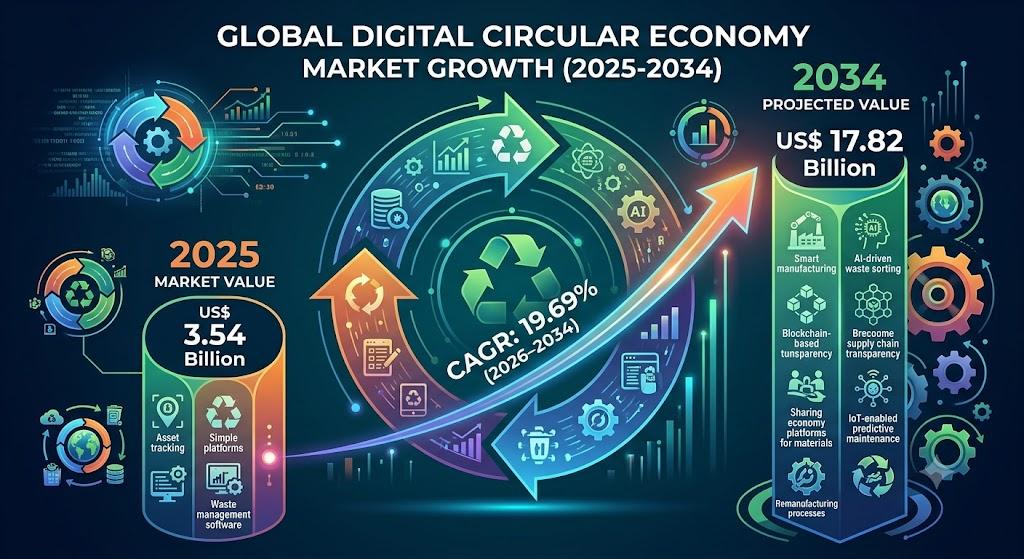
The Digital Circular Economy Market is advancing through technologies such as artificial intelligence, Internet of Things, blockchain, cloud computing, and big data analytics. Their integration enables organizations to monitor resources and optimize circular processes.
According to The Insight Partners, The digital circular economy market was valued at US$ 3.54 Billion in 2025 and is projected to reach US$ 17.82 Billion by 2034, registering a CAGR of 19.69% during 2026–2034.
Get Sample PDF@ https://www.theinsightpartners.com/sample/TIPRE00039813
Digital Circular Economy Market Growth Drivers
- Expansion of Digital Traceability Across Supply Chains:-The growing need for supply chain transparency is a major driver of the digital circular economy market. Companies need greater visibility into where materials originate, how products are manufactured, how assets are used, and what happens to products at the end of their useful lives.
- Increasing Integration of AI and Machine Learning:-AI and ML are becoming important technologies for optimizing circular economy operations. AI-enabled systems can analyze large datasets to identify waste-reduction opportunities, forecast equipment maintenance requirements, optimize inventory, and improve resource allocation.
- Digital Circular Economy Market Trends:- One of the key trends shaping the market is the transition from standalone sustainability tools toward integrated digital circular economy platforms. Enterprises increasingly want solutions that connect sustainability data with existing enterprise resource planning, supply chain management, manufacturing, and asset management systems.
Digital Circular Economy Market Segmentation Analysis
By Offering
The Digital Circular Economy Market is segmented into software and services. Software represents the largest offering segment, accounting for approximately 45–50% of the market in 2025. Digital platforms provide lifecycle tracking, resource monitoring, analytics, sustainability reporting, and material intelligence capabilities.
Services include consulting, implementation, customization, integration, maintenance, and operational support. As businesses seek to integrate circular solutions with existing systems, demand for specialized implementation and consulting services is expected to increase.
By Technology
Based on technology, the Digital Circular Economy Market includes blockchain and distributed ledger technology, IoT, AI and ML, AR and VR, VR-based training, cloud computing, big data analytics, and other technologies.
IoT enables real-time monitoring of assets and resources, while AI and ML support predictive analysis and optimization. Blockchain improves traceability, cloud computing enables scalable digital infrastructure, and big data analytics helps businesses interpret complex information related to materials, products, and supply chains.
By Vertical
The major verticals include consumer electronics, IT and telecom, automotive, manufacturing, construction and building, healthcare and medical devices, and others.
Consumer electronics companies are using circular economy technologies to improve device recovery, component reuse, and material tracking. IT and telecom companies are focusing on asset lifecycle management and responsible equipment disposal.
Automotive companies are implementing digital platforms for vehicle lifecycle tracking, component reuse, and manufacturing optimization. Manufacturing organizations are applying connected technologies to minimize waste and improve resource efficiency.
Regional Outlook
North America held approximately 32–36% of the market in 2025 and is expected to remain an important regional market. Strong enterprise digitization, advanced digital infrastructure, sustainability initiatives, and widespread adoption of cloud-based technologies support market development.
The United States represents the leading contributor within North America, supported by industrial technology investments, enterprise software adoption, and growing corporate sustainability initiatives.
Europe accounted for approximately 28–32% of the market in 2025. Regulatory emphasis on sustainable production, resource efficiency, product lifecycle management, and circular business models supports adoption across Germany, the UK, France, Italy, and other European markets.
Asia Pacific is expected to demonstrate particularly strong growth. China, Japan, India, and South Korea are investing in smart manufacturing, digital infrastructure, IoT platforms, analytics, and sustainability initiatives. The region is projected to register a CAGR of approximately 21–24% during 2026–2034.
Key Companies in the Digital Circular Economy Market
Major companies analyzed in the market include:
- SAP
- Capgemini
- Dassault Systèmes
- Cisco
- IBM
- Oracle
- Ingram Micro
- Honeywell
- Accenture
- Hitachi
These companies are strengthening their market positions through enterprise software, lifecycle management platforms, consulting services, industrial connectivity, cloud technologies, AI, digital twins, and sustainability-focused solutions.
Opportunities in the Digital Circular Economy Market
The expansion of digital infrastructure in emerging economies presents substantial opportunities for market participants. Manufacturers in developing markets are increasingly adopting smart production technologies, cloud platforms, connected assets, and analytics to improve resource efficiency.
Another opportunity lies in the development of interoperable circular economy platforms. Solutions that connect manufacturers, suppliers, recyclers, logistics providers, and consumers can create more efficient circular ecosystems.
The growing adoption of AI-powered decision-making also creates opportunities for technology providers. AI can help organizations forecast demand, optimize material usage, identify maintenance requirements, and determine the most efficient strategies for reuse or recovery.
Future Outlook
The Digital Circular Economy Market is expected to maintain strong growth as sustainability objectives become increasingly integrated with digital transformation strategies. Companies are moving from traditional waste reduction approaches toward data-driven lifecycle management in which products, materials, equipment, and supply chains can be continuously monitored and optimized.
About The Insight Partners
The Insight Partners delivers market intelligence and consulting services to help clients make informed decisions. The firm covers industries such as Aerospace and Defense, Automotive and Transportation, Semiconductor and Electronics, Biotechnology, Healthcare IT, Manufacturing, Medical Devices, Technology, Media, and Chemicals and Materials.
Contact Us
Email: sales@theinsightpartners.com
Website: www.theinsightpartners.com
Phone: +1-646-491-9876

 English
 Arabic
 French
 Spanish
 Portuguese
 Deutsch
 Turkish
 Dutch
Dutch
 Italiano
 Romaian
 Portuguese (Brazil)
 Greek
Greek
