
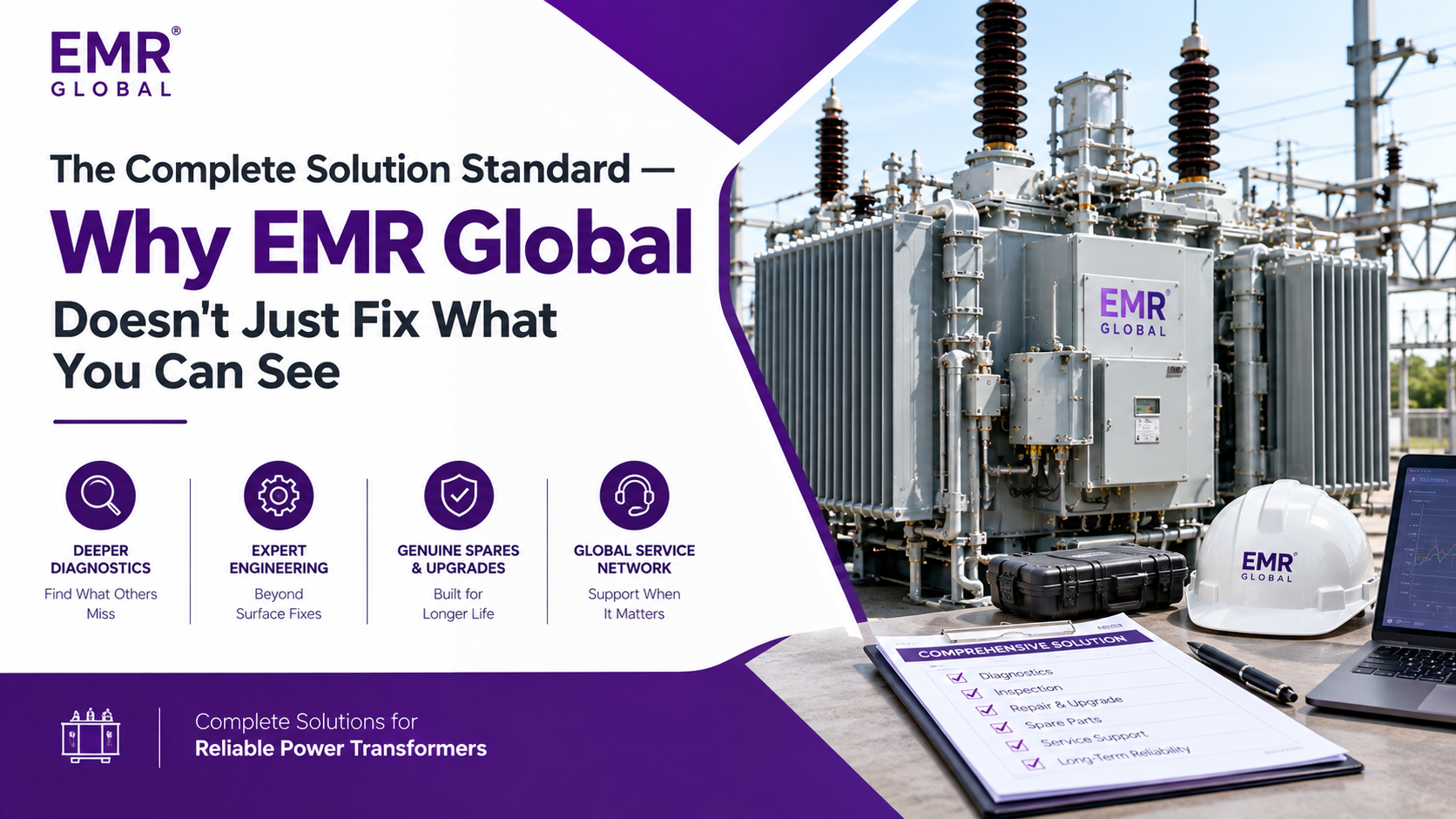
The Complete Solution Standard, Why EMR Global Doesn't Just Fix What You Can See
The Distinction That Defines a Service Brand
There is a fundamental difference in approach between a service provider who addresses the reported symptom and one who diagnoses the system that produced it. The first is faster at the initial intervention and more likely to see the same client again for the same problem. The second takes more time at the first visit and is less likely to see the same problem return.
EMR Global's service philosophy is unambiguously the second type — and the reason is not altruistic. It is operational: a service that resolves the symptom without identifying the cause does not build the client relationship that sustains a long-term B2B partnership. It builds a transactional relationship that ends the moment a competitor offers a lower first-visit price.
The office hub case described in this series illustrates this philosophy in practice. The client's reported symptom was power consumption increase and voltage irregularity. The rapid-response approach would have been to check the tap position, make an adjustment, and leave. The complete solution approach was to ask why the tap position was producing the wrong voltage, what had happened to the OLTC since the previous service, and what the system-level consequences of the previous specification failures had been.
That distinction — between addressing the symptom and diagnosing the system — is what the complete solution standard means.
What the Complete Solution Covered
The complete solution that EMR Global's team delivered to the office hub client addressed five system elements simultaneously:
Element 1: Voltage regulation accuracy restoration
The OLTC mechanism was restored to specification through genuine spare parts replacement — contact sets verified for material compliance, motor drive recalibrated to timing specification, tap position accuracy verified against the transformer's nameplate turns ratio at every position. The secondary voltage at each tap was confirmed within the acceptable tolerance before the service was considered complete.
Element 2: OLTC oil system restoration
Contaminated oil was replaced with specification-grade degassed oil, tested for dielectric strength, moisture content, and acidity before use. The oil fill was documented with the test results attached — creating a baseline from which future oil condition monitoring can trend.
Element 3: Protection system verification and recalibration
The OSR relay was tested, found to be incorrectly set, and recalibrated to the correct threshold for the specific OLTC design. The Buchholz relay was inspected and confirmed operational. The complete protection scheme was verified functional before the transformer was returned to service.
Element 4: Documentation
Every component replaced was documented with its material certification and traceability record. The as-found and as-left condition of every measured parameter was recorded. The service report provided the client with a complete record of what was found, what was done, and the measured evidence that the solution had achieved its intended outcome.
Element 5: Client briefing
The client received a plain-English explanation of what had been found, why it had caused the problems he had reported, what had been done to resolve it, and what monitoring he should maintain to confirm the resolution was sustained. The briefing included specific indicators to watch — oil colour, secondary voltage at the metering point, any recurrence of equipment irregularities — so the client could assess the service outcome himself rather than taking the service provider's word for it.
The Client Satisfaction That Results From This Standard
The client who receives a complete solution — whose problem is fully resolved rather than partially addressed, who receives documentation that holds up to scrutiny, and who is briefed in terms he can understand and verify — does not need to be retained through price competition. He is retained through the experience of having his problem actually solved.
This is not a soft customer service observation. It is a commercial reality in B2B technical services: clients who trust that a service provider will solve the problem rather than manage the symptom give that provider their repeat business without re-tendering, their referrals without being asked, and their advocacy within their own organisation without commercial inducement.
Bharat Heavy Electricals Limited (BHEL) — one of India's most technically demanding engineering organisations — has maintained its relationship with EMR Global through exactly this mechanism. BHEL's procurement and quality functions are not easily satisfied. They apply rigorous supplier qualification criteria and maintain ongoing performance monitoring that would identify any gap between what is promised and what is delivered. The sustained BHEL-EMR Global relationship is the evidence that EMR Global's complete solution standard passes those criteria consistently.
That is what client satisfaction means to a brand that takes it seriously. Not a post-service survey score. A relationship that survives the scrutiny of technically demanding clients across multiple projects and multiple years.

 Arabic
 French
 Spanish
 Portuguese
 Deutsch
 Turkish
 Dutch
Dutch
 Italiano
 Russian
 Romaian
 Portuguese (Brazil)
 Greek
Greek
