
Ethanol Market Outlook: Policy and Energy Security Drive Expansion
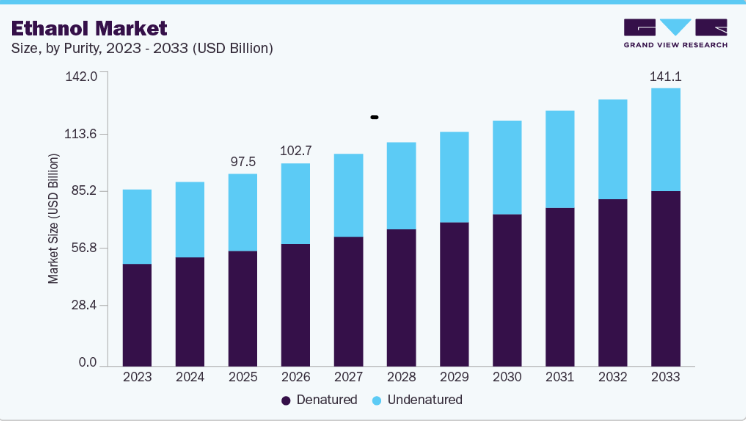
The ethanol market is entering a phase where policy, energy security, transportation demand, and production technology are increasingly shaping its trajectory. Valued at USD 97.5 billion in 2025, the market is expected to grow from USD 102.7 billion in 2026 to USD 141.1 billion by 2033, registering a 4.6% CAGR from 2026 to 2033.
North America represented the largest regional market, accounting for 53.5% of global Ethanol Market revenue in 2025. Meanwhile, the Middle East & Africa is projected to experience the fastest growth through 2033.
A Policy-Led Market With Expanding Demand
Unlike markets driven primarily by consumer preferences, ethanol demand is strongly influenced by government policy. Countries are increasing biofuel blending targets as they seek to reduce fossil fuel consumption and greenhouse gas emissions.
Renewable fuel standards, subsidies, tax incentives, and mandatory blending requirements are creating greater visibility for ethanol producers. These policies are also encouraging capacity expansion and investment in new production projects.
The energy-security aspect adds another layer of demand. Domestic ethanol production from corn, sugarcane, wheat, cassava, and molasses can help reduce dependence on imported petroleum while supporting agricultural economies.
Where Is Ethanol Being Consumed?
The market remains heavily concentrated in transportation.
Fuel & its additives accounted for 66.7% of revenue in 2025, making it the largest application segment. Ethanol supports gasoline blending while improving octane performance and enabling cleaner combustion.
Download a free sample report or claim your copy of this full market intelligence report
But the market is not limited to fuel. Ethanol is also used across:
- Industrial solvents
- Pharmaceuticals
- Personal care products
- Beverages
- Sanitizers and disinfectants
- Chemical manufacturing
This diversified demand base provides additional support beyond transportation fuel consumption.
Feedstock Is Becoming a Strategic Factor
The sugar & molasses-based segment held 58.0% of revenue in 2025. Molasses, as a byproduct of sugar production, provides an accessible feedstock and enables closer integration between sugar and ethanol production.
At the same time, the industry is moving toward non-food sources.
Second-generation ethanol uses agricultural residues, forestry waste, and other non-food biomass. Its development is particularly important because it can reduce dependence on food crops while addressing concerns related to land use and food security.
Improved fermentation processes, enzyme technologies, and production optimization are also helping producers improve yields and reduce production costs.
The Denatured Ethanol Advantage
The purity landscape is led by denatured ethanol, which represented 60.0% of market revenue in 2025.
Its importance comes largely from fuel and industrial applications. Denaturing makes ethanol unsuitable for human consumption, allowing it to be used more broadly in fuel programs without being treated in the same way as beverage alcohol.
Meanwhile, undenatured ethanol continues to serve beverage and food-grade applications where high purity is required.
Regional Markets Tell Different Stories
North America: Policy Creates Stability
North America leads the global market, with the U.S. acting as the region's primary demand center. The Renewable Fuel Standard provides a policy-backed foundation for ethanol consumption.
The widespread use of E10 and growing availability of E15 create opportunities for additional ethanol volumes, while carbon-credit markets can provide further economic value for producers using sustainable production practices.
Asia Pacific: Energy Security Takes Center Stage
Asia Pacific is increasingly important because of ambitious national blending programs. India is promoting ethanol produced from sugarcane and surplus grain to reduce crude oil imports and support agricultural incomes.
Thailand and the Philippines are also supporting domestic ethanol consumption through established biofuel policies.
Europe: Carbon Performance Matters
European demand is closely connected to renewable-energy and climate policies. Sustainability criteria and lifecycle greenhouse gas reductions play an important role in determining which ethanol production pathways are favored.
Latin America: Brazil Leads the Model
Latin America's ethanol industry is strongly associated with Brazil's sugarcane-based production system. Mandatory gasoline blending and extensive flex-fuel vehicle adoption have created an established market for both anhydrous and hydrous ethanol.
Middle East & Africa: An Emerging Demand Base
The Middle East & Africa remains a developing ethanol market, but its growth potential is significant. South Africa and Nigeria are among the countries supporting blending programs, with energy security, fuel imports, agricultural surpluses, and air pollution influencing market development.
The Market's Main Pressure Points
Ethanol's growth does not come without challenges.
Feedstock costs can fluctuate significantly, affecting production economics and margins. Competition between food and fuel uses can also become more prominent when agricultural supplies are constrained.
Infrastructure represents another consideration. Storage, transportation, and compatibility with higher ethanol blends can influence how quickly individual markets adopt larger quantities of ethanol.
These challenges make production efficiency, feedstock flexibility, and technology increasingly important competitive factors.
The Next Opportunity: More Sustainable Ethanol
The industry's future growth is increasingly connected with the ability to produce ethanol more efficiently and sustainably.
Second-generation technologies, non-food biomass, improved enzymes, and more efficient fermentation processes can help producers address environmental and resource-related concerns.
At the same time, industrial solvent demand offers another avenue for market expansion, particularly as manufacturers seek alternatives to petroleum-based solvents.
Companies Shaping the Competitive Environment
The global ethanol market includes major participants such as ADM, POET LLC, Valero Energy Corporation, Green Plains Inc., Koch Industries, Raizen Energia, Cargill Inc., Alto Ingredients Inc., Tereos Participations, and CropEnergies AG.
These companies are pursuing product innovation, strategic acquisitions, collaborations, technology development, and distribution expansion to strengthen their positions.
The Bottom Line
The ethanol market's growth story is no longer limited to gasoline blending. Government mandates create the foundation, transportation fuels generate the largest demand, agricultural feedstocks support production, and advanced technologies are creating the next layer of opportunity.
With the market projected to reach USD 141.1 billion by 2033, regional policies and the transition toward more sustainable production will remain central to how the industry develops.
About us:
Grand View Research, a market research and consulting company, provides syndicated research reports, customized research reports, and consulting services. Grand View Research database is used by the world's renowned academic institutions and Fortune 500 companies to understand the global and regional business environment. Our database features thousands of statistics and in-depth analysis on 46 industries in 25 major countries worldwide.

 English
 Arabic
 French
 Spanish
 Portuguese
 Deutsch
 Turkish
 Dutch
Dutch
 Russian
 Romaian
 Portuguese (Brazil)
 Greek
Greek
