
Petrochemical Growth Supports Gas Separation Membrane Adoption
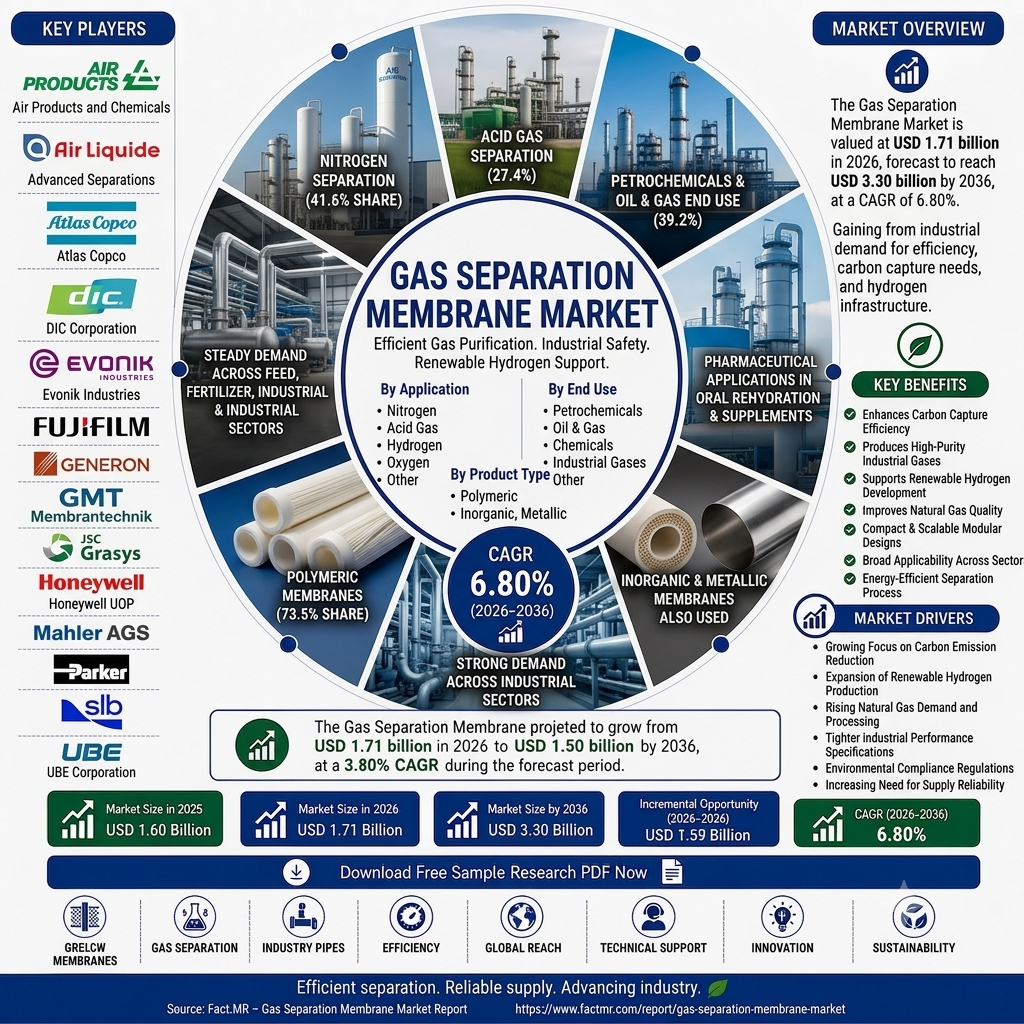
Subhead: Market reaches USD 1.71 billion in 2026; forecast to USD 3.30 billion by 2036; CAGR of 6.80% from 2026 to 2036.
August 25, 2026 — The global gas separation membrane market is valued at USD 1.71 billion in 2026, is forecast to reach USD 3.30 billion by 2036, and is expected to expand at a 6.80% CAGR from 2026 to 2036, according to Fact.MR.
The market is gaining from rising industrial demand for efficient gas separation. Fact.MR points to expanding end-use requirements, tighter performance specifications, growing adoption in emerging applications, and stronger focus on supply reliability as key factors supporting procurement. Regulatory and quality requirements are also pushing buyers toward higher-performance product grades. Qualified suppliers with consistent manufacturing capabilities can gain an advantage as buyers place greater weight on reliability and application-specific performance.
The technology serves several industrial needs. Applications include nitrogen separation, acid gas separation, oxygen separation, hydrogen separation, and other uses. Product categories include polymeric, inorganic, and metallic membranes. Fact.MR identifies nitrogen separation as the largest application and polymeric membranes as the leading product category in 2026.
Get detailed market forecasts, competitive benchmarking, and pricing trends: https://www.factmr.com/connectus/sample?flag=S&rep_id=4803
Third-Party Market Evidence
Fact.MR's published page includes a bibliography listing a relevant industry regulatory authority (2025), an international trade association (2025), an international standards organization (2025), a leading industry participant (2025), and a government statistical agency (2025). However, the public page does not disclose specific statistics from these sources. Therefore, no third-party numerical statistics are added here. This avoids introducing figures that cannot be verified from the requested source page.
Key Numbers
|
Market Metric |
Value |
|
Market size, 2025 |
USD 1.60 billion |
|
Market size, 2026 |
USD 1.71 billion |
|
Forecast value, 2036 |
USD 3.30 billion |
|
CAGR, 2026–2036 |
6.80% |
|
Incremental opportunity |
USD 1.59 billion |
|
Polymeric membranes share, 2026 |
73.5% |
|
Nitrogen separation share, 2026 |
41.6% |
|
Petrochemicals and oil & gas share |
39.2% |
|
Chemicals share |
21.1% |
|
Air Products and Chemicals share |
16.8% |
*Source: Fact.MR. *
Segment Breakdown
Polymeric membranes lead the product segment. Fact.MR reports that polymeric membranes hold a 73.5% share in 2026. Their established manufacturing scalability, application documentation, standardized module configurations, and cost-effectiveness support their position. Hollow fiber configurations also serve compact nitrogen generation systems.
Inorganic membranes serve demanding conditions. Inorganic membranes account for an 18.8% share, according to Fact.MR. Ceramic and zeolite-based systems are positioned for applications requiring thermal stability, chemical resistance, and durability under harsh conditions.
Nitrogen separation is the largest application. It holds a 41.6% share. Demand comes from inert atmosphere generation, food preservation, blanketing, chemical process inerting, and industrial safety applications.
Acid gas separation remains important. This application accounts for 27.4%. It supports carbon dioxide removal, hydrogen sulfide treatment, and natural gas purification.
Petrochemicals and oil & gas lead end use. This segment holds a 39.2% share, supported by natural gas treatment, hydrogen recovery, and refinery gas purification. Chemicals follow with 21.1%.
Country CAGR Outlook
|
Country |
CAGR, 2026–2036 |
|
India |
8.7% |
|
China |
8.3% |
|
USA |
7.8% |
|
Saudi Arabia |
7.6% |
|
Brazil |
7.1% |
|
Germany |
6.9% |
|
Japan |
6.4% |
*Source: Fact.MR. *
India records the fastest growth among the countries listed, at 8.7% CAGR. Fact.MR links this expansion to petrochemical manufacturing and industrial gas infrastructure development. China follows at 8.3%, supported by petrochemical capacity expansion and environmental compliance investment. The USA records 7.8%, with natural gas infrastructure, hydrogen development, and carbon capture supporting demand.
Competitive Landscape
The market has a moderately consolidated structure, with approximately 40–60 active players, according to Fact.MR. Air Products and Chemicals, Inc. leads with a 16.8% market share. Other named companies include Air Liquide, Advanced Separations, Atlas Copco AB, DIC Corporation, Evonik Industries AG, FUJIFILM Corporation, GENERON, GMT Membrantechnik GmbH, JSC Grasys, Honeywell International Inc., Mahler AGS GmbH, Parker Hannifin Corp, SLB, and UBE Corporation.
Competition extends beyond membrane production. Global distribution, application engineering, technical support, manufacturing efficiency, quality control, and performance documentation influence purchasing decisions. Fact.MR also identifies mixed matrix membranes and hydrogen separation as areas offering differentiation opportunities.
Analyst View
Shambhu Nath Jha, Principal Consultant at Fact.MR, said: “Procurement decisions in the gas separation membrane market increasingly depend on application-specific performance documentation and supply chain reliability credentials rather than per-unit pricing alone.”
Frequently Asked Questions
How large is the gas separation membrane market in 2026?
Fact.MR estimates the market at USD 1.71 billion in 2026.
What will the gas separation membrane market be worth in 2036?
The market is projected to reach USD 3.30 billion by 2036.
What is the CAGR of the gas separation membrane market?
The market is expected to grow at a 6.80% CAGR from 2026 to 2036.
Which gas separation membrane product leads the market?
Polymeric membranes lead with a 73.5% share in 2026.
Which application has the largest share?
Nitrogen separation leads with a 41.6% share in 2026.
About Fact.MR
Fact.MR provides market research and advisory services covering industry trends, market sizing, forecasts, competitive analysis, and strategic intelligence. The gas separation membrane report covers product, application, end-use, regional, competitive, and supply-chain analysis through 2036.

 Arabic
 French
 Spanish
 Portuguese
 Deutsch
 Turkish
 Dutch
Dutch
 Italiano
 Russian
 Romaian
 Portuguese (Brazil)
 Greek
Greek
