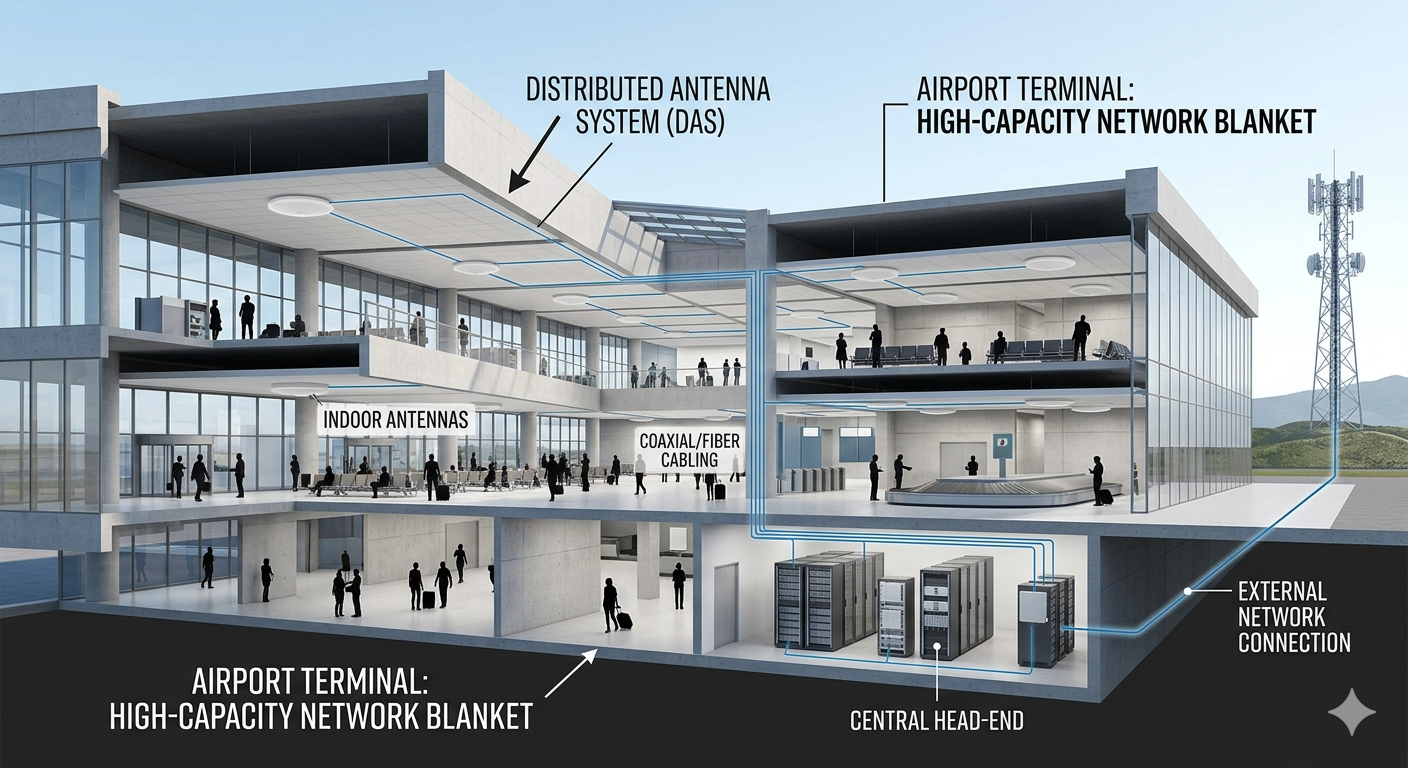
The Distributed Antenna Market is experiencing strong growth as the demand for seamless indoor and outdoor connectivity continues to rise across industries. Distributed antenna systems (DAS) have become an essential wireless coverage solution, ensuring uninterrupted communication in large buildings, stadiums, airports, and urban environments. With the rapid expansion of mobile data usage and the deployment of 5G networks, the importance of efficient cellular signal distribution through a robust telecom antenna network has never been greater.
Market Overview
The distributed antenna market is evolving rapidly, driven by increasing smartphone penetration, growing reliance on mobile data, and the need for consistent network performance. A DAS system enhances signal strength by distributing signals across multiple antennas, making it a vital network coverage module for areas where traditional cell towers fall short.
Industries such as healthcare, transportation, retail, and hospitality are adopting distributed antenna solutions to improve communication reliability. As digital transformation accelerates globally, businesses are investing heavily in advanced wireless infrastructure to support connected devices and IoT ecosystems.
Key Market Drivers
One of the primary factors fueling market growth is the surge in mobile data traffic. As consumers demand high-speed connectivity for streaming, gaming, and remote work, telecom providers are deploying distributed antenna systems to ensure optimal performance.
The rollout of 5G technology is another significant driver. DAS systems are crucial for supporting high-frequency bands used in 5G networks, particularly in dense urban areas and indoor environments. Additionally, smart city initiatives and infrastructure modernization projects are contributing to the expansion of telecom antenna networks worldwide.
Technological Advancements
Innovations in wireless communication are transforming the distributed antenna market. Modern DAS systems now integrate with cloud-based management platforms, enabling real-time monitoring and optimization. Advanced network coverage modules are designed to handle multiple frequency bands, ensuring compatibility with evolving communication standards.
Furthermore, the adoption of fiber-optic technology in DAS deployment enhances signal quality and reduces latency. These advancements are making distributed antenna solutions more efficient, scalable, and cost-effective for large-scale applications.
Market Challenges
Despite its growth potential, the distributed antenna market faces several challenges. High installation and maintenance costs can be a barrier, especially for small and medium-sized enterprises. Additionally, the complexity of integrating DAS with existing infrastructure requires skilled professionals and careful planning.
Regulatory compliance and spectrum management also play a critical role in market development. Ensuring compatibility with regional telecom standards can be challenging for global deployments.
Emerging Opportunities
The integration of distributed antenna systems with emerging technologies such as IoT, AI, and edge computing presents significant opportunities. These innovations enable smarter and more adaptive wireless coverage solutions, improving efficiency and user experience.
Markets like the Japan Wireless Connectivity Market are witnessing rapid advancements, driven by strong technological infrastructure and early adoption of next-generation networks. Similarly, sectors linked to financial transactions and mobility, such as the Commercial Payment Cards Market, are benefiting from improved connectivity enabled by distributed antenna systems.
Regional Insights
North America and Europe currently lead the distributed antenna market due to advanced telecom infrastructure and early adoption of 5G technology. However, Asia-Pacific is emerging as a high-growth region, supported by urbanization, increasing mobile users, and government initiatives for digital connectivity.
Countries like Japan, China, and India are investing heavily in wireless infrastructure, making the region a key contributor to future market expansion.
Future Outlook
The distributed antenna market is poised for significant growth in the coming years. As connectivity becomes a critical component of modern life, the demand for reliable and high-performance wireless networks will continue to rise.
With ongoing technological advancements and increasing investments in telecom infrastructure, distributed antenna systems will play a pivotal role in shaping the future of communication. Businesses and governments alike are recognizing the importance of robust cellular signal distribution to support digital transformation and innovation.
FAQs
1. What is a Distributed Antenna System (DAS)?
A DAS system is a network of spatially separated antennas connected to a common source, designed to improve wireless coverage and signal strength in specific areas.
2. Why is the Distributed Antenna Market growing rapidly?
The market is expanding due to increasing mobile data usage, 5G deployment, and the need for reliable wireless coverage in complex environments like airports, malls, and office buildings.
3. Where are distributed antenna systems commonly used?
They are widely used in large venues such as stadiums, hospitals, transportation hubs, commercial buildings, and urban centers to ensure seamless connectivity.
➤➤ Explore Market Research Future - Related Ongoing Coverage :
3D Eye Tracking Software Market
3D Projector Market
802 15 4 Chipset Market
Ac Dc Controller Market
Accelerometer Sensor Market
Acousto Optic Device Market
Active Energy Measurement Integrated Circuits Ic Market
Agriculture Automation Control System Market
Agriculture Reinsurance Market
Alternative Legal Service Providers Market


 Arabic
 French
 Spanish
 Portuguese
 Deutsch
 Turkish
 Dutch
Dutch
 Italiano
 Russian
 Romaian
 Portuguese (Brazil)
 Greek
Greek